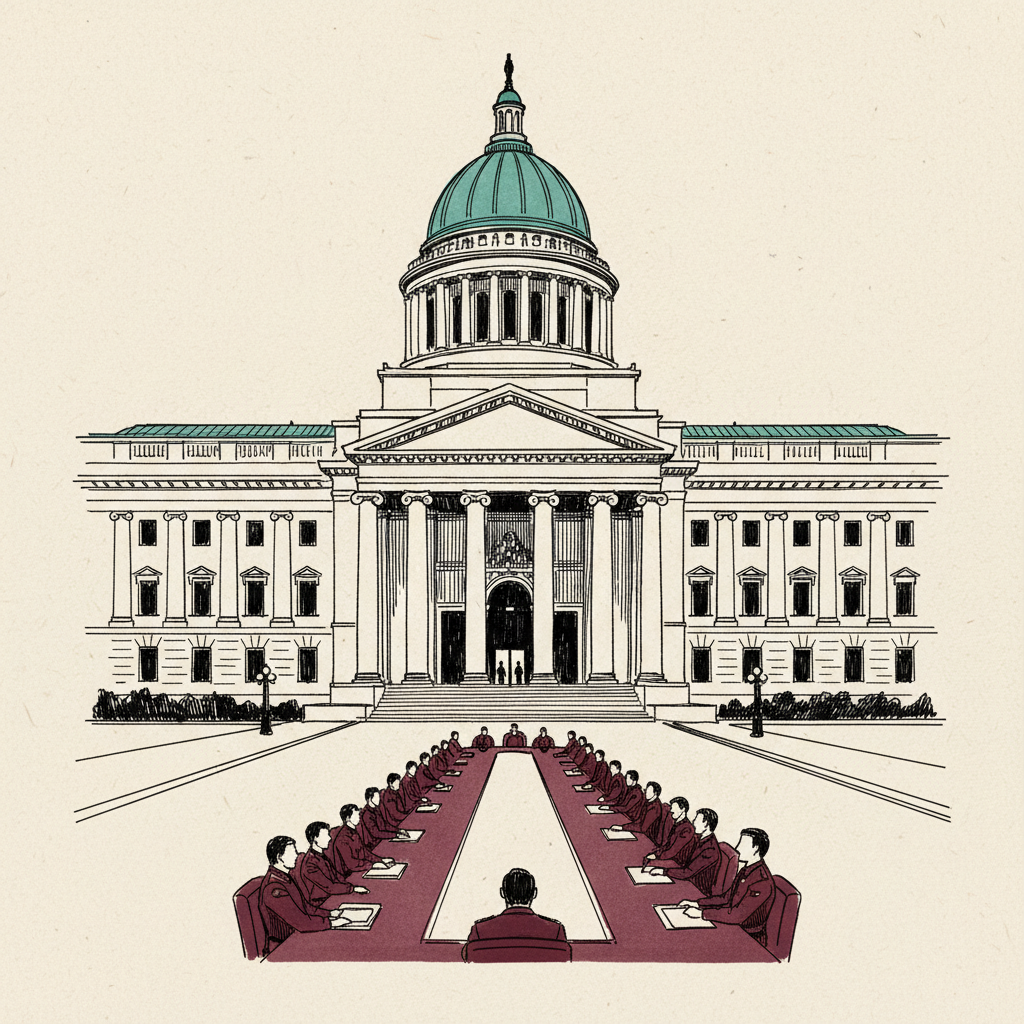
National Revolutionary Police
Cuba's national police force, subordinate to MININT, responsible for public order enforcement.
National Revolutionary Police is Cuba's national uniformed police force, designated by Washington on 18 May 2026 as an instrument of political repression.
Last refreshed: 17 July 2026 · Appears in 1 active topic
Why did the US sanction Cuba's entire police force rather than individual officers?
Timeline for National Revolutionary Police
Designated as SDN entity under EO 14404
Cuba Dispatch: Sanctions reach Cuba's ministries and partyBackground
The National Revolutionary Police (Policia Nacional Revolucionaria, PNR) is Cuba's uniformed law-enforcement body, responsible for public order and crime. Established after the 1959 revolution and structured as a national force without regional or municipal autonomy, it operates under the direct authority of the Ministry of the Interior (MININT). Unlike most police forces in the region, the PNR is explicitly subordinate to a political ministry rather than a justice ministry with judicial accountability, so its operational priorities are set by the Communist Party's security needs as much as by ordinary crime enforcement.
The force makes arrests, conducts the initial detention of dissidents, and enforces the administrative restrictions that the State Security Arm prescribes. For Havana it is a public-order body; for Washington and international human rights monitors, including OCDH, Prisoners Defenders and Amnesty International, it is the street-level Arm of a surveillance state holding over 1,300 political prisoners as of mid-2026.
Sanctions targeted the institution itself
On 18 May 2026 Washington's OFAC listing added the force to Executive Order 14404's sanctions roster, one of three institutions, alongside MININT and the Directorate of Intelligence, caught in that wave. The force was identified as a vehicle of political repression, used in the crackdowns following the July 2021 protests and in enforcement actions the OCDH logged at 366 repressive acts in April 2026 alone.
Designating a uniformed police force rather than a named commander sets a precedent for treating institutional complicity rather than individual responsibility. The force was not re-designated in the larger 13 July wave, which instead added ten other entities; the 18 May listing stands as the precedent cited for that later, wider campaign of roughly 31 cumulative designations across six waves.
What is the National Revolutionary Police in Cuba?
Why was Cuba's police force sanctioned by the United States?
How is Cuba's police different from police forces in other countries?
Was Cuba's police force sanctioned again in July 2026?

Written with AI from Lowdown's published reporting. Not individually reviewed by an editor. Updated 17 July 2026. Editorial standards.