Skip to content
You can now search across every topic, entity and event.What's new
Autonomous Systems: Land & Sea
12AUG

White House freezes all Patriot exports

2 min read
14:17UTC

Global Patriot export approvals went on ice after three days of Iran war operations burned through more rounds than the United States builds in an entire year.

TechnologyDeveloping
Key takeaway

A Patriot export freeze on top of the production gap leaves Ukraine no resupply route that clears in time.

Defense News and the Washington Post reported this week that the White House suspended PAC-3 export approvals worldwide after more than 800 rounds were expended in three days of Iran war operations 1. Annual US production runs at roughly 600. The arithmetic does not reconcile with even a single restock cycle, let alone two.

For Kyiv, the suspension compounds the Lockheed contract arithmetic covered separately in this briefing. Gulf customers lose near-term deliveries, but Ukraine is the only recipient whose stockpile deadline falls inside the ninety-day window. Zelenskyy's figure from late March did not anticipate the export queue freezing on top of the production gap.

Zelenskyy had already flagged in late March that Ukraine needed 800 interceptors of the same kind the US expended in Iran in three days against roughly 700 Ukraine had received all winter . The export freeze converts that asymmetry from a supply warning into a supply wall. Ukraine's STING interceptor drone, validated a week earlier, does not close the gap for ballistic or cruise threats, which still require the PAC-3 airframe. What Ukraine can do alone is narrower than what it needs Washington to backfill.

Deep Analysis

In plain English

After the recent conflict with Iran, the US used more than 800 Patriot missiles in just three days. To put that in perspective, the US only makes about 600 per year. The White House responded by temporarily stopping all Patriot sales to other countries, including Ukraine, while production catches up. This leaves Ukraine in a queue alongside dozens of other US allies, with no guaranteed timeline for resuming deliveries. Ukraine's air defence shields its cities from ballistic missiles; without interceptors, those shields run dry.

Deep Analysis
Root Causes

The root cause is a production base that was sized for deterrence, not attrition warfare. US PAC-3 production was optimised over two decades for planned peacetime deliveries to Gulf and Asian allies, not for sustained wartime consumption rates. The Iran conflict consumed in 72 hours what US factories produce in 16 months.

A secondary cause is institutional: the US never established a strategic interceptor reserve analogous to the Strategic Petroleum Reserve. Each PAC-3 is allocated to a named buyer at contract signature, leaving no unallocated buffer that could be redirected to Ukraine under emergency authority.

Escalation

The suspension, if maintained beyond six to eight weeks, creates a predictable window for Russia to test Ukraine's depleted Patriot coverage with ballistic missile concentrations on Kyiv or Odesa. Russian targeting patterns historically exploit confirmed air defence gaps within 30-60 days of detection.

What could happen next?
  • Risk

    A sustained suspension creates a measurable window for Russian ballistic missile penetration of Ukrainian air defence coverage within 30-60 days.

  • Consequence

    FMS buyers who hold Patriot systems, including Germany, Netherlands, Japan, and Saudi Arabia, will face their own restocking delays, adding diplomatic friction to existing US alliance management.

First Reported In

Update #12 · Three narrowings of US support for Kyiv

Defense News· 11 Apr 2026
Read original
Different Perspectives
Conservative opposition
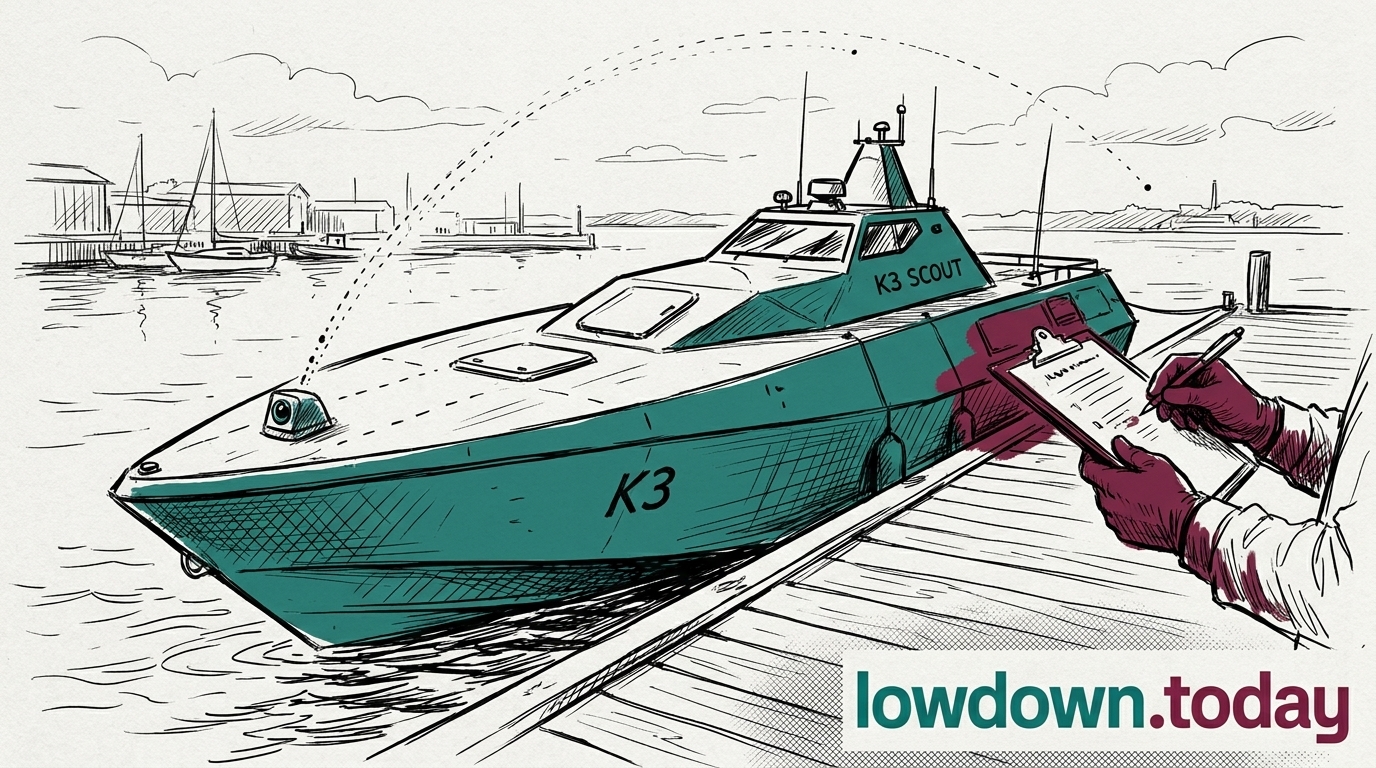
The Conservative opposition called on the Government on 9 August to 'urgently audit' equipment for hidden Chinese components, after the Telegraph's K3 SCOUT report. No named MP has been quoted on the record; the call came at party level, alongside the Ministry of Defence's own 10 August statement that no data had been compromised.
Netherlands Ministry of Defence
The Netherlands Ministry of Defence authorised Dutch Naval Design on 4 August to design 12-metre anti-submarine warfare uncrewed vessels for the Dutch-Belgian frigate programme, and to buy an adapted Compact FLASH dipping sonar from Thales Underwater Systems France. The order commits money and a named supplier while Britain's own certification body remains at the market-engagement stage.
Kraken Technology Group
Kraken Technology Group is a UK maritime-defence company based in Portsmouth that builds the K3 SCOUT, and crossed a $1bn valuation in July on a single-sourced $175m raise. The camera components reached the fleet under a third party's written security assurance, which the Platform Authority, which does not yet exist, was never positioned to check.
Navy Commercial
Navy Commercial
Navy Commercial at Whale Island published two notices on 5 August: 074032-2026, asking industry how to build a Platform Authority to certify uncrewed vessels, and 074351-2026, a GBP10m multi-role USV testbed for the Defence Chief Technology Officer. Responses on the Platform Authority close 19 August, ten days after the cameras were found transmitting to China.
Ministry of Defence
Ministry of Defence
The Ministry of Defence said on 10 August that a routine cyber vulnerability assessment found the camera fault, and a thorough investigation found no evidence that MoD data or systems had been accessed, compromised or transmitted externally. It stripped the cameras of internet connectivity but did not say whether it acted against the supplier.
Thales
Thales
Thales converted its 6 July engaging accord with Exail into a definitive combination agreement on 30-31 July, but the tender offer for Exail's remaining shares now closes by early 2028, later than July's timetable implied. Thales integrates its new undersea prime while still bidding against Kongsberg and DRASS's 2027 target for the AUKUS Pillar II contest.
