Skip to content
You can now search across every topic, entity and event.What's new
Autonomous Systems: Land & Sea
12AUG

Germany signs €4bn for Ukraine, routes Raytheon directly

3 min read
14:17UTC

Defence ministers Fedorov and Pistorius signed a package of interceptors, launchers and joint drone production on 14 April. The €3.2bn centrepiece is a direct commercial sale that bypasses the White House Patriot export freeze.

TechnologyDeveloping
Key takeaway

Germany bought what Ukraine can legally receive; the class it cannot remains on Washington's shelf.

Ukrainian Defence Minister Mykhailo Fedorov and German Defence Minister Boris Pistorius signed a €4 billion defence package in Berlin on 14 April, with President Volodymyr Zelenskyy and Chancellor Friedrich Merz in attendance. The headline item is a roughly €3.2 billion German-funded Raytheon contract for several hundred GEM-T (Guidance Enhanced Missile-Tactical) Patriot interceptors, routed as a direct commercial sale with a new production line planned at Schrobenhausen in Bavaria. The package also covers 36 IRIS-T (Infrared Imaging System Tail) air defence launchers, €300 million for Ukrainian long-range strike, and joint production of 5,000 mid-range AI-enabled strike drones.

The procurement route matters more than the round count. The White House suspended global Patriot export approvals after over 800 PAC-3 MSE rounds were expended in three days of Iran war operations , and Lockheed's $4.76 billion PAC-3 MSE contract has 94% of output pre-committed to foreign military sales . By funding Raytheon directly for GEM-T rather than applying for a US Foreign Military Sale, Berlin has built a workaround that does not require State Department export approval. Other NATO allies now have a template.

The airframe is the catch. GEM-T is the lower-tier Patriot interceptor; it engages aircraft, cruise missiles and drones. It is not PAC-3 MSE (Patriot Advanced Capability-3 Missile Segment Enhancement), the ballistic-class interceptor that stops Iskanders and Kinzhals. The 800-to-700 figure Zelenskyy gave the BBC in March identified a ballistic gap, and The White House freeze converted that warning into a wall. Berlin has bought the air-defence volume Ukraine can legally receive. A commercial-sale route can deliver GEM-T; it cannot deliver the airframe class that stops Kinzhals.

Deep Analysis

In plain English

Germany and Ukraine signed a military support agreement worth €4 billion on 14 April. The centrepiece is an order for hundreds of Patriot air defence missiles worth around €3.2 billion, plus 36 launchers of a German air defence system called IRIS-T, €300 million for long-range strike weapons, and a joint project to build 5,000 drones together. The Patriot missiles in this deal are a type called GEM-T, which can shoot down aircraft, cruise missiles, and drones. However, they cannot intercept ballistic missiles, the high-speed weapons like Russia's Iskander that fall from near-space. Ukraine needs a different Patriot type for that, called PAC-3 MSE, but the US has suspended exports of those globally. So this package is genuinely significant for drone and cruise missile defence, but does not close Ukraine's biggest gap: protection against ballistic missiles.

Deep Analysis
Root Causes

The White House global Patriot export suspension converted what would have been a straightforward foreign military sales request into a procurement dead end for PAC-3 MSE.

Germany's workaround, using the direct commercial sale route for GEM-T, a lower-tier interceptor not covered by the suspension, reflects the structural split within the Patriot system family: GEM-T is a Raytheon commercial product; PAC-3 MSE is a Lockheed government product subject to ITAR export controls that the White House can suspend.

The joint drone production element, 5,000 AI-enabled mid-range strike drones, addresses a different capability gap: Ukraine's long-range strike capacity has been constrained by the Western reluctance to supply range-extended munitions. Producing jointly removes the ITAR licensing friction, as German-origin components dominate the design.

What could happen next?
  • Consequence

    Germany's direct commercial sale route for GEM-T provides a replicable template for other European NATO members to procure lower-tier Patriot interceptors outside the frozen US FMS queue.

    Short term · 0.81
  • Risk

    GEM-T deliveries from existing Raytheon inventory are constrained by competing NATO customer orders; the Schrobenhausen line will not reach rated output until late 2027.

    Medium term · 0.77
  • Opportunity

    The joint 5,000-drone production programme establishes a German-Ukrainian defence industrial base that could scale beyond this contract if long-range strike demand persists.

    Medium term · 0.68
First Reported In

Update #13 · Treasury kills the Russian crude waiver

Ukrainian Cabinet of Ministers· 16 Apr 2026
Read original
Different Perspectives
Conservative opposition
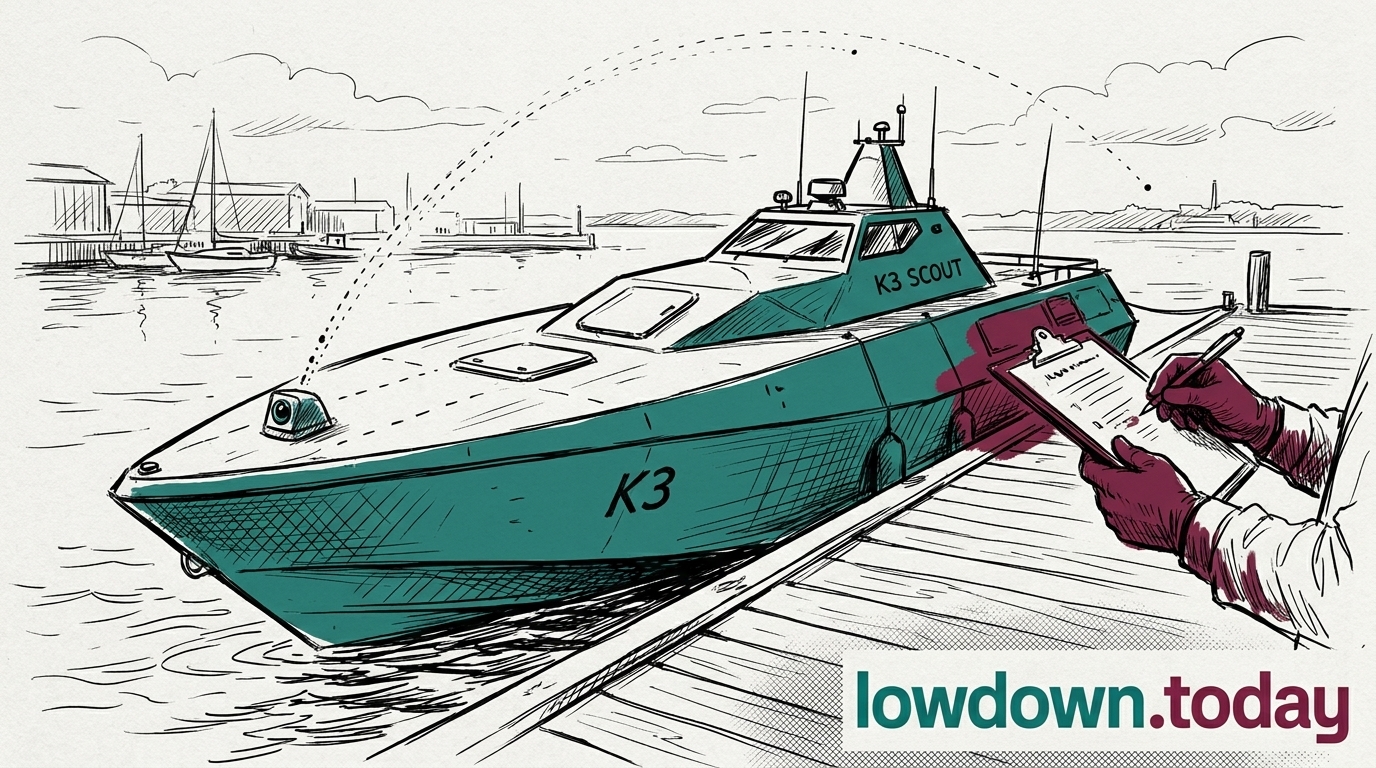
The Conservative opposition called on the Government on 9 August to 'urgently audit' equipment for hidden Chinese components, after the Telegraph's K3 SCOUT report. No named MP has been quoted on the record; the call came at party level, alongside the Ministry of Defence's own 10 August statement that no data had been compromised.
Netherlands Ministry of Defence
The Netherlands Ministry of Defence authorised Dutch Naval Design on 4 August to design 12-metre anti-submarine warfare uncrewed vessels for the Dutch-Belgian frigate programme, and to buy an adapted Compact FLASH dipping sonar from Thales Underwater Systems France. The order commits money and a named supplier while Britain's own certification body remains at the market-engagement stage.
Kraken Technology Group
Kraken Technology Group is a UK maritime-defence company based in Portsmouth that builds the K3 SCOUT, and crossed a $1bn valuation in July on a single-sourced $175m raise. The camera components reached the fleet under a third party's written security assurance, which the Platform Authority, which does not yet exist, was never positioned to check.
Navy Commercial
Navy Commercial
Navy Commercial at Whale Island published two notices on 5 August: 074032-2026, asking industry how to build a Platform Authority to certify uncrewed vessels, and 074351-2026, a GBP10m multi-role USV testbed for the Defence Chief Technology Officer. Responses on the Platform Authority close 19 August, ten days after the cameras were found transmitting to China.
Ministry of Defence
Ministry of Defence
The Ministry of Defence said on 10 August that a routine cyber vulnerability assessment found the camera fault, and a thorough investigation found no evidence that MoD data or systems had been accessed, compromised or transmitted externally. It stripped the cameras of internet connectivity but did not say whether it acted against the supplier.
Thales
Thales
Thales converted its 6 July engaging accord with Exail into a definitive combination agreement on 30-31 July, but the tender offer for Exail's remaining shares now closes by early 2028, later than July's timetable implied. Thales integrates its new undersea prime while still bidding against Kongsberg and DRASS's 2027 target for the AUKUS Pillar II contest.
