Skip to content
Welcome, thoughtbot's Giant Robots listeners!Start here
Autonomous Systems: Land & Sea
12AUG

Ukraine lands 347 drones on Moscow's Victory Day

3 min read
14:17UTC

Ukraine launched the second-largest aerial attack of the war on the night of 8-9 May, the eve of Russia's Victory Day. The Russian Defence Ministry reported 347 Ukrainian drones downed across 20 regions, with Moscow Mayor Sergei Sobyanin confirming 26 intercepted over the capital.

TechnologyDeveloping
Key takeaway

Ukraine demonstrated saturation-strike volume against Moscow at the moment Russian drone quality is failing in the air.

Ukraine launched the second-largest aerial attack of the war on the night of 8-9 May, the eve of Russia's Victory Day. The Russian Defence Ministry reported 347 Ukrainian drones downed across 20 regions⁠1. Moscow Mayor Sergei Sobyanin confirmed 26 drones intercepted over Moscow specifically. Russia shut down all mobile internet and SMS messaging across Moscow on 9 May and ringed the parade route with 101 air defence systems. The largest Ukrainian aerial attack to date, 389 drones, came in March 2026.

Russia's Moscow mobile-internet shutdown on 9 May concedes that civil signals leak GPS spoofing and drone telemetry data the moment a saturation strike crosses the border. A communications blackout across a capital city on a public holiday is not a routine air defence posture; it is a public acknowledgement that Ukrainian targeting now relies on Russian network metadata as part of the kill chain.

Ukraine's offensive capability has scaled in parallel to Russia's quality collapse. Tekever's AR3 ISR drone has now logged more than 50,000 operational hours in Ukraine on prior MoD-funded contracts, one component of a strike architecture that has been industrialised around long-endurance reconnaissance and short-range interceptor pairing. The figure that matters is throughput: 347 inbound airframes against 101 fielded interceptor systems, plus whatever Pantsir and S-400 batteries were already deployed inside Moscow's ring.

The count itself comes from the Russian Defence Ministry, which has incentive to overstate intercept totals; Ukraine's General Staff has not publicly confirmed launch numbers. Even discounted, a 347-figure on the Kremlin's own admission resets the working assumption about how much Ukrainian strike volume Russian air defence absorbs on a benchmarked night.

Deep Analysis

In plain English

Ukraine launched 347 drones at Moscow on the night of 8-9 May, the evening before Russia's Victory Day parade. Russia said it shot them all down. Moscow's mayor confirmed 26 were intercepted specifically over the city. Russia shut down mobile internet across Moscow and ringed the parade route with 101 air defence systems. A year ago Ukraine could not sustain an attack at this scale. Now it can, and Russia must absorb the political and military cost of defending its capital on its most important national holiday.

Deep Analysis
Root Causes

Ukraine's capacity to sustain a 347-drone salvo on a single night rests on three developments from the preceding twelve months.

First, dispersed production. Ukraine's drone industry now operates from dozens of sites rather than identifiable factories, after Russian targeting destroyed centralised facilities in 2023. The dispersal trades per-unit efficiency for survivability and makes a single strike unable to meaningfully reduce production.

Second, one-way attack drone unit economics. Ukraine's FPV-class and maritime strike drones cost $400-$2,500 per unit. At that price, a 347-salvo costs approximately $140,000-$870,000 in drone acquisition, a fraction of the interceptor cost Russia must expend. Russia's Pantsir-S1 interceptors cost roughly $80,000 per round; if Russia fired 200 interceptors, the cost asymmetry already favours Ukraine.

Third, navigation technology. Star-tracker and optical-flow navigation on longer-range Ukrainian drones, cited by CSIS, allows significant GPS-denied accuracy at ranges required to reach Moscow. This is the technical gate Ukraine crossed in late 2025 that made capital-city strikes operationally practical rather than symbolic.

First Reported In

Update #8 · The week defence-AI got priced

Kyiv Independent· 10 May 2026
Read original →
Causes and effects
This Event
Ukraine lands 347 drones on Moscow's Victory Day
Russia shut down all mobile internet and SMS messaging across Moscow on 9 May and ringed the parade route with 101 air defence systems. Ukraine's ability to put 347 drones over Russian airspace in one night sets a saturation-strike volume that NATO air defence schemes will be benchmarked against. The attack pairs with the Russian quality collapse reported four days earlier: volume doctrine hit a ceiling at exactly the moment Ukrainian strike capability scaled.
Different Perspectives
Conservative opposition
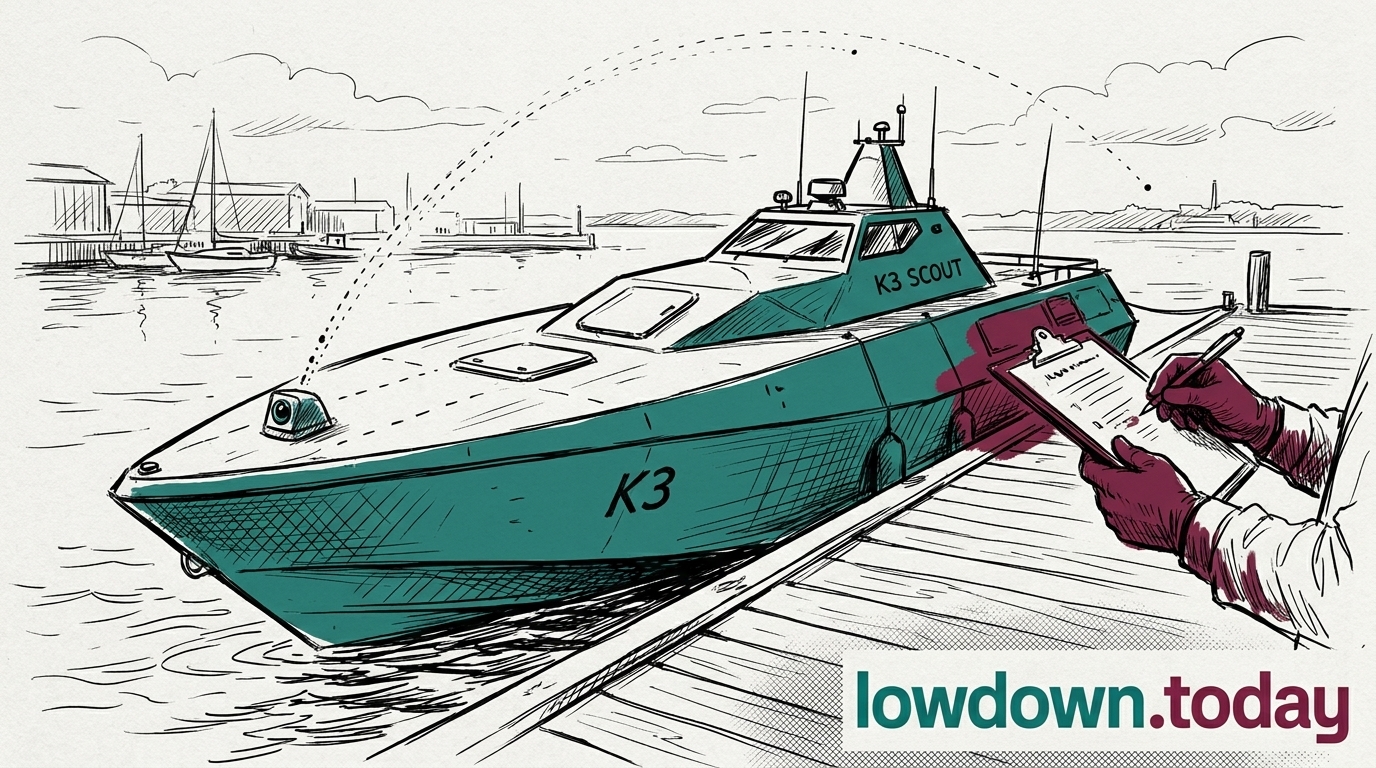
The Conservative opposition called on the Government on 9 August to 'urgently audit' equipment for hidden Chinese components, after the Telegraph's K3 SCOUT report. No named MP has been quoted on the record; the call came at party level, alongside the Ministry of Defence's own 10 August statement that no data had been compromised.
Kraken Technology Group
Kraken Technology Group is a UK maritime-defence company based in Portsmouth that builds the K3 SCOUT, and crossed a $1bn valuation in July on a single-sourced $175m raise. The camera components reached the fleet under a third party's written security assurance, which the Platform Authority, which does not yet exist, was never positioned to check.
Navy Commercial
Navy Commercial
Navy Commercial at Whale Island published two notices on 5 August: 074032-2026, asking industry how to build a Platform Authority to certify uncrewed vessels, and 074351-2026, a GBP10m multi-role USV testbed for the Defence Chief Technology Officer. Responses on the Platform Authority close 19 August, ten days after the cameras were found transmitting to China.
HUMAIN
HUMAIN
HUMAIN and Applied Intuition stated a 2030 target for thousands of autonomous trucks on Saudi logistics corridors. The announcement disclosed no order, fleet baseline or contract value.
Saildrone
Saildrone
Saildrone and Lockheed Martin demonstrated two JAGM launches from a Surveyor-class vessel at RIMPAC. The accepted record identifies no requirement, customer or production configuration behind the demonstration.
Taiwan Legislative Yuan
Taiwan's Legislative Yuan passed the Act at third reading with a small suicide uncrewed boat on the named development list. The NT$240 billion ceiling covers all unmanned domains, and the Act was not promulgated by 4 September.
