Skip to content
Welcome, thoughtbot's Giant Robots listeners!Start here
Autonomous Systems: Land & Sea
12AUG

Russian Geranium drones falling apart in flight

4 min read
14:17UTC

UAS Vision reported on Monday 4 May that Russian Geranium-2 drones are arriving at Ukrainian air defence batteries with access panels torn away, bent wingtips, and detached nose fairings. The Russian hit rate has fallen to its lowest level since March 2025 despite rising launch volumes from a 2025 base of 50,000 to 55,000 Shahed-type drones.

TechnologyDeveloping
Key takeaway

Russia's drone production hit a quality ceiling on chips, engines, and labour at the same moment.

Russian Geranium-2 drones, Russian-built variants of the Iranian Shahed-136 loitering munition, are arriving at Ukrainian air defence batteries with access panels torn away, bent wingtips, and detached nose fairings, UAS Vision reported on Monday 4 May⁠1. The Russian hit rate has fallen to its lowest level since March 2025, despite rising launch volumes from a 2025 base of 50,000 to 55,000 Shahed-type drones. Estimated Geranium-2 unit cost: ~$48,000. Geranium-3 and Geranium-5 variants use Chinese Telefly jet engines, assessed as inferior to the original Iranian-specification powerplant. Pre-flight procedures are reportedly being abbreviated or skipped under launch-cadence pressure. The Alabuga workforce includes roughly 200 African workers aged 18-22.

The report rewrites the Foundation for Defense of Democracies (FDD) Alabuga-recruiting thesis from late April. FDD framed the Telegram-recruited unmanned-systems brigade and the African worker cohort as evidence Russia was scaling production. The disintegration footage suggests the labour model is throughput-constrained rather than capacity-expanding: more launches, fewer hits, and a quality ceiling visible in the wreckage.

The failure modes split across two supply chains. On the chip side, the Center for Strategic and International Studies (CSIS) documented in mid-April that 69% of US-origin processors sit inside Russia's AI-equipped autonomous drones. On the engine side, Chinese Telefly powerplants are now showing reliability shortfalls against the original Iranian specification. Russian drone production depends on two foreign supply chains that Western export controllers can map and target separately.

At $48,000 per unit, the cost-exchange logic that made mass attrition compelling for Russia in 2024-25 reverses if a meaningful share of airframes never reach engagement. The counter-view is volume: 50,000-plus launches per year, even at degraded effectiveness, still represent a strategic threat that Ukrainian and Western air defences have to absorb. Alabuga may be triaging output rather than collapsing.

Deep Analysis

In plain English

Russia has been attacking Ukraine with thousands of cheap drones called Geranium-2, based on an Iranian design. The strategy was to overwhelm Ukrainian air defences by launching more drones than could be shot down. These drones are now falling apart before they reach their targets, with panels tearing away, wings bending, and nose sections detaching, apparently because Russia switched to lower-quality Chinese engines and is rushing production. At $48,000 each, a drone that breaks apart in flight is $48,000 wasted. Ukraine launched 347 drones at Moscow in a single night the same week. Both facts together suggest the drone war is moving against Russia's current strategy.

Deep Analysis
Root Causes

The quality collapse traces to a specific chain of supply substitutions rather than a general production failure.

Iran's Shahed-136 used a purpose-built engine derived from the Austrian Rotax 912, modified for Iranian production. When the 2024 sanctions round tightened the Iranian supply chain, Russia's Alabuga facility switched to Chinese Telefly jet engines for the Geranium-3 and Geranium-5 variants.

Telefly's manufacturing tolerances are rated for civilian UAV applications, not the 800 km range and launch-stress profile of the Geranium airframe. The bent wingtips and detached nose fairings visible in the intercept footage are consistent with aerodynamic loading at airframe speeds the Telefly engine was not designed to sustain.

The Alabuga workforce composition compounds the engine problem. Abbreviated pre-flight procedures under launch-cadence pressure mean structural failures that a proper inspection cycle would catch are reaching the air. The two failures are independent causes producing the same observable outcome, which makes the counter-argument about batch dating harder to sustain: if the failure were purely batch-specific, the hit-rate data would be bimodal rather than uniformly low since March 2025.

What could happen next?
  • Risk

    Western export controls on Telefly engine components would close Russia's last viable mass-production drone engine alternative, but require China's cooperation to be enforceable, a political ask that current US-China trade negotiations do not support.

  • Consequence

    Russia's volume-attrition model faces a production ceiling: the Alabuga capacity at nine times original target may be approaching the point where further volume increases degrade hit rates without generating proportional strategic pressure on Ukraine.

First Reported In

Update #8 · The week defence-AI got priced

UAS Vision· 10 May 2026
Read original →
Different Perspectives
Conservative opposition
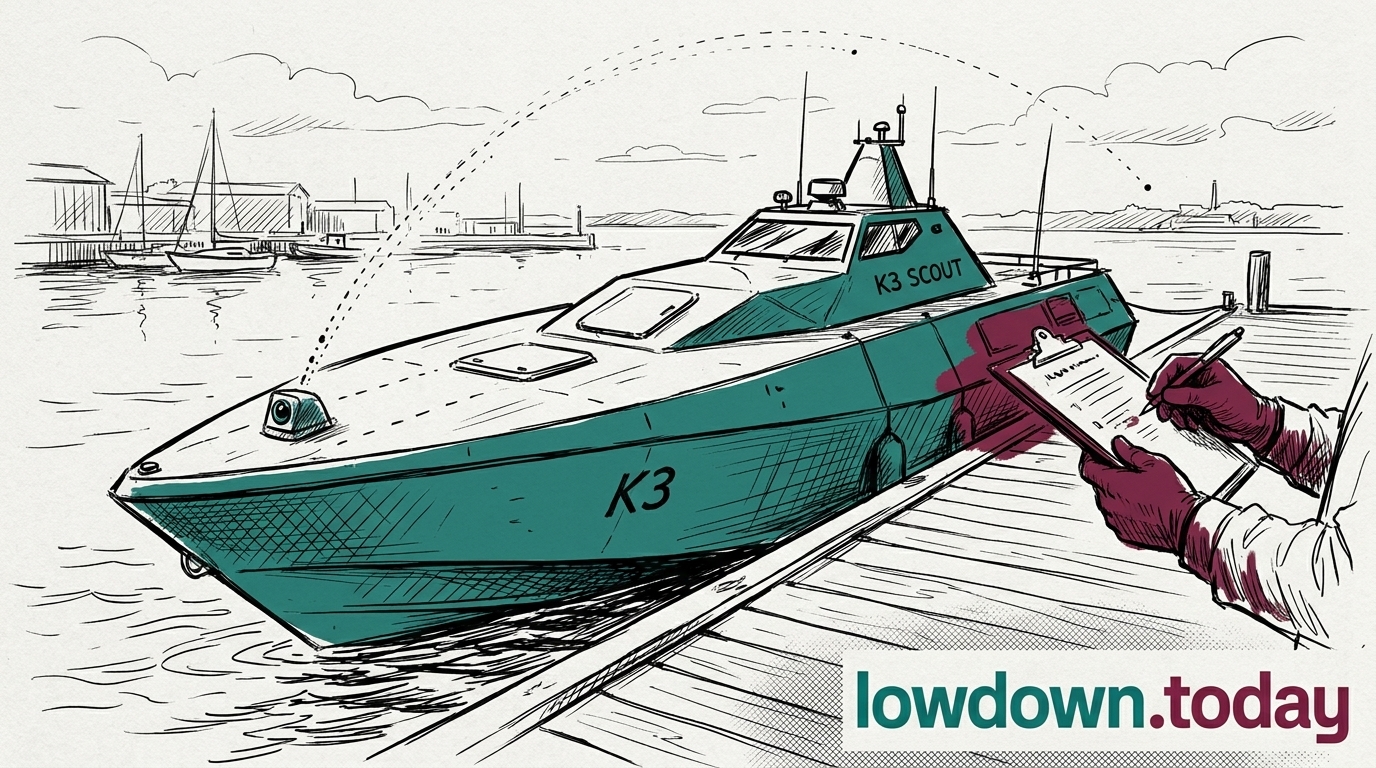
The Conservative opposition called on the Government on 9 August to 'urgently audit' equipment for hidden Chinese components, after the Telegraph's K3 SCOUT report. No named MP has been quoted on the record; the call came at party level, alongside the Ministry of Defence's own 10 August statement that no data had been compromised.
Kraken Technology Group
Kraken Technology Group is a UK maritime-defence company based in Portsmouth that builds the K3 SCOUT, and crossed a $1bn valuation in July on a single-sourced $175m raise. The camera components reached the fleet under a third party's written security assurance, which the Platform Authority, which does not yet exist, was never positioned to check.
Navy Commercial
Navy Commercial
Navy Commercial at Whale Island published two notices on 5 August: 074032-2026, asking industry how to build a Platform Authority to certify uncrewed vessels, and 074351-2026, a GBP10m multi-role USV testbed for the Defence Chief Technology Officer. Responses on the Platform Authority close 19 August, ten days after the cameras were found transmitting to China.
HUMAIN
HUMAIN
HUMAIN and Applied Intuition stated a 2030 target for thousands of autonomous trucks on Saudi logistics corridors. The announcement disclosed no order, fleet baseline or contract value.
Saildrone
Saildrone
Saildrone and Lockheed Martin demonstrated two JAGM launches from a Surveyor-class vessel at RIMPAC. The accepted record identifies no requirement, customer or production configuration behind the demonstration.
Taiwan Legislative Yuan
Taiwan's Legislative Yuan passed the Act at third reading with a small suicide uncrewed boat on the named development list. The NT$240 billion ceiling covers all unmanned domains, and the Act was not promulgated by 4 September.
