Skip to content
You can now search across every topic, entity and event.What's new
Autonomous Systems: Land & Sea
12AUG

Ukraine blocks drone sales as Gulf burns

2 min read
14:17UTC

Ukraine's export regulator suspended Gulf drone sales applications, keeping combat-proven interceptors costing $2,100 to $2,500 per unit locked away from buyers spending millions per salvo.

TechnologyDeveloping
Key takeaway

The cheapest combat-proven interceptors on the market remain locked away from the Gulf states consuming millions per salvo.

Ukraine's State Service for Export Control suspended Gulf drone export applications, citing the EU Common Position 2008/944/CFSP conflict-aggravation clause. Named manufacturers including General Cherry, Wild Hornets, and Ukrspetsystems are receiving hundreds of enquiries they cannot legally fulfil. SkyFall told Reuters its manufacturing capacity runs into "tens of thousands per month", far exceeding domestic demand.

The cost asymmetry is the core of the story. Ukrainian interceptors cost $2,100 to $2,500 per unit, refined through three years of combat against Russian drones. A single PAC-3 MSE round costs millions. Gulf states are spending orders of magnitude more per intercept than necessary because the cheapest solution is locked behind export controls. Zelenskyy disclosed in March that up to 10 drone factories had been built abroad to circumvent the ban ; the shadow factories are a symptom of a strategic choice, not a regulatory accident.

Kyiv's logic is deliberate. Allowing commercial sales would disperse Ukraine's most potent bargaining asset. The SSEC suspension preserves leverage for tightly controlled bilateral 10-year agreements with Saudi Arabia and Qatar . The 228 counter-drone specialists deployed across five Gulf states are the human expression of this strategy: Ukraine is selling expertise and strategic alignment, not commodity hardware.

For Western defence companies, the deadlock temporarily shields premium-priced interceptor systems from low-cost Ukrainian competition. That protection cannot hold if the Gulf conflict intensifies further.

Deep Analysis

In plain English

Ukraine has become very good at making cheap, effective drone interceptors through three years of fighting Russian drones. Gulf countries are now being bombarded by Iranian drones and want to buy Ukraine's interceptors, which cost just $2,100-$2,500 each, compared to millions for the Western alternatives. But Ukraine has refused to allow open commercial sales. Instead it wants to control who gets the technology through long-term government-to-government deals. This keeps Ukraine in control of a combat-proven interceptor technology and means it can use that technology as a bargaining chip in diplomatic negotiations. The downside is that Ukrainian companies like SkyFall are sitting on factory capacity that could be producing tens of thousands of interceptors a month, but they cannot legally sell them.

What could happen next?
  • Consequence

    Ukraine's export control strategy converts its most cost-competitive technology into a diplomatic instrument rather than a revenue stream, concentrating strategic alignment leverage with a small number of Gulf partners rather than distributing it commercially.

  • Risk

    If bilateral agreements with Gulf states expire or lose value after the conflict ends, Ukraine will have foregone substantial hard-currency revenue in exchange for strategic relationships whose durability depends on shared threat perception that may not persist.

First Reported In

Update #5 · Gulf drone war rewrites procurement

Ukrainska Pravda· 13 Apr 2026
Read original
Different Perspectives
Conservative opposition
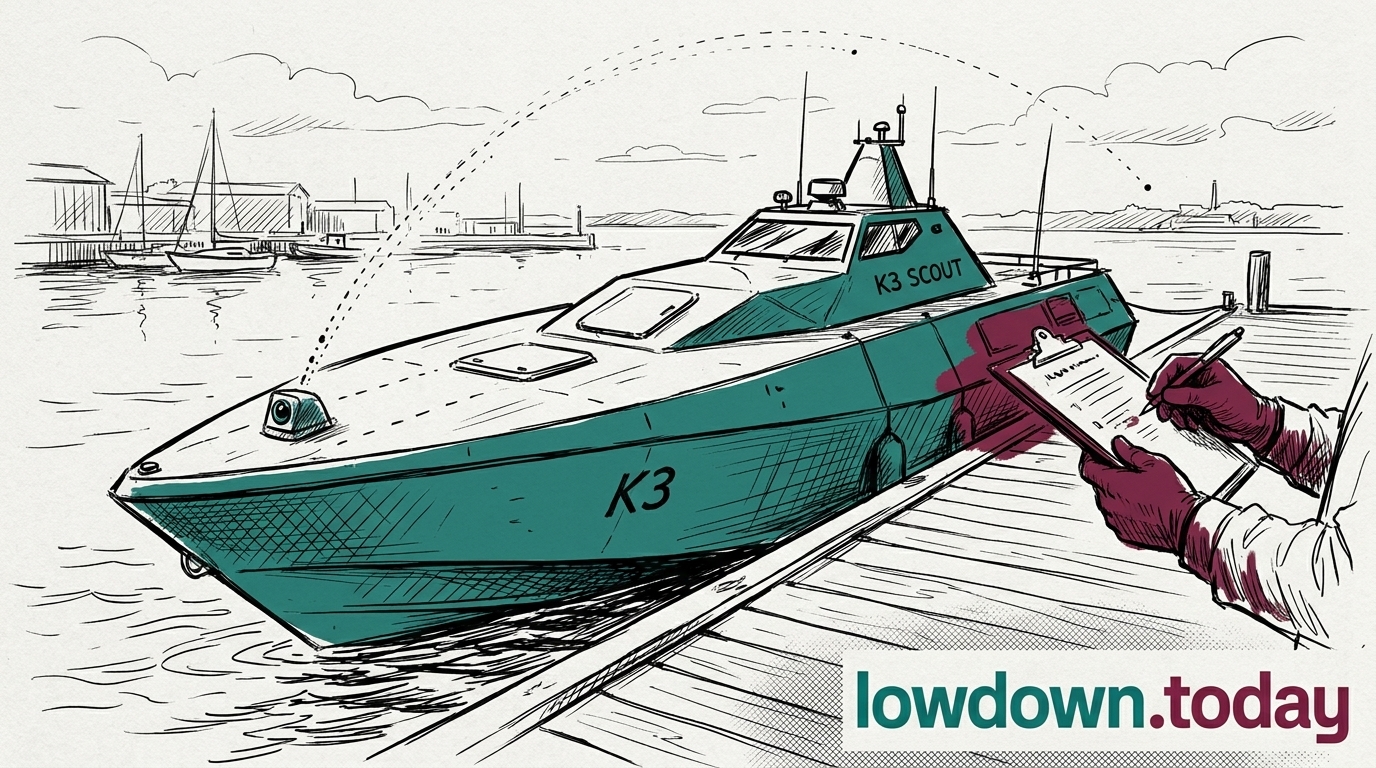
The Conservative opposition called on the Government on 9 August to 'urgently audit' equipment for hidden Chinese components, after the Telegraph's K3 SCOUT report. No named MP has been quoted on the record; the call came at party level, alongside the Ministry of Defence's own 10 August statement that no data had been compromised.
Netherlands Ministry of Defence
The Netherlands Ministry of Defence authorised Dutch Naval Design on 4 August to design 12-metre anti-submarine warfare uncrewed vessels for the Dutch-Belgian frigate programme, and to buy an adapted Compact FLASH dipping sonar from Thales Underwater Systems France. The order commits money and a named supplier while Britain's own certification body remains at the market-engagement stage.
Kraken Technology Group
Kraken Technology Group is a UK maritime-defence company based in Portsmouth that builds the K3 SCOUT, and crossed a $1bn valuation in July on a single-sourced $175m raise. The camera components reached the fleet under a third party's written security assurance, which the Platform Authority, which does not yet exist, was never positioned to check.
Navy Commercial
Navy Commercial
Navy Commercial at Whale Island published two notices on 5 August: 074032-2026, asking industry how to build a Platform Authority to certify uncrewed vessels, and 074351-2026, a GBP10m multi-role USV testbed for the Defence Chief Technology Officer. Responses on the Platform Authority close 19 August, ten days after the cameras were found transmitting to China.
Ministry of Defence
Ministry of Defence
The Ministry of Defence said on 10 August that a routine cyber vulnerability assessment found the camera fault, and a thorough investigation found no evidence that MoD data or systems had been accessed, compromised or transmitted externally. It stripped the cameras of internet connectivity but did not say whether it acted against the supplier.
Thales
Thales
Thales converted its 6 July engaging accord with Exail into a definitive combination agreement on 30-31 July, but the tender offer for Exail's remaining shares now closes by early 2028, later than July's timetable implied. Thales integrates its new undersea prime while still bidding against Kongsberg and DRASS's 2027 target for the AUKUS Pillar II contest.
