Skip to content
Welcome, thoughtbot's Giant Robots listeners!Start here
Autonomous Systems: Land & Sea
12AUG

Red Cat lands NATO order via NSPA, Kyiv tie-up

3 min read
14:17UTC

Red Cat Holdings reported Q1 2026 revenue of $15.5 million on Thursday 7 May, up 849% year-on-year. A NATO ally placed a Black Widow order routed through the NATO Support and Procurement Agency, and Red Cat signed a partnership with Ukraine's Spetstechnoexport for next-generation unmanned systems.

TechnologyDeveloping
Key takeaway

Red Cat broke into NATO procurement via NSPA and tied up with Kyiv's state arms exporter in the same quarter.

Red Cat Holdings reported Q1 2026 revenue of $15.5 million on Thursday 7 May, up 849% year-on-year from $1.6 million⁠1. Gross margin improved 64.8 percentage points to 12.7%. Cash stood at $131.9 million. Net loss widened to $26.6 million from $23.1 million. At that growth rate, the cash position funds at least two more quarters before Red Cat needs external capital to reach its $150-180 million run-rate target.

The headline development sits in the order book. A NATO ally placed a Black Widow drone order routed through the NATO Support and Procurement Agency (NSPA), the Alliance's institutional procurement arm. A second Asia-Pacific ally placed a separate Black Widow order. Red Cat signed a partnership with Ukraine's Spetstechnoexport for next-generation unmanned systems, and a definitive agreement to acquire Canadian Quaze Technologies (~$25 million in stock) is pending Investment Canada Act clearance, anticipated this month. The Blue Ops maritime division launched third-generation uncrewed surface vessels with integrated drone payloads. Management projects an annual revenue run rate of $150-180 million in the short to medium term.

NSPA aggregates allied demand and runs procurement against pooled NATO budgets; a bilateral Foreign Military Sale (FMS) is one nation buying from another. An NSPA-routed order draws on alliance-pooled funding rather than a single nation's defence budget, which changes which procurement officials can release the next contract. That re-routes which budget signs the next purchase order.

The Spetstechnoexport partnership inverts the Ukraine State Service for Export Control (SSEC) export-suspension narrative: Kyiv's state arms exporter is collaborating with a US-listed firm at exactly the moment Ukraine's regulator is blocking interceptor sales to Gulf buyers. The Quaze acquisition adds wireless-power charging autonomy to the portfolio, the supply-side counterpart to the orders.

Deep Analysis

In plain English

Red Cat makes small military drones, notably the Black Widow, which the US Army selected as its standard short-range reconnaissance aircraft. This week the company reported that a NATO member country ordered Black Widows through the Alliance's shared purchasing agency, and a separate Asia-Pacific country placed another order. Red Cat also signed a deal with Spetstechnoexport, Ukraine's state arms exporter, to develop next-generation drone systems together. Ukraine and a US company are collaborating on drone designs at exactly the moment Ukraine's export regulator is blocking other drone sales abroad. That apparent contradiction reflects two different Ukrainian government bodies running separate policies simultaneously.

Deep Analysis
Root Causes

Two structural features explain why Red Cat reached NATO procurement while still reporting a net loss of $26.6 million.

First, the FCC ban on Chinese-origin drones created a captive-market condition in US procurement that does not apply directly in NATO. Red Cat's Black Widow gained NSPA approval through its US Army programme-of-record status: the Army SRR designation acts as third-party quality assurance that NSPA can rely on without running its own evaluation cycle.

This is the same mechanism used by larger US primes; NSPA routinely catalogues US Army programme-of-record winners without independent qualification tests.

Second, the Spetstechnoexport partnership inverts the export-suspension narrative established around Ukraine's state arms exporter. Kyiv's export regulator has been blocking interceptor drone sales to Gulf buyers, but Spetstechnoexport, which handles state-authorised exports, is simultaneously partnering with a US-listed company to develop next-generation systems. The two tracks operate under different Ukrainian ministerial authorities, which is why they can coexist.

First Reported In

Update #8 · The week defence-AI got priced

Red Cat Holdings· 10 May 2026
Read original →
Causes and effects
This Event
Red Cat lands NATO order via NSPA, Kyiv tie-up
An NSPA-routed order draws on alliance-pooled funding rather than a single nation's defence budget, which changes which procurement officials can release the next contract. The Spetstechnoexport partnership inverts the SSEC export-suspension narrative: Kyiv's state arms exporter is collaborating with a US-listed firm at the same moment Ukraine's regulator is blocking interceptor sales to Gulf buyers.
Different Perspectives
Conservative opposition
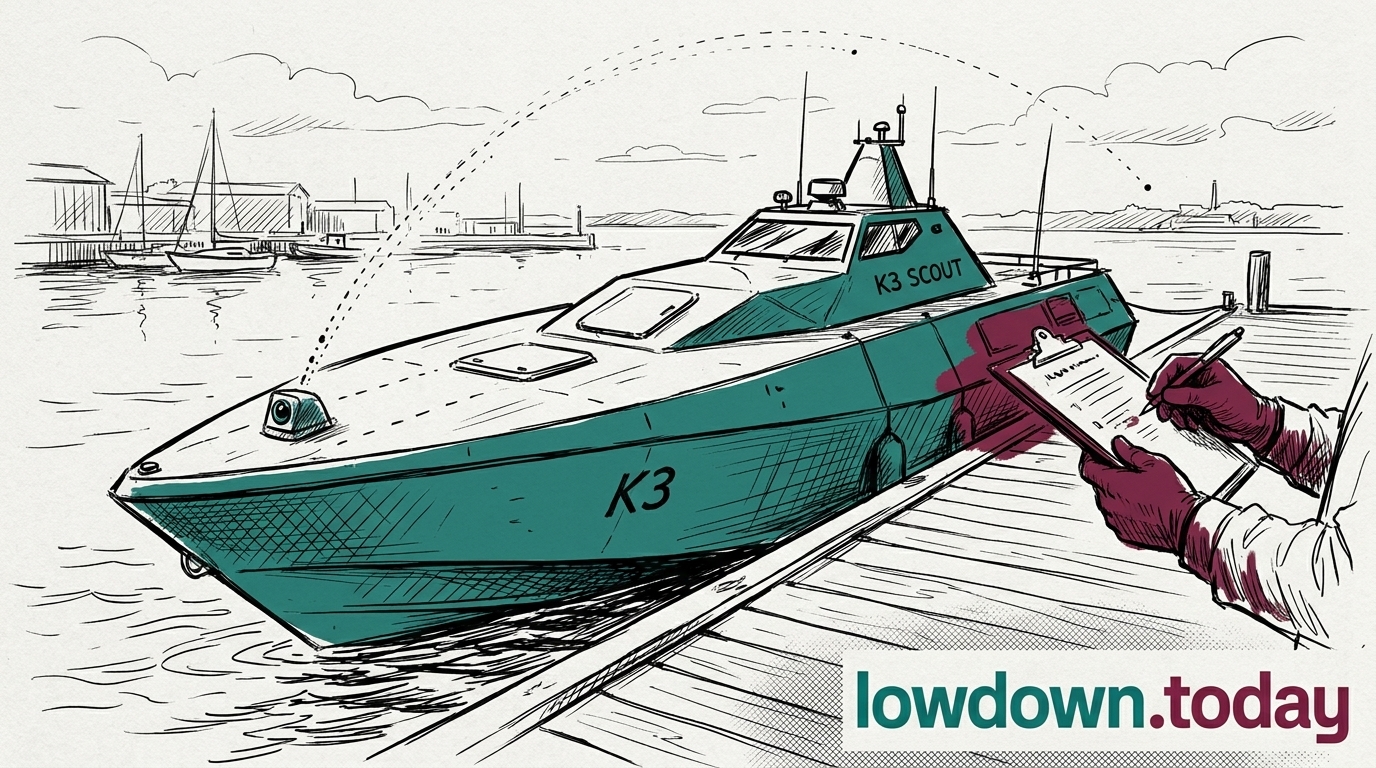
The Conservative opposition called on the Government on 9 August to 'urgently audit' equipment for hidden Chinese components, after the Telegraph's K3 SCOUT report. No named MP has been quoted on the record; the call came at party level, alongside the Ministry of Defence's own 10 August statement that no data had been compromised.
Kraken Technology Group
Kraken Technology Group is a UK maritime-defence company based in Portsmouth that builds the K3 SCOUT, and crossed a $1bn valuation in July on a single-sourced $175m raise. The camera components reached the fleet under a third party's written security assurance, which the Platform Authority, which does not yet exist, was never positioned to check.
Navy Commercial
Navy Commercial
Navy Commercial at Whale Island published two notices on 5 August: 074032-2026, asking industry how to build a Platform Authority to certify uncrewed vessels, and 074351-2026, a GBP10m multi-role USV testbed for the Defence Chief Technology Officer. Responses on the Platform Authority close 19 August, ten days after the cameras were found transmitting to China.
HUMAIN
HUMAIN
HUMAIN and Applied Intuition stated a 2030 target for thousands of autonomous trucks on Saudi logistics corridors. The announcement disclosed no order, fleet baseline or contract value.
Saildrone
Saildrone
Saildrone and Lockheed Martin demonstrated two JAGM launches from a Surveyor-class vessel at RIMPAC. The accepted record identifies no requirement, customer or production configuration behind the demonstration.
Taiwan Legislative Yuan
Taiwan's Legislative Yuan passed the Act at third reading with a small suicide uncrewed boat on the named development list. The NT$240 billion ceiling covers all unmanned domains, and the Act was not promulgated by 4 September.
