Skip to content
You can now search across every topic, entity and event.What's new
Autonomous Systems: Land & Sea
12AUG

Germany awards €840M+ across three drone makers

3 min read
14:17UTC

The Bundeswehr has now placed more than €840 million across three loitering-munition contracts since late February: Helsing's HX-2, Stark Defence's Virtus and Rheinmetall's FV-014. Rheinmetall is retooling a Neuss car plant to build them.

TechnologyDeveloping
Key takeaway

Rheinmetall has put auto-grade industrial capacity on a drone line, ending the prime-versus-startup framing in Germany.

Germany has now awarded more than €840 million across three loitering-munition contracts to three different industrial tiers since late February. Helsing booked an initial €270 million tranche for 4,300 HX-2 units inside a framework potentially worth €2 billion, which the Bundestag's budget committee cut from a €4.3 billion original ceiling. Stark Defence of Berlin won a parallel €270 million initial tranche for 2,200 Virtus units, a VTOL (vertical take-off and landing) loitering munition with a 130-kilometre range, 90-minute endurance and a reusable training mode 1. Rheinmetall disclosed on Wednesday 22 April that its FV-014 had taken a multi-billion-euro framework with an initial €300 million call-off for more than 10,000 units; production runs out of a converted Neuss auto plant, with deliveries from the first half of 2027 2.

The Bundeswehr has earmarked these systems primarily for the German brigade in Lithuania, a NATO Forward Land Forces commitment. That places German procurement across three industrial tiers in parallel: a venture-backed startup (Helsing), a Berlin mid-tier (Stark) and a heritage prime (Rheinmetall). Rheinmetall's award changes the German story most. Until late April, German drone procurement had been startup-led, and the policy debate assumed prime contractors would resist attritable economics. Rheinmetall converting an auto plant for 10,000-unit loitering-munition runs settles that assumption, and the cumulative German order book underwrote the cap table that priced Helsing at $18 billion .

All three programmes are manufactured inside the EU. The cumulative German commitment now sits at roughly the same scale as the UK's £752 million Berlin package for Ukraine, but routed through the Bundeswehr rather than as foreign military assistance, and on a fielding clock measured in months rather than years.

Deep Analysis

In plain English

A loitering munition is a drone that flies to a target area, circles until it identifies what it is looking for, and then crashes into it, destroying itself and the target. Think of it as a guided bomb that can wait. Germany has just ordered more than €840 million worth of these from three different companies in a single quarter. One of the companies, Rheinmetall, has converted a car factory in Neuss to build them at scale. The drones are destined for the German troops stationed in Lithuania, where Germany has a permanent NATO base close to the Russian border. The three-company split means Germany is not depending on any single manufacturer to deliver on time.

Deep Analysis
Root Causes

Two structural conditions drove Germany to award contracts to three distinct industrial tiers rather than selecting a single prime. First, Germany has no established national prime contractor for loitering munitions: Rheinmetall's traditional expertise is in armoured vehicles and ammunition, not airborne systems; Helsing and Stark are too young to absorb a 10,000-unit national contract without supply-chain risk. The three-way split hedges against any single failure.

Second, the Lithuanian brigade fielding clock drove a timeline that no single supplier could meet. Deliveries are needed within roughly 12 months across all three programmes; Rheinmetall's H1 2027 delivery date at 10,000-plus units, Helsing's 4,300 units and Stark's 2,200 units must all be in the field before the next NATO rotation cycle. Germany chose breadth of industrial coverage over depth of any single programme because the alternative was a capacity shortfall against a fixed date.

What could happen next?
  • Opportunity

    Rheinmetall's Neuss conversion, combined with Helsing and Stark contracts, positions Germany as Europe's highest-capacity loitering-munition producer by volume; allied procurement offices may route orders through the Bundeswehr framework rather than running separate national competitions.

    Medium term · Assessed
  • Risk

    Operating three separate loitering-munition logistics and training chains in the Lithuanian brigade simultaneously increases sustainment complexity; if two of the three systems require different ground equipment, the field-support burden on a single brigade becomes unmanageable.

    Short term · Assessed
  • Meaning

    Rheinmetall accepting a €300 million drone call-off alongside its armoured-vehicle core business confirms heritage European primes have concluded that attritable drone production is not margin-dilutive at 10,000-unit scale.

    Medium term · Reported
First Reported In

Update #9 · Schmidt's Perennial wins $500M drone deal

Rheinmetall AG· 21 May 2026
Read original
Different Perspectives
Conservative opposition
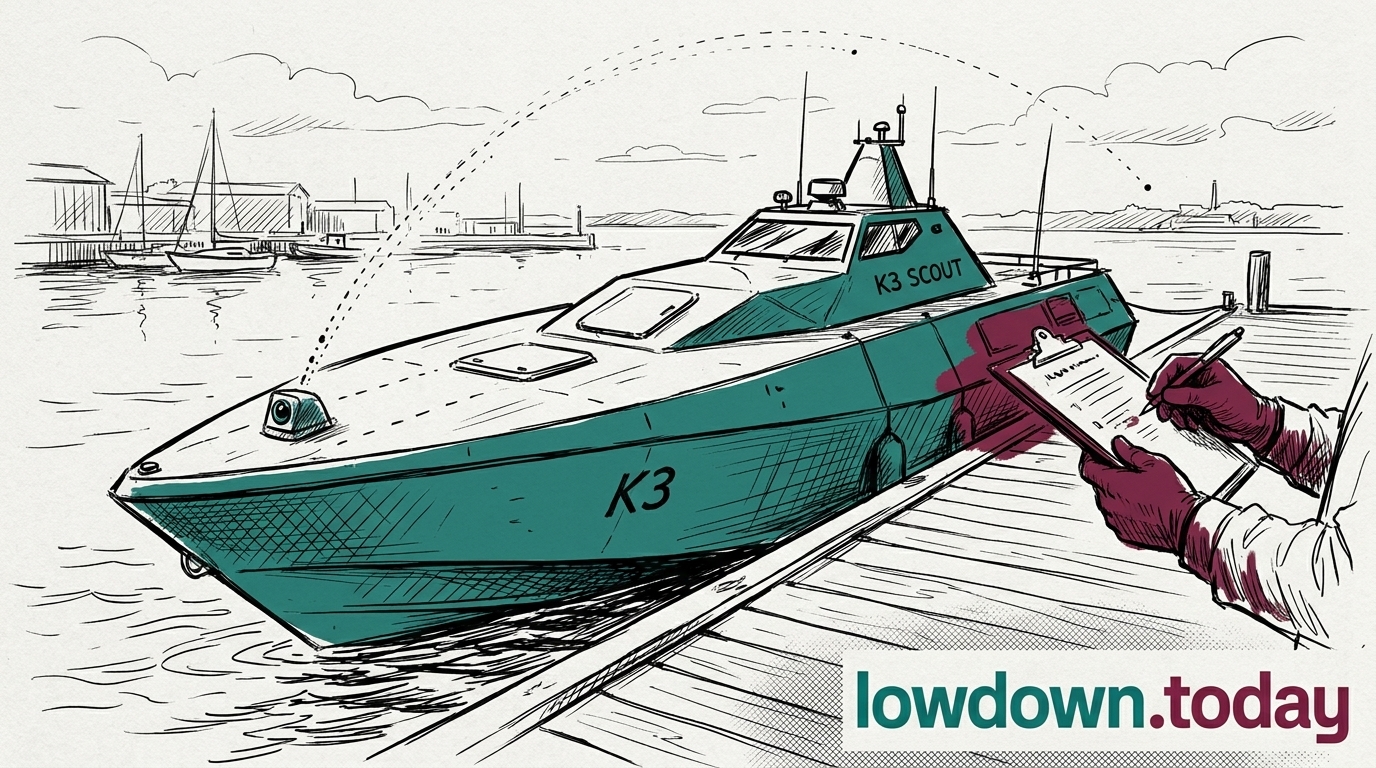
The Conservative opposition called on the Government on 9 August to 'urgently audit' equipment for hidden Chinese components, after the Telegraph's K3 SCOUT report. No named MP has been quoted on the record; the call came at party level, alongside the Ministry of Defence's own 10 August statement that no data had been compromised.
Netherlands Ministry of Defence
The Netherlands Ministry of Defence authorised Dutch Naval Design on 4 August to design 12-metre anti-submarine warfare uncrewed vessels for the Dutch-Belgian frigate programme, and to buy an adapted Compact FLASH dipping sonar from Thales Underwater Systems France. The order commits money and a named supplier while Britain's own certification body remains at the market-engagement stage.
Kraken Technology Group
Kraken Technology Group is a UK maritime-defence company based in Portsmouth that builds the K3 SCOUT, and crossed a $1bn valuation in July on a single-sourced $175m raise. The camera components reached the fleet under a third party's written security assurance, which the Platform Authority, which does not yet exist, was never positioned to check.
Navy Commercial
Navy Commercial
Navy Commercial at Whale Island published two notices on 5 August: 074032-2026, asking industry how to build a Platform Authority to certify uncrewed vessels, and 074351-2026, a GBP10m multi-role USV testbed for the Defence Chief Technology Officer. Responses on the Platform Authority close 19 August, ten days after the cameras were found transmitting to China.
Ministry of Defence
Ministry of Defence
The Ministry of Defence said on 10 August that a routine cyber vulnerability assessment found the camera fault, and a thorough investigation found no evidence that MoD data or systems had been accessed, compromised or transmitted externally. It stripped the cameras of internet connectivity but did not say whether it acted against the supplier.
Thales
Thales
Thales converted its 6 July engaging accord with Exail into a definitive combination agreement on 30-31 July, but the tender offer for Exail's remaining shares now closes by early 2028, later than July's timetable implied. Thales integrates its new undersea prime while still bidding against Kongsberg and DRASS's 2027 target for the AUKUS Pillar II contest.
