Skip to content
You can now search across every topic, entity and event.What's new
Autonomous Systems: Land & Sea
12AUG

Helsing closes $18bn round, led by Dragoneer

4 min read
14:17UTC

Helsing is closing a $1.2 billion funding round at an $18 billion valuation, led by Dragoneer Investment Group with Lightspeed Venture Partners as co-lead, the Financial Times reported on 9 May. The valuation sits roughly 30% above the €12 billion mark Helsing cleared in June 2025.

TechnologyDeveloping
Key takeaway

US growth funds have priced Europe's largest defence-AI company at $18bn, with 80% of equity still European-held.

Helsing, Europe's largest defence-AI company, is closing a $1.2 billion funding round at an $18 billion valuation, led by Dragoneer Investment Group with Lightspeed Venture Partners as co-lead, the Financial Times reported on 9 May 1. Allocations closed at multiples of the original target, pricing European defence-AI as a growth asset class. The valuation sits roughly 30% above the €12 billion mark Helsing cleared in June 2025, and arrives weeks after the EU AGILE (Accelerated Government Innovation for Lethality and Effectiveness, the European Union's first single-company defence-tech fund) €115 million pilot opened single-company applications for the first time and Britain doubled its autonomous systems pledge to £4 billion .

Helsing's order book gives the price a floor. Germany awarded the company a €269 million initial contract for HX-2 one-way effector (loitering munition), with framework options taking the deal to €1.46 billion over seven years, and the HX-2 has been cleared for Ukrainian frontline use. Germany's combined Helsing and Stark (Munich-based drone manufacturer) suicide-drone awards now total €4.3 billion inside a wider €9 billion strike-drone shift. The capital is moving the way the contracts already moved.

Anduril is in parallel talks at a valuation above $60 billion 2. The gap between the two companies, $18 billion against $60 billion plus, prices European defence-AI at roughly 30% of the US benchmark despite a more captive customer base in Berlin, Brussels, and Whitehall. The round is reportedly led by US capital but the equity stays approximately 80% European-owned, a structure that mirrors Australia's A$7 billion counter-drone commitment : Western governments are buying European production while US growth funds set the price.

The counter-view is that Helsing's revenue base, even read generously, supports a high single-digit multiple, not the mid-teens revenue multiple implied at $18 billion. Dragoneer's lead position signals the buyer disagrees, but oversubscription does not equal earnings.

Deep Analysis

In plain English

Helsing builds the software that controls how military drones and aircraft make decisions in combat. It is best known for the AI systems being used on Ukrainian frontlines. A group of American investors just agreed to value the company at $18 billion, roughly what a mid-sized European bank is worth. American investors are now pricing European defence software at levels previously reserved for US companies. That change matters because it makes it easier for companies like Helsing to raise more money and win more contracts, and it raises the benchmark valuation for all European defence-tech firms that come after.

Deep Analysis
Root Causes

Three structural conditions make this valuation possible now but not in 2023.

First, German industrial-policy mechanics. The Bundeswehr's HX-2 contract and its 1.46 billion euro framework ceiling gave Helsing a government-backed revenue floor that investors can model. Without the contract, the round would be a pure speculation bet on European rearmament intent. With it, the floor supports a traditional growth-equity underwrite.

Second, the EU foreign-investment screening gap. European defence-AI companies face CFIUS-equivalent review in Germany and France but not yet at EU level. Dragoneer's structure, preserving 80% European ownership, is specifically designed to stay below the German Federal Foreign Trade and Payments Act (AWG) 25% threshold that triggers mandatory notification. The cap table shape is not incidental: it is regulatory arbitrage built in at term-sheet stage.

Third, the US growth-fund calendar. Dragoneer's co-investment with Lightspeed signals that two major crossover funds have simultaneously run out of domestic defence-AI paper. Shield AI, Anduril, and Palantir are either private at fully-priced valuations or already public. Helsing is the last large-cap European entry point before the sector matures.

What could happen next?
  • Consequence

    The EU AGILE 115 million euro single-company ceiling faces pressure to revise upward, as Helsing's cap table implies the instrument is undersized relative to market valuation.

    Short term · 0.72
  • Risk

    Dragoneer's crossover fund structure means Helsing faces IPO pressure within 3-5 years, creating a potential conflict between German export-control obligations and US public-market disclosure requirements.

    Medium term · 0.65
  • Opportunity

    The round opens a pricing benchmark for European defence-AI follow-on rounds; Saab, Diehl spin-outs, and UK start-ups can now reference $18 billion as a comparable when approaching institutional capital.

    Short term · 0.78
First Reported In

Update #8 · The week defence-AI got priced

Bloomberg· 10 May 2026
Read original
Causes and effects
This Event
Helsing closes $18bn round, led by Dragoneer
US growth-equity has now priced European defence-AI as a standalone asset class. Helsing's order book gives the figure a contractual floor that earlier European defence rounds lacked, and the round structure preserves roughly 80% European ownership against future foreign-investment screening. Anduril is in parallel talks above $60 billion, putting Helsing at roughly 30% of the US benchmark despite a more captive customer base in Berlin, Brussels, and Whitehall.
Different Perspectives
Conservative opposition
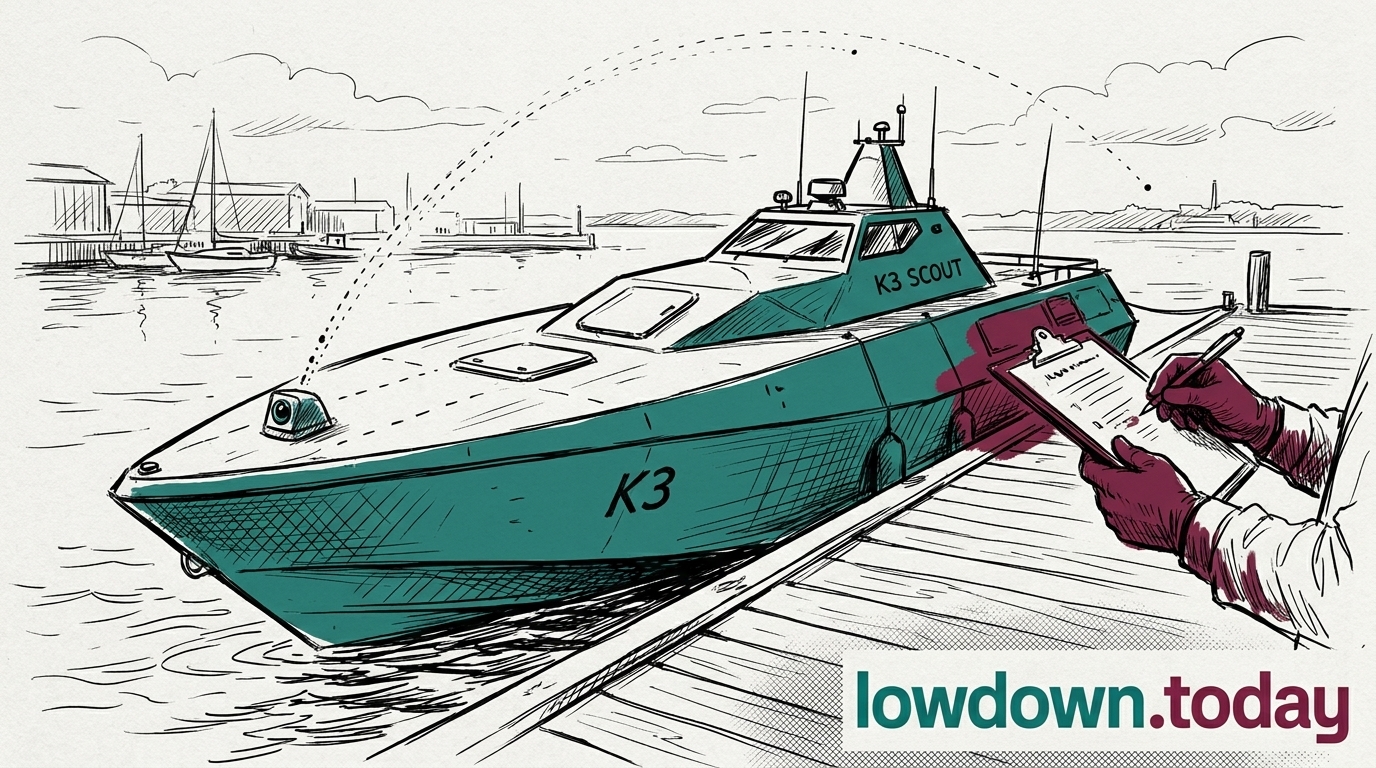
The Conservative opposition called on the Government on 9 August to 'urgently audit' equipment for hidden Chinese components, after the Telegraph's K3 SCOUT report. No named MP has been quoted on the record; the call came at party level, alongside the Ministry of Defence's own 10 August statement that no data had been compromised.
Netherlands Ministry of Defence
The Netherlands Ministry of Defence authorised Dutch Naval Design on 4 August to design 12-metre anti-submarine warfare uncrewed vessels for the Dutch-Belgian frigate programme, and to buy an adapted Compact FLASH dipping sonar from Thales Underwater Systems France. The order commits money and a named supplier while Britain's own certification body remains at the market-engagement stage.
Kraken Technology Group
Kraken Technology Group is a UK maritime-defence company based in Portsmouth that builds the K3 SCOUT, and crossed a $1bn valuation in July on a single-sourced $175m raise. The camera components reached the fleet under a third party's written security assurance, which the Platform Authority, which does not yet exist, was never positioned to check.
Navy Commercial
Navy Commercial
Navy Commercial at Whale Island published two notices on 5 August: 074032-2026, asking industry how to build a Platform Authority to certify uncrewed vessels, and 074351-2026, a GBP10m multi-role USV testbed for the Defence Chief Technology Officer. Responses on the Platform Authority close 19 August, ten days after the cameras were found transmitting to China.
Ministry of Defence
Ministry of Defence
The Ministry of Defence said on 10 August that a routine cyber vulnerability assessment found the camera fault, and a thorough investigation found no evidence that MoD data or systems had been accessed, compromised or transmitted externally. It stripped the cameras of internet connectivity but did not say whether it acted against the supplier.
Thales
Thales
Thales converted its 6 July engaging accord with Exail into a definitive combination agreement on 30-31 July, but the tender offer for Exail's remaining shares now closes by early 2028, later than July's timetable implied. Thales integrates its new undersea prime while still bidding against Kongsberg and DRASS's 2027 target for the AUKUS Pillar II contest.
