Skip to content
You can now search across every topic, entity and event.What's new
Autonomous Systems: Land & Sea
12AUG

EU drops consortium rule for AGILE fund

2 min read
14:17UTC

The EU unveiled its €115 million AGILE defence technology programme, the first to allow single-company applications without requiring multinational consortia.

TechnologyDeveloping
Key takeaway

Removing the consortium requirement could accelerate European defence technology deployment by years.

The European Union unveiled the €115 million AGILE (Accelerated Government Innovation for Lethality and Effectiveness) defence technology programme on 7 April. For the first time, a single company can apply directly without forming a multinational consortium. The programme awaits European Parliament and Council approval.

The consortium requirement has historically added months or years to EU defence procurement timelines. Removing it is a structural change to how European defence technology reaches the market. If AGILE passes in its current form, it establishes a precedent for direct EU-to-company contracts that bypasses the national industrial politics constraining capability development across the bloc.

The €115 million pilot is modest relative to Britain's £4bn commitment and the Pentagon's multibillion-dollar Drone Dominance programme. The procedural innovation matters more than the sum: 20 to 30 projects at €1 to €5 million each, with shorter evaluation timelines and retroactive funding for completed work. For European drone startups that previously had no route into EU-level defence procurement, AGILE creates an addressable market that did not exist before.

AGILE arrives weeks after Gulf conflict escalation and DroneShield's Amsterdam headquarters opening . Gulf conflict dynamics are reshaping institutional procurement rules that Brussels had previously treated as politically fixed. Whether Parliament and Council approve the programme without reinstating consortium requirements will determine whether the structural change holds.

Deep Analysis

In plain English

The EU has historically required that multiple companies from different countries form a partnership before applying for defence funding. This was meant to encourage cooperation, but in practice it added so much cost and delay that many small companies simply never applied. AGILE changes that: a single British, French, or Polish startup can now apply for EU defence funding on its own. That is genuinely new. The total fund is €115 million, which across 20-30 projects works out to roughly €4-6 million each. For a small drone startup, that is meaningful early-stage capital with no consortium overhead.

What could happen next?
  • Opportunity

    If AGILE passes without the consortium requirement being reinstated, European drone startups gain a direct funding route to EU defence procurement that bypasses the national industrial gatekeeping that has historically excluded them.

  • Precedent

    The single-company application model, if successful, will be cited in future EU defence procurement reform debates as evidence that the consortium requirement is a bureaucratic rather than a strategic necessity.

First Reported In

Update #5 · Gulf drone war rewrites procurement

Euronews· 13 Apr 2026
Read original
Different Perspectives
Conservative opposition
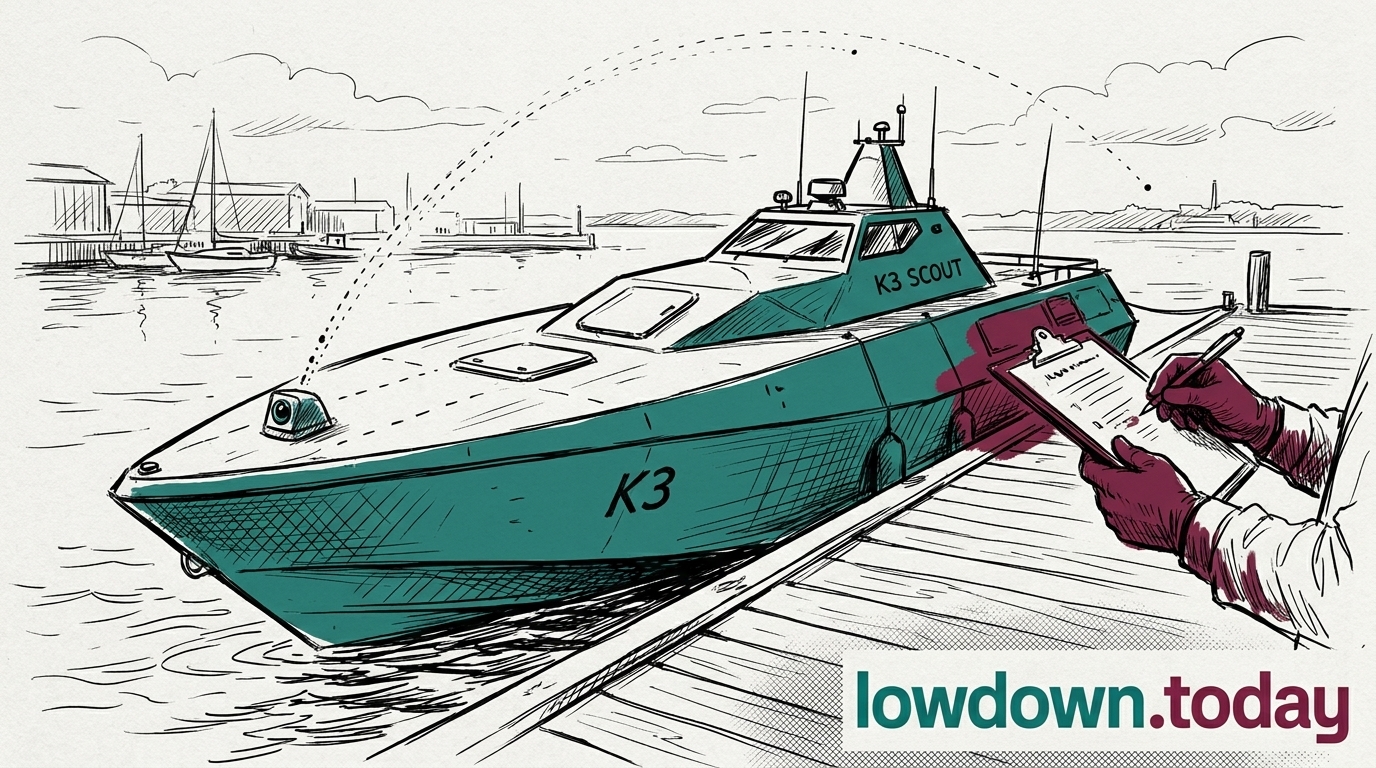
The Conservative opposition called on the Government on 9 August to 'urgently audit' equipment for hidden Chinese components, after the Telegraph's K3 SCOUT report. No named MP has been quoted on the record; the call came at party level, alongside the Ministry of Defence's own 10 August statement that no data had been compromised.
Netherlands Ministry of Defence
The Netherlands Ministry of Defence authorised Dutch Naval Design on 4 August to design 12-metre anti-submarine warfare uncrewed vessels for the Dutch-Belgian frigate programme, and to buy an adapted Compact FLASH dipping sonar from Thales Underwater Systems France. The order commits money and a named supplier while Britain's own certification body remains at the market-engagement stage.
Kraken Technology Group
Kraken Technology Group is a UK maritime-defence company based in Portsmouth that builds the K3 SCOUT, and crossed a $1bn valuation in July on a single-sourced $175m raise. The camera components reached the fleet under a third party's written security assurance, which the Platform Authority, which does not yet exist, was never positioned to check.
Navy Commercial
Navy Commercial
Navy Commercial at Whale Island published two notices on 5 August: 074032-2026, asking industry how to build a Platform Authority to certify uncrewed vessels, and 074351-2026, a GBP10m multi-role USV testbed for the Defence Chief Technology Officer. Responses on the Platform Authority close 19 August, ten days after the cameras were found transmitting to China.
Ministry of Defence
Ministry of Defence
The Ministry of Defence said on 10 August that a routine cyber vulnerability assessment found the camera fault, and a thorough investigation found no evidence that MoD data or systems had been accessed, compromised or transmitted externally. It stripped the cameras of internet connectivity but did not say whether it acted against the supplier.
Thales
Thales
Thales converted its 6 July engaging accord with Exail into a definitive combination agreement on 30-31 July, but the tender offer for Exail's remaining shares now closes by early 2028, later than July's timetable implied. Thales integrates its new undersea prime while still bidding against Kongsberg and DRASS's 2027 target for the AUKUS Pillar II contest.
