Skip to content
Welcome, thoughtbot's Giant Robots listeners!Start here
Autonomous Systems: Land & Sea
12AUG

CBP caps duty on allied-made drones

3 min read
14:17UTC

America's new drone tariff drops to 10 or 15 per cent for allies, but only for drones whose critical parts are allied too.

TechnologyAssessed
Key takeaway

Allied drones pay 10 or 15 per cent US duty only if their critical parts are allied.

US Customs and Border Protection (CBP) opened new duty lines for drones on 3 September, capping the tariff at 10 per cent for British products and 15 per cent for products of Japan, the EU, South Korea, Switzerland, Taiwan and Liechtenstein⁠1. Other imports pay 100 per cent on Annex I items and 25 per cent on small drones. The caps apply only if importers certify that "substantially all the critical components and technology" come from the US or the same partners, under the Section 232 proclamation that set the tariffs⁠2.

A European airframe with a Chinese motor or thermal camera therefore falls back to the full rate: 25 per cent for a small drone, and 100 per cent if it carries a thermal imager or weighs over 25kg. The Commerce Department has yet to publish how it will judge the certificates. Two zero-rate duty lines exist for importers with approved onshoring plans. The interim one, for plans with conditional approval from Homeland Security or the Department of War, closes on 9 February 2027, the day duties on the Annex III component list begin⁠3. Beijing already requires a licence for US-bound exports of the same kinds of parts.

A Federal Communications Commission (FCC) rule published on 11 September closes the parts route from a second side⁠4. It bars certification of any device containing a "logic-bearing hardware component" made by a company on the FCC Covered List, the commission's register of firms judged a national-security risk. Once the rule takes effect, due on 13 October, a US-assembled drone with a Chinese-made flight controller or radio will not win approval.

A separate FCC notice of 24 August asked whether to stop imports and sales of some foreign drones that already hold authorisation; comments closed on 23 September⁠5. Autel, a Chinese drone maker on the Covered List, contested its own designation in a May filing to the FCC.

Deep Analysis

In plain English

The United States wants fewer Chinese-made drones and drone parts in the country, mainly over security worries, and it has two tools for the job. The first tool, a tariff, taxes imported drones. Drones from close allies such as Britain, Japan and EU countries pay a lower rate, but only if their important parts are not Chinese. The second is a rule from the Federal Communications Commission, the agency that approves electronic devices for sale. From October it will refuse approval to any device with key electronics made by companies on its security blacklist.

Deep Analysis
Root Causes

Chinese firms supply many of the motors, cameras, flight controllers and radios that go into drones assembled elsewhere. A tariff or ban on finished Chinese aircraft leaves that route open, so both instruments now target the parts inside.

The FCC rule also extends its marketing rules to online marketplaces and makes them display a device's FCC ID at the point of sale. Enforcement therefore moves from the border to the shops where most small drones are sold.

What could happen next?
  • Consequence

    European and Asian drone makers selling in the US must document the origin of motors, cameras and controllers to keep the lower tariff.

  • Risk

    Without a published certification process, importers face uncertainty over whether customs will accept their parts declarations.

First Reported In

Update #18 · Four EU states skip tenders on drone defence

Federal Register· 1 Oct 2026
Read original →
Different Perspectives
Conservative opposition
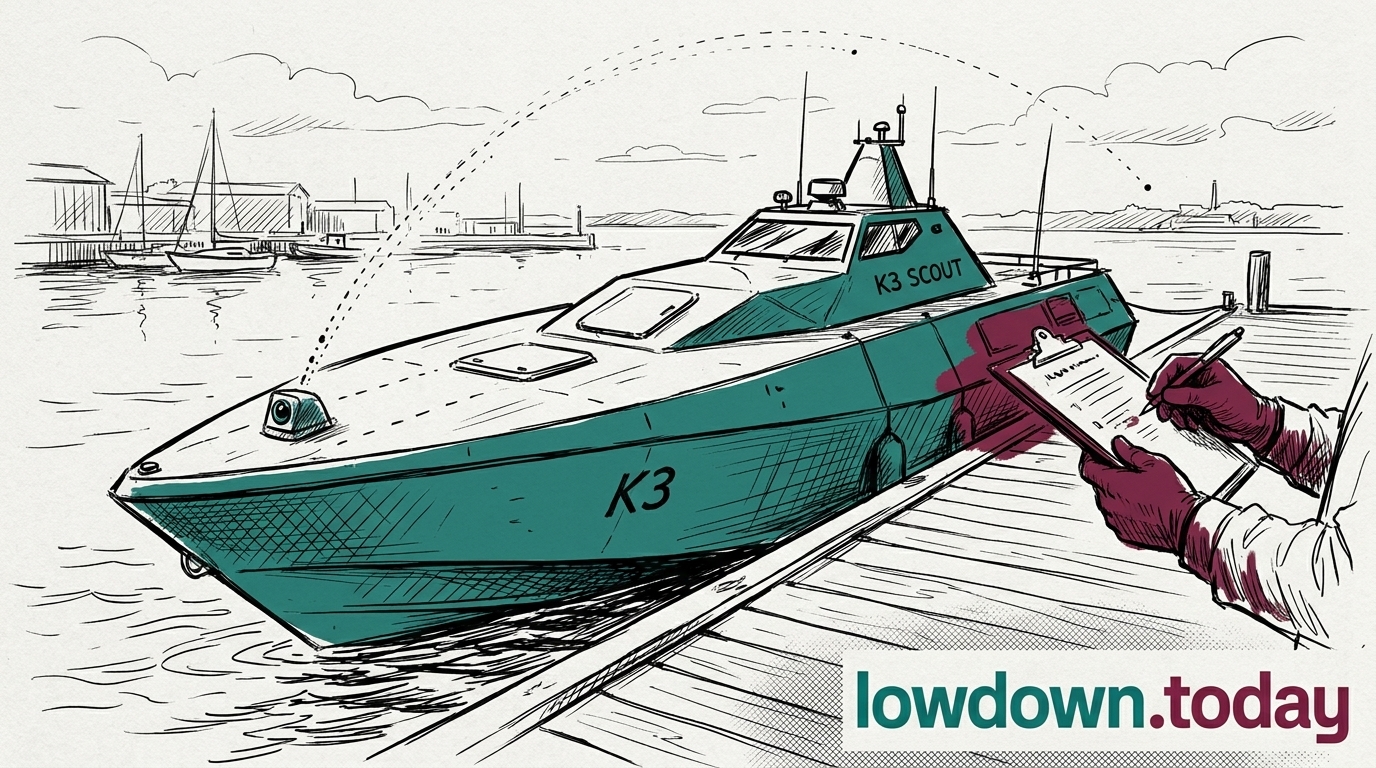
The Conservative opposition called on the Government on 9 August to 'urgently audit' equipment for hidden Chinese components, after the Telegraph's K3 SCOUT report. No named MP has been quoted on the record; the call came at party level, alongside the Ministry of Defence's own 10 August statement that no data had been compromised.
Kraken Technology Group
Kraken Technology Group is a UK maritime-defence company based in Portsmouth that builds the K3 SCOUT, and crossed a $1bn valuation in July on a single-sourced $175m raise. The camera components reached the fleet under a third party's written security assurance, which the Platform Authority, which does not yet exist, was never positioned to check.
Navy Commercial
Navy Commercial
Navy Commercial at Whale Island published two notices on 5 August: 074032-2026, asking industry how to build a Platform Authority to certify uncrewed vessels, and 074351-2026, a GBP10m multi-role USV testbed for the Defence Chief Technology Officer. Responses on the Platform Authority close 19 August, ten days after the cameras were found transmitting to China.
HUMAIN
HUMAIN
HUMAIN and Applied Intuition stated a 2030 target for thousands of autonomous trucks on Saudi logistics corridors. The announcement disclosed no order, fleet baseline or contract value.
Saildrone
Saildrone
Saildrone and Lockheed Martin demonstrated two JAGM launches from a Surveyor-class vessel at RIMPAC. The accepted record identifies no requirement, customer or production configuration behind the demonstration.
Taiwan Legislative Yuan
Taiwan's Legislative Yuan passed the Act at third reading with a small suicide uncrewed boat on the named development list. The NT$240 billion ceiling covers all unmanned domains, and the Act was not promulgated by 4 September.
