Skip to content
You can now search across every topic, entity and event.What's new
Drones: Industry & Defence
20AUG

Beijing puts US drone parts on licence

2 min read
16:38UTC

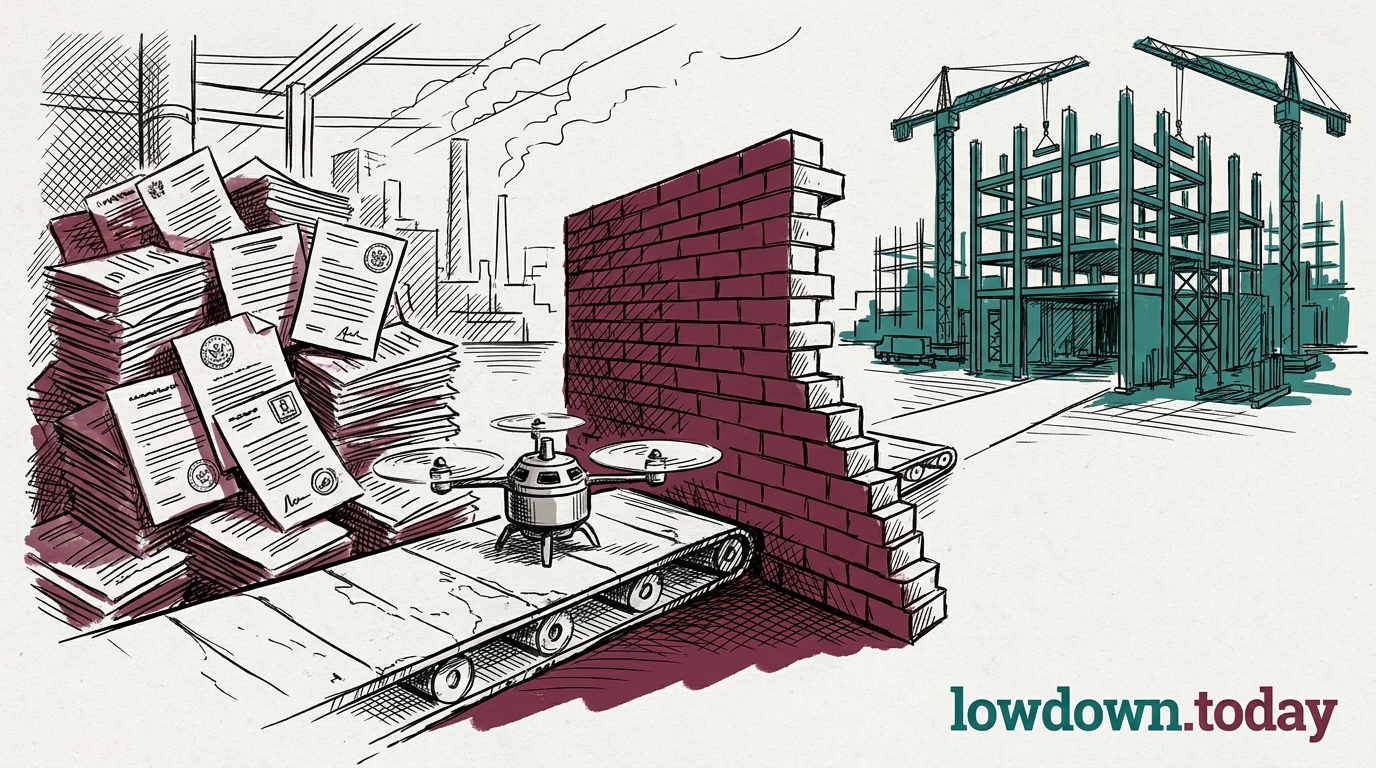
China's Ministry of Commerce subjected US-bound dual-use drone components to case-by-case export review on 5 August, and withdrew the fast lane that let approved exporters ship against a standing permission.

TechnologyDeveloping
Key takeaway

Chinese drone components bound for America now need a licence decision rather than a filing.

China's Ministry of Commerce published Announcement No. 34 of 2026 on 5 August, subjecting listed dual-use uncrewed aircraft systems (UAS), their key components and the related technology to case-by-case export review when the destination is the United States 1. Dual-use means an item with both civil and military application. Licence facilitation, the arrangement that let approved exporters ship against a standing permission, does not apply. The measure took effect on publication.

A Chinese motor or optics supplier shipping to an American integrator now waits on a decision rather than filing a form, and no deadline attaches to that decision. Nothing in Announcement No. 34 raises the price of a motor; it changes when the motor arrives. An integrator who has already sold a September slot carries the delay on its own balance sheet.

Washington's own rules had been pushing the same parts out of the same programmes for months. The Pentagon barred Chinese motors and batteries from the bills of materials submitted to its Gauntlet II component sprint , so several of the firms most exposed to Beijing's review had already begun designing those inputs out. Within days of Announcement No. 34, a US tariff proclamation reached the same components from the customs side. Neither document mentions the other, and the two governments acted independently, but a supplier sitting between them now answers to both.

Deep Analysis

In plain English

China makes many of the small motors, batteries and control chips that go inside drones sold in the US. Until 5 August, US companies could generally get these parts through customs without extra paperwork. Now China's commerce ministry is reviewing each shipment of certain "dual-use" parts (components that could be used in either civilian or military equipment) one at a time. This does not ban the parts outright. It gives Chinese officials the power to slow, delay or refuse individual shipments without saying publicly why. For a US drone maker waiting on a batch of motors, the practical effect can look identical to a ban even if none was ever declared.

Deep Analysis
Root Causes

The measure depends on the same dual-use classification China has used since its 2020 Export Control Law: any component with both a civilian and a military application can be licensed individually, which gives MOFCOM discretion over volume without amending the underlying regulation.

US drone assemblers still depend on Chinese-origin motors, flight controllers and batteries for a large share of components even after two years of onshoring pressure , so a licensing slowdown reaches production lines faster than a comparable measure would in a less concentrated supply chain.

What could happen next?
  • Consequence

    US drone assemblers face longer, less predictable lead times for Chinese-origin motors, batteries and flight controllers while each shipment is reviewed case by case.

  • Risk

    Licensing friction gives Beijing a lever it can tighten or loosen without a formal policy change, making the true severity hard for buyers to plan against.

First Reported In

Update #17 · Two walls close on the drone supply chain

Ministry of Commerce of the People's Republic of China· 20 Aug 2026
Read original
Different Perspectives
South Korea's Defense Acquisition Program Administration
DAPA folded drone and roadside-bomb jammers into an 18-year, KRW 3.448 trillion K2 tank upgrade approved 11 August, rather than fund counter-drone kit as its own programme. Seoul is treating the threat as permanent enough to write into a platform's lifecycle, not urgent enough to buy ahead of it.
NATO Support and Procurement Agency
NSPA named five pre-qualified counter-drone suppliers under new framework contracts on 27 July, giving allies a purchasing route with no published budget attached. A framework without committed money is an instrument waiting for a spending decision, not a guarantee one is coming.
Ukraine's Ministry of Defence
Ukraine's forces strike with more than 70 AI and computer-vision systems drawn from over 200 domestic producers, the ministry said on 18 August, a supplier base neither Washington's tariff fight nor Beijing's export licence touches. Kyiv is scaling capability faster than either government is writing rules for it.
A European drone-component manufacturer
A European manufacturer selling components into the United States faces the same 100 per cent tariff and 3 September deadline as any other foreign supplier, with the duty-free onshoring carve-out available only to firms building on American soil. That leaves it to absorb the cost, relocate assembly, or cede the US market rather than shop around a rival supply chain.
Chinese drone component exporters
Exporters now need a case-by-case licence for each US-bound dual-use shipment after MOFCOM's 5 August order, with no published review clock. The same week Shenzhen logged nearly 200,000 domestic logistics-drone sorties and Hunan reported record spraying coverage, a home market large enough to absorb what the licence regime slows from leaving the country.
US drone manufacturers
The onshoring carve-out protects Performance Drone Works' $820 million War Department loan, but the same 3 September deadline hits Red Cat Holdings and Unusual Machines, both filing over 500 per cent revenue growth on 6 August, on Chinese-sourced components with no qualified domestic substitute yet.
