Skip to content
Welcome, thoughtbot's Giant Robots listeners!Start here
Autonomous Systems: Land & Sea
12AUG

Autel takes FCC to court over secret evidence

4 min read
14:17UTC

Autel Robotics filed its FCC reply on Tuesday 19 May, arguing the Covered List designation rests on classified evidence Autel has never seen, and invoking a 2014 D.C. Circuit ruling to claim a Fifth Amendment due-process right to examine it.

TechnologyDeveloping
Key takeaway

Autel is attacking the FCC's classified-evidence foundation rather than the substance of the Chinese-drone allegations.

Autel Robotics filed its Federal Communications Commission (FCC) reply on Tuesday 19 May, arguing the FCC's Covered List designation rests on classified evidence Autel has never seen and on allegations imported from the parallel DJI case⁠1. The company invokes Ralls Corp v Committee on Foreign Investment in the United States (CFIUS), the 2014 D.C. Circuit ruling that established a Fifth Amendment due-process right to see the evidence underlying a national-security restriction. Autel's reply met the 11 May statutory deadline under FCC notice DA 26-223 and includes the first public sworn declarations on Autel data handling: AES-128 / AES-256 encryption, local storage by default, no third-party access.

The reply tests whether the regulatory stack that has cleared Chinese drone makers from the US federal market can survive a constitutional challenge. The Department of Defense filed a classified intelligence annex against DJI's parallel FCC petition on 3 April; DJI booked $1.56 billion in 2026 regulatory losses in its Ninth Circuit brief on 22 April. If the Ralls Corp argument carries, the FCC may be forced to construct an unclassified evidentiary record, slowing the regulatory exclusion timetable that Federal Acquisition Regulation (FAR) clause 52.240-1 and the Covered List have built since 22 December 2025.

Autel is the first respondent to attack the procedural foundation rather than the underlying allegations. The Ralls Corp precedent was decided against CFIUS in 2014 after President Obama blocked a Chinese-owned wind farm acquisition without disclosing the intelligence basis; the D.C. Circuit found that targets of national-security restrictions are entitled to see and contest the underlying evidence. Applying that holding to the FCC Covered List would not erase the designation, but it would force the FCC to litigate Autel's exclusion on the evidentiary record rather than on the classified annex DoD has been keeping out of court.

Deep Analysis

In plain English

Autel Robotics is a Chinese company that makes consumer and professional drones. The US government put Autel on a list of companies whose products cannot be certified for use in the United States, based partly on classified intelligence that Autel has never been allowed to see. On 19 May, Autel filed a legal argument with the FCC saying this violates the US Constitution's Fifth Amendment right to due process. Autel is citing a 2014 court ruling in which a Chinese wind-farm company successfully argued that the US government cannot restrict a company on national-security grounds without giving it at least an unclassified summary of the evidence. If Autel wins, the FCC may have to disclose more about why it put Autel on the restricted list, or risk having the restriction overturned.

Deep Analysis
Root Causes

The classified-evidence problem at the core of Autel's challenge traces to a structural tension in the FCC's Covered List process: the agency used a national-security designation mechanism designed for CFIUS-style transactions but applied it to a product certification regime where the normal evidentiary standard is a public technical record.

The gap between the classified intelligence basis and the public-record requirement of FCC equipment authorisation proceedings created the due-process exposure Autel is now exploiting.

Autel's decision to invoke Ralls Corp rather than challenging the underlying allegations also reflects a legal strategy choice: attacking the evidence is impossible when the evidence is classified and the allegations are backed by the DoD's classified annex. Attacking the procedure is available to any company regardless of the underlying merits, because it requires the government to defend its process rather than its intelligence.

What could happen next?
  • Precedent

    A successful Ralls Corp extension to the FCC context would require the FCC to construct an unclassified evidentiary record for every Covered List designation, slowing future exclusions of Chinese technology companies from the US market and establishing a replicable legal template for DJI's parallel Ninth Circuit challenge.

  • Risk

    If the D.C. Circuit applies the Kaspersky precedent and treats the NDAA Covered List authority as a congressional mandate beyond due-process challenge, Autel's case fails and DJI's parallel Ninth Circuit petition faces a reinforced precedent against it.

First Reported In

Update #9 · Schmidt's Perennial wins $500M drone deal

DroneXL· 21 May 2026
Read original →
Different Perspectives
Conservative opposition
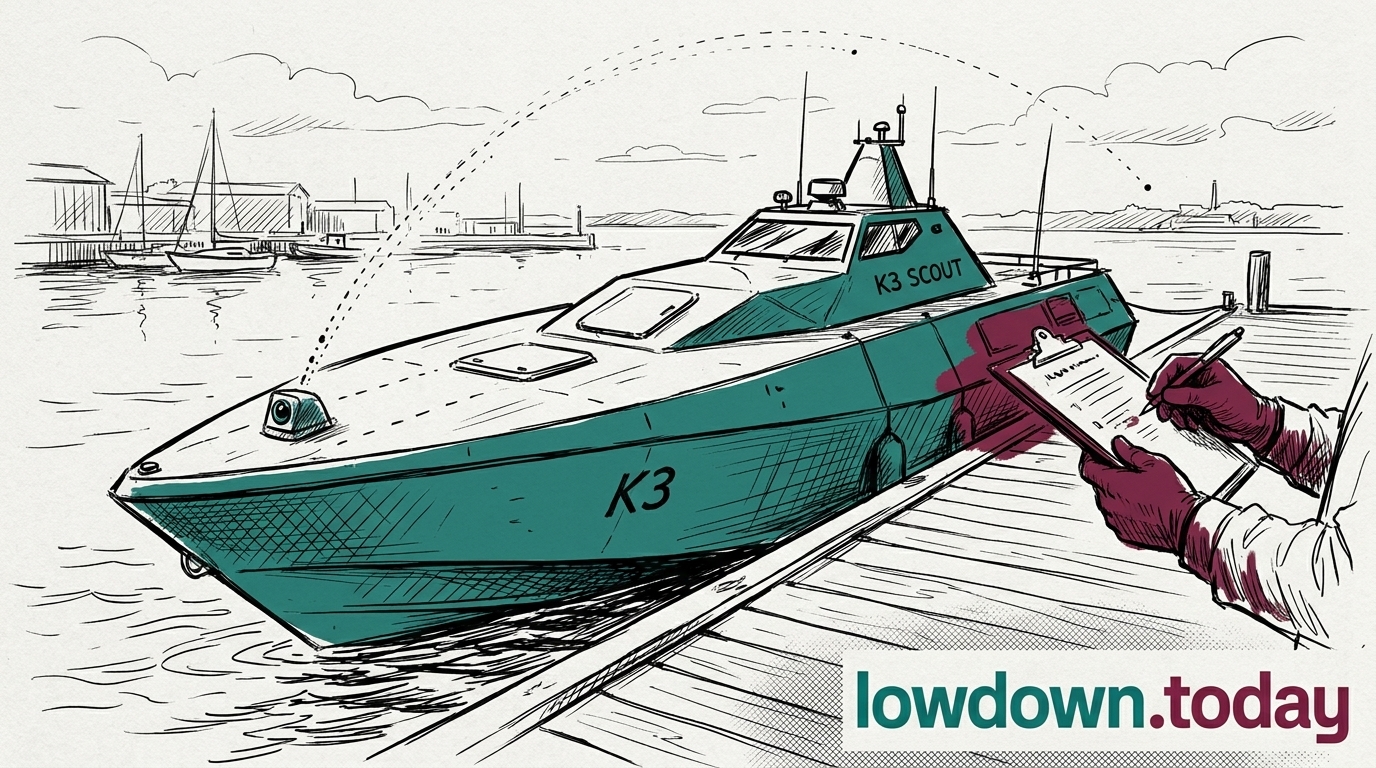
The Conservative opposition called on the Government on 9 August to 'urgently audit' equipment for hidden Chinese components, after the Telegraph's K3 SCOUT report. No named MP has been quoted on the record; the call came at party level, alongside the Ministry of Defence's own 10 August statement that no data had been compromised.
Kraken Technology Group
Kraken Technology Group is a UK maritime-defence company based in Portsmouth that builds the K3 SCOUT, and crossed a $1bn valuation in July on a single-sourced $175m raise. The camera components reached the fleet under a third party's written security assurance, which the Platform Authority, which does not yet exist, was never positioned to check.
Navy Commercial
Navy Commercial
Navy Commercial at Whale Island published two notices on 5 August: 074032-2026, asking industry how to build a Platform Authority to certify uncrewed vessels, and 074351-2026, a GBP10m multi-role USV testbed for the Defence Chief Technology Officer. Responses on the Platform Authority close 19 August, ten days after the cameras were found transmitting to China.
HUMAIN
HUMAIN
HUMAIN and Applied Intuition stated a 2030 target for thousands of autonomous trucks on Saudi logistics corridors. The announcement disclosed no order, fleet baseline or contract value.
Saildrone
Saildrone
Saildrone and Lockheed Martin demonstrated two JAGM launches from a Surveyor-class vessel at RIMPAC. The accepted record identifies no requirement, customer or production configuration behind the demonstration.
Taiwan Legislative Yuan
Taiwan's Legislative Yuan passed the Act at third reading with a small suicide uncrewed boat on the named development list. The NT$240 billion ceiling covers all unmanned domains, and the Act was not promulgated by 4 September.
