Ust-Luga
Russian Baltic port in Leningrad Oblast exporting crude and fuel; a Ukrainian drone target.
Defence Minister Yevhen Khmara listed the Ust-Luga port in October as one of the targets in Kyiv's campaign against Russian oil processing, whose claimed scale no outside agency has confirmed, just as Moscow stopped publishing the terminal and tanker data that would test it.
Last refreshed: 12 October 2026 · Appears in 1 active topic
Why does Ust-Luga keep reappearing on Ukraine's target list?
Timeline for Ust-Luga
Mentioned in: Ukraine strikes Yandex AI data centres
Russia-Ukraine War 2026Mentioned in: Ukraine's strikes move to the Azov
Russia-Ukraine War 2026Marines board shadow tanker in Channel
Russia-Ukraine War 2026Recovered loading volumes by 49% MoM, partially offsetting the price drop
Russia-Ukraine War 2026: Urals falls 12% as China cuts buysMentioned in: Baltic Aframax bid eases off the spike
European Oil MarketsBackground
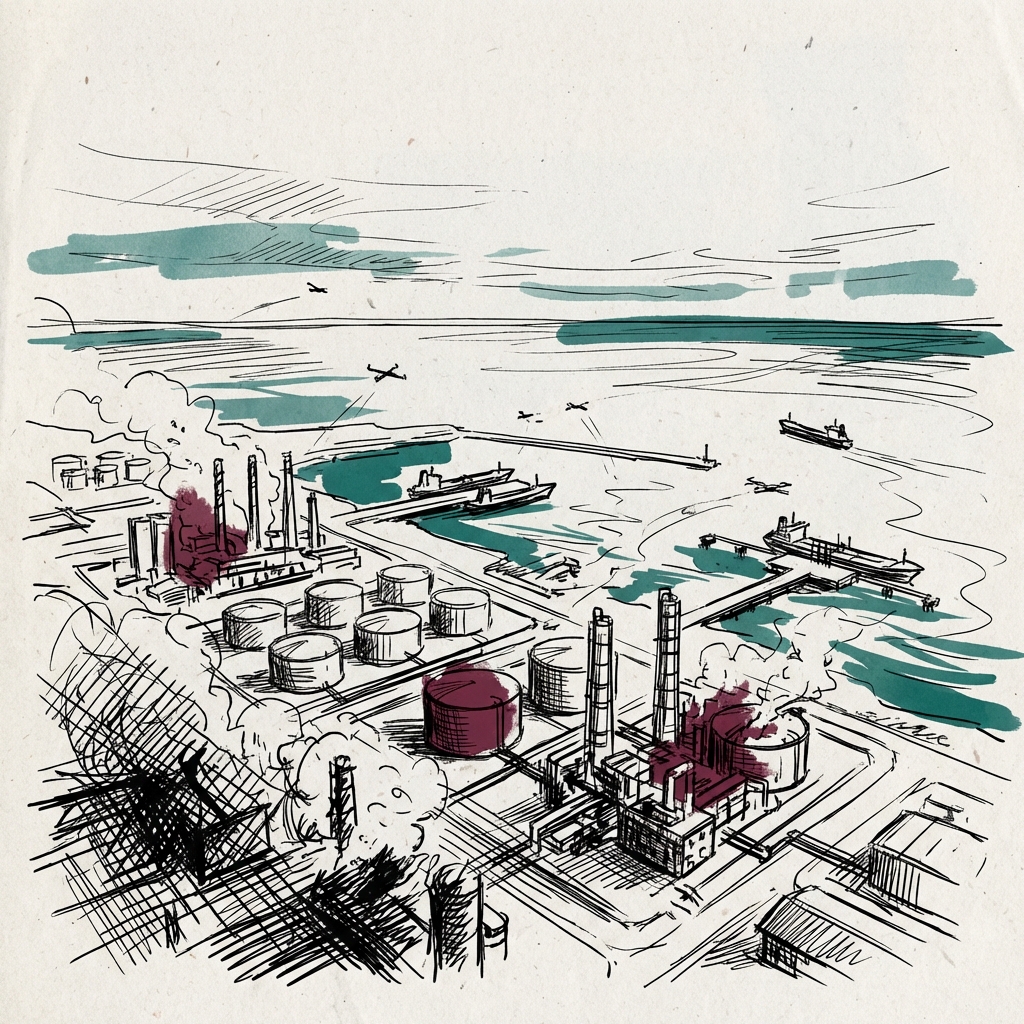
Ust-Luga is a port on The Gulf of Finland in Leningrad Oblast, about 110km west of St Petersburg near the Estonian border. With Primorsk it is one of Russia's two largest Baltic oil export terminals, with berths for crude, fuel oil and petrol.
That role makes it a strategic Ukrainian target. Strikes on the port hit Russian export earnings directly, and damage to its product terminals ripples back into the domestic fuel market: after the March 2026 strikes, Ust-Luga stopped taking fuel oil and petrol, and Russia banned petrol exports from 1 April to 31 July.
It is also a starting point for the shadow fleet of tankers that move Russian oil outside Western price-CAP rules. The ships that load there pass through the Danish straits and the English Channel, where European states have begun boarding suspect tankers. Russia's 28 September decree restricting data on terminals, tankers and loading dates removes the official figures outsiders used to track what leaves the port.
Ust-Luga stays on Kyiv's target list
Ukraine's October claim put Ust-Luga back at the centre of its energy campaign. On 4 October Kyiv said its drones had disabled 51% of Russian oil refining, and Khmara listed Ust-Luga among the sites behind the figure; drones then hit refineries at Omsk and Ukhta.
Checking that claim at the port has become harder. Vladimir Putin's Decree 686 of 28 September restricts public data on refinery output, export prices, buyers, tanker details and loading times. For a terminal whose loadings outsiders have tracked month by month since the March strikes, that removes the official half of the comparison and leaves ship-tracking as the only check on what Ust-Luga ships.
Four strikes cut Russia's seaborne crude
Ust-Luga's worst weeks came at the end of March. Ukrainian drones struck it and Primorsk, Russia's two largest Baltic oil export terminals, at least four times between 22 and 31 March, and weekly Russian seaborne crude exports fell from 4.07 million to 2.32 million barrels a day, a 43% drop.
Satellite imagery from 1 April showed Ust-Luga's crude terminal physically intact while its fuel and product terminals bore fire traces. That split shaped the aftermath: crude loading resumed on 5 April, while the loss of product exports fed Russia's petrol export ban from 1 April.
Loadings recovered faster than refining
The port came back quickly as a crude outlet. In May Ust-Luga loadings recovered 49% as the shadow fleet kept rerouting, which let Russia's total fossil-fuel revenue rise 2% even as Urals crude fell 12% and China cut purchases.
Since June, Britain has boarded tankers loaded at Ust-Luga as well as listing them. On 14 June Royal Marines boarded the Smyrtos in the English Channel, nine days after it left Ust-Luga, and Britain's National Crime Agency arrested one person for suspected sanctions offences. It was Britain's first physical boarding of a Russian shadow tanker after years of designating ships on paper.
Four strikes cut Russia's seaborne crude
What is Ust-Luga and why does Ukraine keep attacking it?
Loadings recovered faster than refining
Has Ust-Luga recovered after the March 2026 drone strikes?
What shadow tanker from Ust-Luga did Britain seize?

