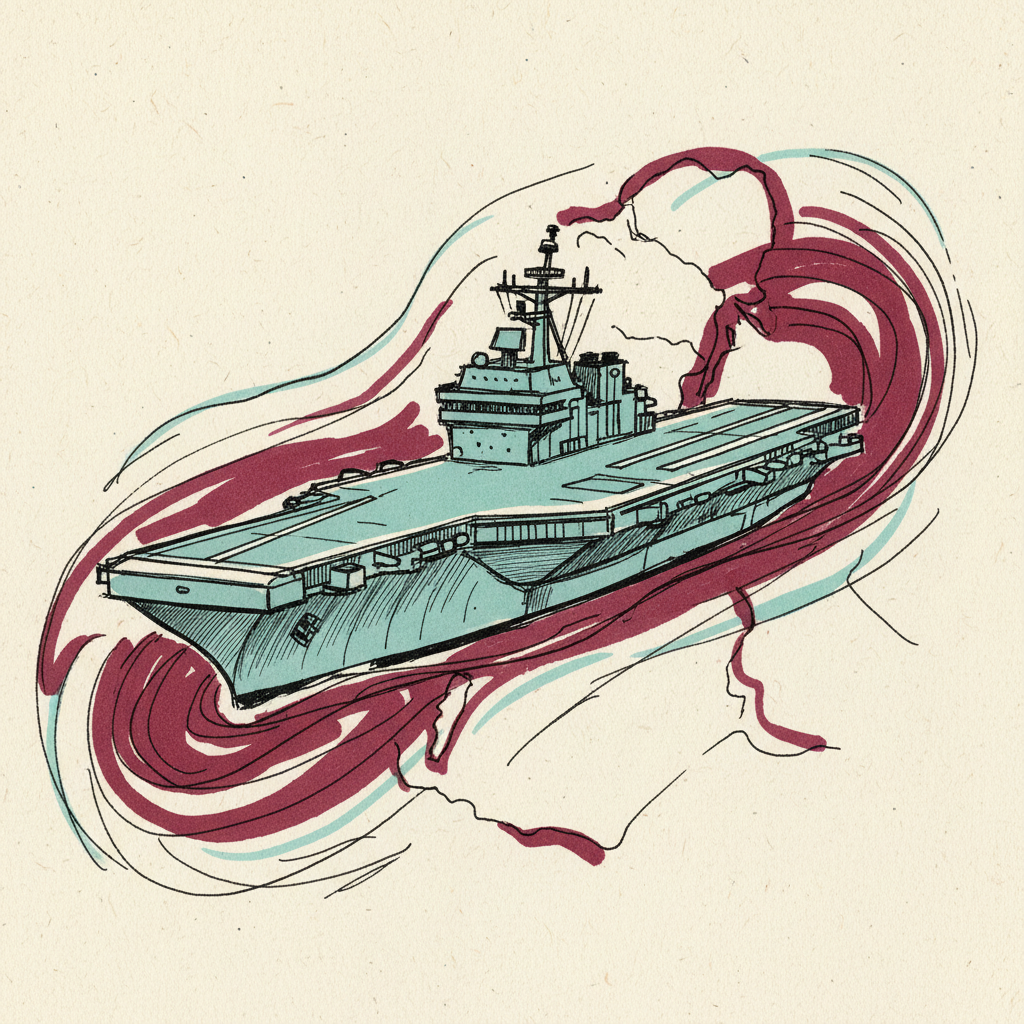
Why did America's newest carrier move away from Iran on deadline day?
Timeline for USS Gerald R. Ford
Remained deployed in Red Sea as second carrier in theatre
Iran Conflict 2026: Third US carrier reaches CENTCOM theatreUS carriers slip out of strike range
Iran Conflict 2026Background
On 7 April 2026, the USS Gerald R. Ford repositioned south to the Central Red Sea off Jeddah, placing it more than 1,100 km from Iran's coast, up from under 350 km earlier in the conflict. The Pentagon attributed the move to prudent force protection following an Iranian gunboat engagement of a USS Abraham Lincoln escort vessel. The reposition happened on the morning Donald Trump's fifth Hormuz ultimatum was due to expire, moving the platform most likely to enforce any Deadline out of the operational envelope it would need to be inside to deliver a decisive strike.
The USS Gerald R. Ford (hull classification CVN-78) is the lead ship of the Ford class, the US Navy's newest carrier design, commissioned in July 2017 after a prolonged and over-budget construction programme. At approximately 100,000 tons full load, she is the world's largest warship by displacement. Key innovations over the Nimitz class include electromagnetic aircraft launch systems (EMALS), replacing steam catapults, and an advanced arresting gear system. She carries an air wing of roughly 75 aircraft and a CREW of approximately 4,500. The Ford class was designed to reduce operating costs and increase sortie generation rates, though early operational deployments revealed persistent reliability issues with her novel systems.
The Gerald R. Ford's departure from effective strike range is the operational counterpart to the pattern of rhetorical escalation and flat enforcement ceilings that has defined each Hormuz deadline cycle. A carrier at 1,100 km can still project air power, but the transit time and reduced sortie tempo materially reduce the platform's coercive value compared to a forward position. Whether Washington orders the strike group back towards the Iranian coast, and what that signal would mean for the sixth Deadline cycle, is the watch item.
Where is the USS Gerald R. Ford now?
How many US aircraft carriers are near Iran?
Why did the USS Ford move away from Iran?


