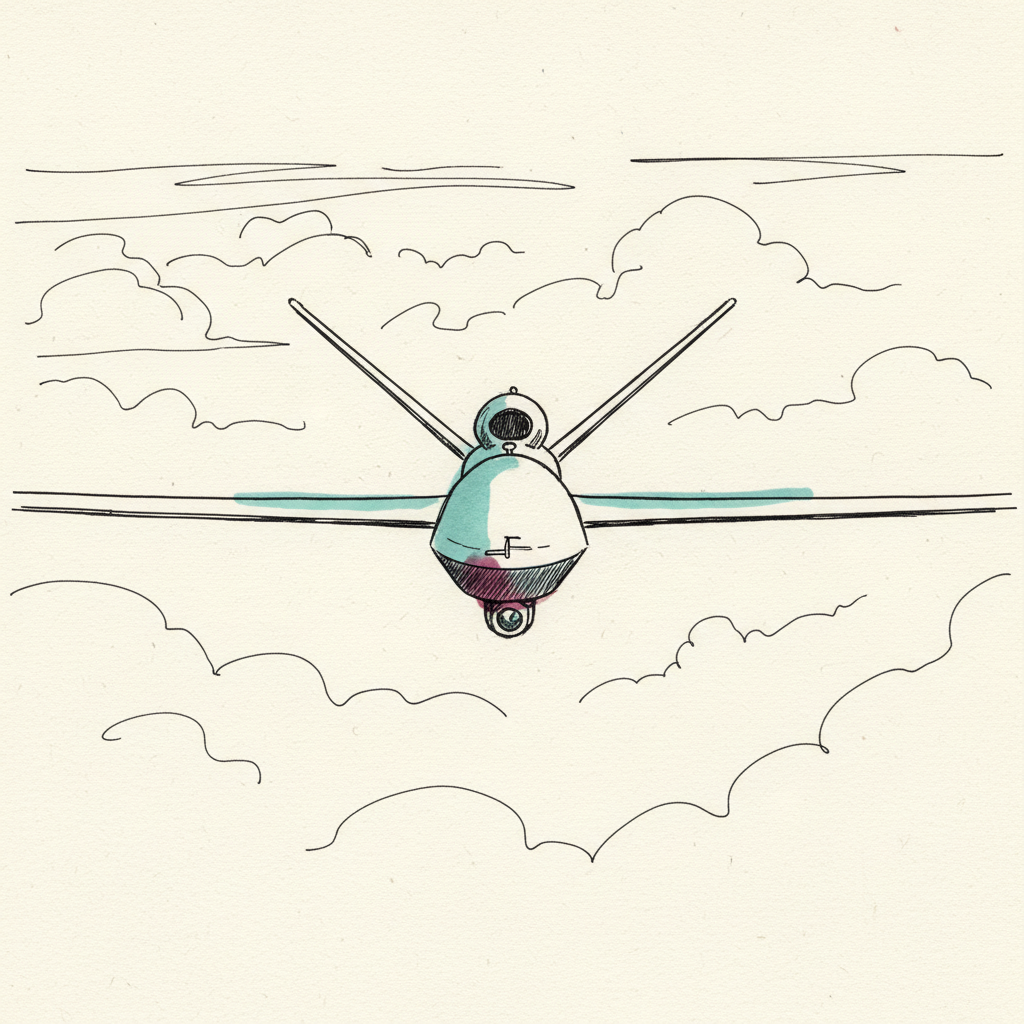
RQ-4
Northrop Grumman high-altitude long-endurance surveillance drone; Iran shot one down in June 2019.
Last refreshed: 27 May 2026 · Appears in 1 active topic
Is the 2026 IRGC RQ-4 claim a repeat of Iran's 2019 Gulf Hawk shootdown?
Timeline for RQ-4
Mentioned in: CENTCOM hits Goruk and Qeshm Island
Iran Conflict 2026IRGC claims first US aircraft kill
Iran Conflict 2026Background
The RQ-4 Global Hawk is a high-altitude long-endurance (HALE) unmanned aerial surveillance system built by Northrop Grumman. Unlike the MQ-9 Reaper it carries no weapons: the RQ-4 is a pure intelligence-gathering platform, designed to cruise at above 60,000 feet for up to 34 hours across a single mission, collecting imagery and signals intelligence across a 100,000 km² swath per day via its Integrated Sensor Suite (ISS). It entered US Air Force service in 2001 and has been operated by NATO as the Alliance Ground Surveillance system.
Unit cost is approximately $131 million, making it one of the most expensive unmanned platforms in the US inventory. Because it operates at extremely high altitude, it was originally assumed to be effectively immune to most air defence systems. That assumption was challenged on 20 June 2019, when Iran's IRGC Aerospace Force shot down an RQ-4A Global Hawk over the strait of Hormuz, claiming the aircraft had violated Iranian airspace. The US disputed the location. The incident became a significant precedent for high-altitude ISR vulnerability in The Gulf theatre.
On 26 May 2026, the IRGC claimed it fired upon a US RQ-4 surveillance aircraft operating over Iranian airspace, forcing it out of the area. The claim was made alongside assertions of shooting down an MQ-9 Reaper and engaging an F-35. CENTCOM issued no statement on the reported incident. No physical evidence was produced.
The 2026 claim echoes the 2019 precedent directly. Iran's 2019 RQ-4 shootdown (acknowledged by the US as a loss, disputed only on location) demonstrated that IRGC aerospace units can engage HALE platforms; the 2026 claim asserts that same capability remains intact more than six years later. For the US, operating an RQ-4 in range of Iranian surface-to-air missiles represents a deliberate ISR trade-off: the platform's endurance and sensor suite are irreplaceable, but its exposure over contested Gulf airspace has never been zero-risk.
What happened to the RQ-4 over Iran in June 2019?
Did Iran fire on a US RQ-4 on 26 May 2026?
What is the RQ-4 Global Hawk used for?
How does the RQ-4 Global Hawk differ from the MQ-9 Reaper?

