Skip to content
You can now search across every topic, entity and event.What's new
US Midterms 2026
6JUN

Florida locks its map for November

4 min read
12:16UTC

The Florida Supreme Court declined to touch the Republican-drawn congressional map on 10 June, and three days later the candidate qualifying deadline sealed it before any appeal could reach the merits.

PoliticsDeveloping
Key takeaway

Florida's map is now fixed for November, and its legality will be argued only after the election it governs.

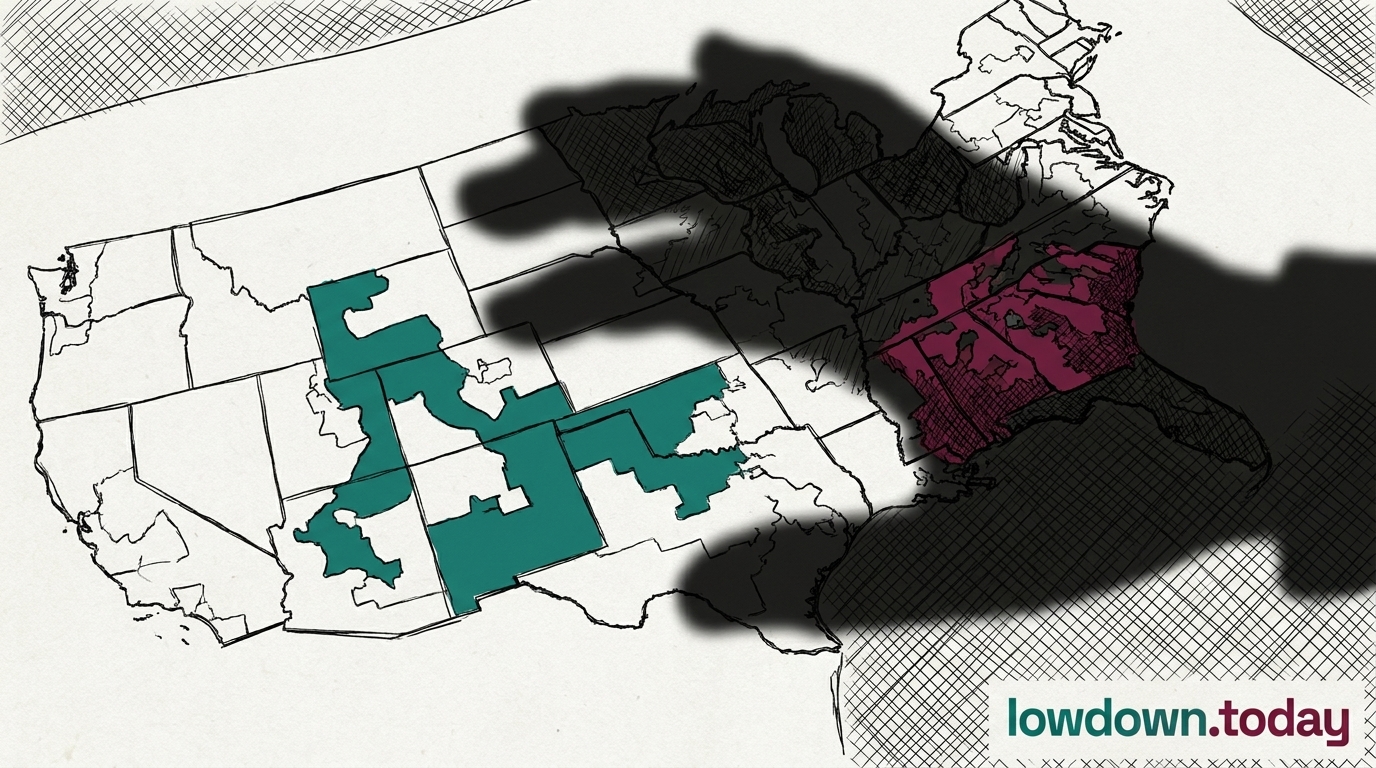
The Florida Supreme Court declined jurisdiction over the Fair Districts challenge to the state's 24R-4D congressional map on Wednesday 10 June, voting 6-1 to leave the map standing for November 1. The Fair Districts amendments are Florida's constitutional ban on partisan gerrymandering, added by voters in 2010. the Court did not rule on whether the map breaches that ban; it held that the First District Court of Appeal, an intermediate appellate court, must hear the case first.

Justice Jorge Labarga, the only one of the seven justices not appointed by Governor Ron DeSantis, dissented alone, arguing the Court had jurisdiction and that no chance to review the map before the election would now remain 2. Three days later, at noon on Saturday 13 June, the US House candidate qualifying deadline closed, fixing the field before any further appeal could be heard. Equal Ground Education Fund's challenge continues at the First District Court of Appeal, but it can no longer deliver a 2026 remedy.

The lock matters because of where the map sits in the national tally. Cook Political Report, the nonpartisan forecaster whose ratings are the industry reference, absorbed the post-Callais Louisiana and Alabama maps into its 9 June baseline: Democrats favoured in 206 seats, Republicans in 211, with 18 toss-ups 3. The 2025 Supreme Court ruling in Louisiana v. Callais removed the Voting Rights Act requirement to draw majority-Black districts , and Louisiana's legislature then erased the majority-Black seat held by Cleo Fields, flipping it from Solid Democrat to Solid Republican . If the Alabama map also survives, after the Supreme Court stayed the injunction against it on 2 June , Democrats drop to 205.

Banked seats do not decide the chamber. Cook still favours Democrats to take the House at a D+6.6 generic ballot, the average margin by which voters say they prefer a Democratic over a Republican candidate. The locked seats are settled losses no wave can reclaim, because the map holds until the next census; only the 18 toss-ups can still move in November. The harvest narrows the Democratic path without closing it.

Deep Analysis

In plain English

Every ten years, after the census, states redraw the lines of their congressional districts. Florida added seats after the 2020 census and Governor Ron DeSantis drew a new map giving Republicans 24 of the 28 seats. Opponents said this violated Florida's own constitution, which bans maps drawn to favour a political party. To stop the map being used in November, opponents needed a court to review it before the candidate sign-up deadline passed. Florida's Supreme Court said a lower court should look at it first, and the sign-up deadline then passed on 13 June. Now candidates are running on the DeSantis map in November, and the legal case continues afterwards, when it can no longer change anything for this election.

Deep Analysis
Root Causes

Florida's Fair Districts amendments (Amendments 5 and 6, passed in 2010 with over 60% of the vote) created a state constitutional check on partisan gerrymandering that operates independently of federal Voting Rights Act Section 2 requirements. After the US Supreme Court's 2023 ruling in Moore v.

Harper rejected the independent-state-legislature doctrine, that state-constitutional check became the last meaningful legal barrier against a DeSantis-drawn map. The root cause of the jurisdictional avoidance is structural: a court composed of the governor's own appointees lacked institutional incentive to rule on the merits of a challenge to the governor's own map before an election the map is designed to shape.

Florida's 8 June congressional qualifying deadline, set by statute and not subject to court modification absent an injunction, operated as a second structural lock: once that date passed with no injunction in place, the map became permanent for November regardless of any subsequent ruling. The court did not need to endorse the map; deferring past the statutory deadline achieved the same result.

What could happen next?
  • Consequence

    The 24R-4D map becomes the fixed baseline for November 2026; four previously competitive Democratic incumbents now run in districts drawn for elimination, removing them from the Democratic path to a House majority.

    Immediate · Assessed
  • Precedent

    A jurisdictional avoidance split precisely on appointment lines, combined with a statutory qualifying deadline, sets a template for insulating governor-drawn maps from pre-election constitutional review in states with similar judicial appointment structures.

    Long term · Reported
  • Risk

    If the 1st DCA eventually rules the map unconstitutional, the remedy arrives after the 2026 election cycle, making it relevant only for 2028 redistricting, which the legislature could simply re-do under the same process.

    Medium term · Reported
  • Opportunity

    The constitutional question reaching the 1st DCA before 2028 creates a potential vehicle for the Florida Supreme Court to take the case on its merits with a different political urgency, since 2030 census redistricting would be at stake.

    Long term · Suggested
First Reported In

Update #9 · Florida locks the map; the rulebook locks next

WFSU News· 14 Jun 2026
Read original
Different Perspectives
Non-US foreign-policy commentary (Jerusalem Post)
Jerusalem Post coverage frames Graham's death chiefly as a foreign-policy loss, citing his role as the Senate's most vocal advocate for Ukraine and Russia sanctions and Israel-related security votes, distinct from Washington's floor-arithmetic framing. That reporting adds that South Carolina has not elected a Democrat to the Senate since 1998, so control of the seat itself was never genuinely contested.
Election-law and voting-rights critics
Election-law critics point to South Carolina's own arithmetic: the federal 45-day overseas-ballot deadline for the 11 August primary fell on 27 June, a fortnight before Graham died, and Section 7-11-55 contains no voter-eligibility language despite grounding the June-primary voter bar. They read both as design gaps a state can exploit through inaction, not through any single deliberate violation.
South Carolina State Election Commission
Commission director Conway Belangia declared the eligibility review "completed" on 16 July, barring anyone who voted in June's Democratic primary from the 11 August Republican primary, citing only "the requirements of South Carolina election law". The commission is standing behind that ruling and its filing-to-runoff calendar without naming the statute either rests on.
Senate Democratic opposition
Senate Democrats have not cast a floor vote against the House Budget Committee's 20-14 resolution yet, but their standing objection, that documentary-proof-of-citizenship rules burden voters who lack ready access to those documents, applies directly to the $10bn grant structure it just advanced. They are counting on the Byrd Rule to do what floor votes could not.
Senate Republican leadership
Majority Leader John Thune moved within two days of Graham's death to install Ron Johnson as Budget chair, whose office says he is "prepared to serve", though no conference vote has confirmed it. Leadership pushed the FY2027 resolution through committee 20-14 on 16 July, treating the vacancy as a gap to close, not a reason to pause the SAVE Act.
Labour-market economists
Economists note June payrolls rose just 57,000, about half the forecast 115,000, with April and May revised down further. They call it the only development this week bearing directly on how incumbents can run on the economy in November.
