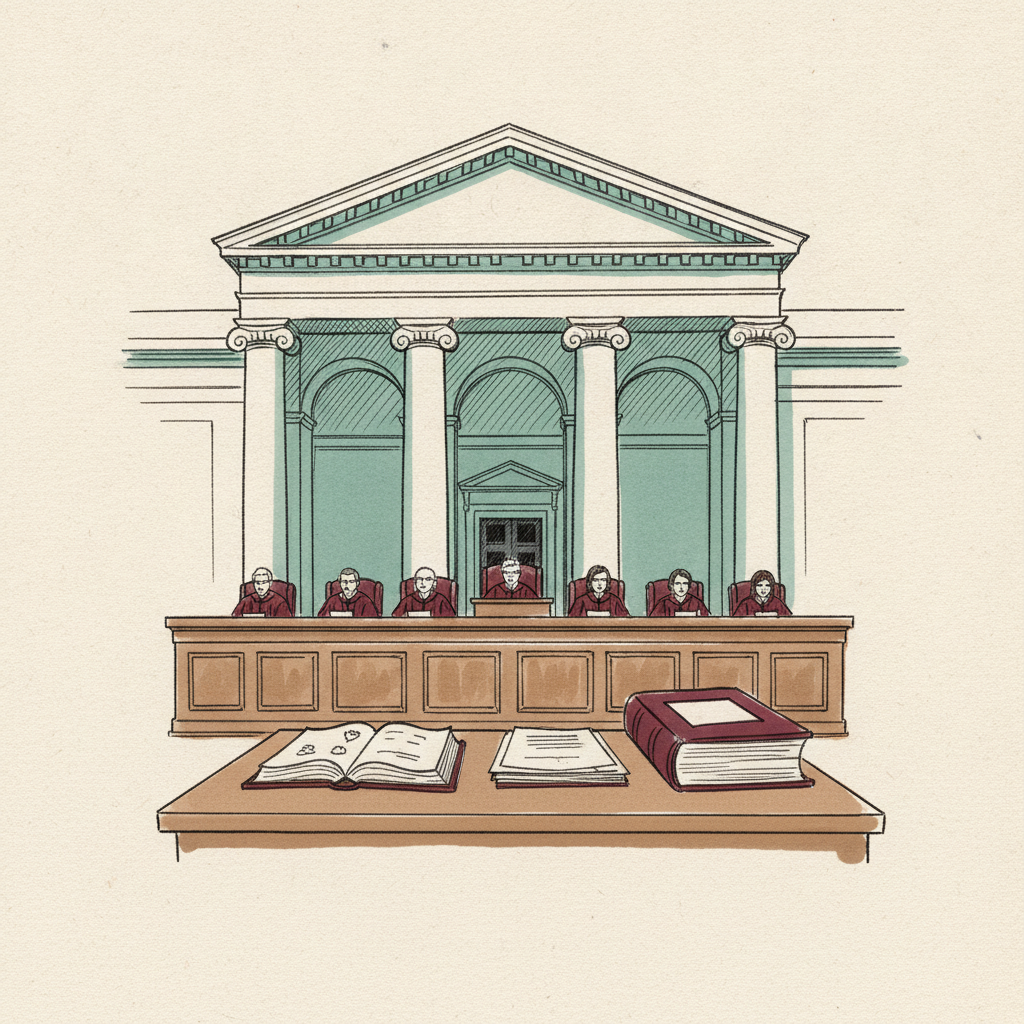
Florida Supreme Court
Florida's apex court; voted 6-1 to decline jurisdiction on the Fair Districts map challenge.
The Florida Supreme Court's six DeSantis appointees voted 6-1 on 10 June 2026 to decline jurisdiction over a challenge to the governor's own congressional map, locking it in for November three days later.
Last refreshed: 26 July 2026 · Appears in 1 active topic
Why did six DeSantis-appointed justices refuse to review the governor's own map?
Timeline for Florida Supreme Court
Mentioned in: Court finds Hoskins in civil contempt
US Midterms 2026Mentioned in: One justice ends Missouri's map appeal
US Midterms 2026Mentioned in: Sabato moves three races for governor
US Midterms 2026Voted 6-1 to decline jurisdiction over the Fair Districts challenge
US Midterms 2026: Florida locks its map for NovemberBackground
The Florida Supreme Court is the state's highest court, comprising seven justices serving six-year terms subject to merit-retention votes, with final authority over questions of Florida law that cannot be appealed to the US Supreme Court. Justices are appointed by the governor from a shortlist produced by a judicial nominating commission whose own members the governor appoints.
As of 2026, six of the seven seats are held by justices appointed by Governor Ron DeSantis, a concentration achieved through a wave of mandatory-retirement-age departures and DeSantis's appointment of Adam Tanenbaum in January 2026 as the sixth such seat. The remaining seat is held by Justice Jorge Labarga, appointed by Governor Charlie Crist in 2009.
Democracy Docket and the Brennan Center have characterised the court's approach to redistricting challenges as jurisdictional avoidance that achieves the same practical outcome as a merits ruling for the state, without the court ever having to formally endorse a map.
It declined to hear its own map
On 10 June 2026 the Florida Supreme Court voted 6-1 to decline jurisdiction over the Fair Districts challenge to the state's 24R-4D congressional map, deferring to the First District Court of Appeal rather than ruling on whether the map violates Florida's constitutional ban on partisan gerrymanders. The sole dissenter, Justice Jorge Labarga, the only non-DeSantis appointee on the bench, argued that deferring past the qualifying calendar would eliminate any chance of pre-election review.
Three days later, the 13 June candidate qualifying Deadline closed, locking the map in for November regardless of the underlying merits question, which the court never reached.