Skip to content
You can now search across every topic, entity and event.What's new
US Midterms 2026
15SEP

Florida locks its map for November

4 min read
14:21UTC

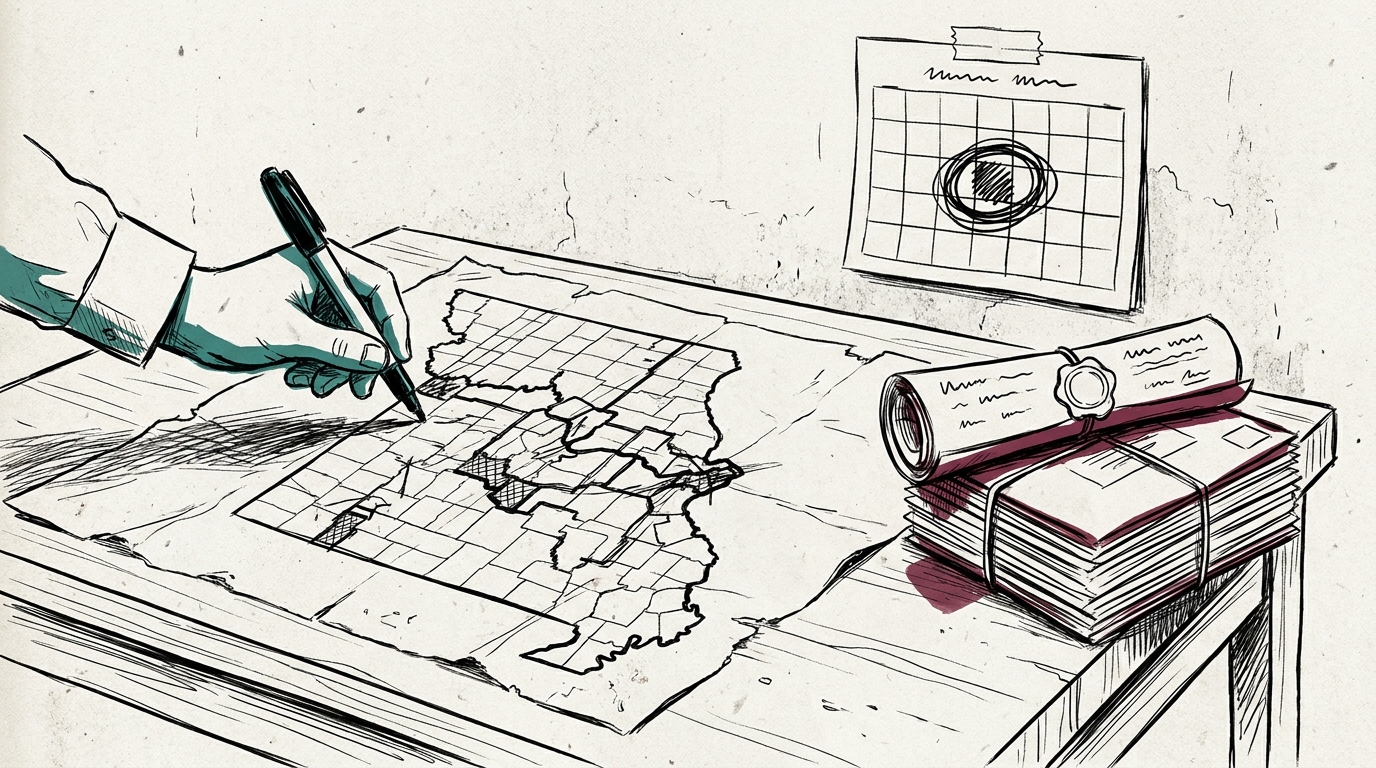
The Florida Supreme Court declined to touch the Republican-drawn congressional map on 10 June, and three days later the candidate qualifying deadline sealed it before any appeal could reach the merits.

PoliticsDeveloping
Key takeaway

Florida's map is now fixed for November, and its legality will be argued only after the election it governs.

The Florida Supreme Court declined jurisdiction over the Fair Districts challenge to the state's 24R-4D congressional map on Wednesday 10 June, voting 6-1 to leave the map standing for November 1. The Fair Districts amendments are Florida's constitutional ban on partisan gerrymandering, added by voters in 2010. the Court did not rule on whether the map breaches that ban; it held that the First District Court of Appeal, an intermediate appellate court, must hear the case first.

Justice Jorge Labarga, the only one of the seven justices not appointed by Governor Ron DeSantis, dissented alone, arguing the Court had jurisdiction and that no chance to review the map before the election would now remain 2. Three days later, at noon on Saturday 13 June, the US House candidate qualifying deadline closed, fixing the field before any further appeal could be heard. Equal Ground Education Fund's challenge continues at the First District Court of Appeal, but it can no longer deliver a 2026 remedy.

The lock matters because of where the map sits in the national tally. Cook Political Report, the nonpartisan forecaster whose ratings are the industry reference, absorbed the post-Callais Louisiana and Alabama maps into its 9 June baseline: Democrats favoured in 206 seats, Republicans in 211, with 18 toss-ups 3. The 2025 Supreme Court ruling in Louisiana v. Callais removed the Voting Rights Act requirement to draw majority-Black districts , and Louisiana's legislature then erased the majority-Black seat held by Cleo Fields, flipping it from Solid Democrat to Solid Republican . If the Alabama map also survives, after the Supreme Court stayed the injunction against it on 2 June , Democrats drop to 205.

Banked seats do not decide the chamber. Cook still favours Democrats to take the House at a D+6.6 generic ballot, the average margin by which voters say they prefer a Democratic over a Republican candidate. The locked seats are settled losses no wave can reclaim, because the map holds until the next census; only the 18 toss-ups can still move in November. The harvest narrows the Democratic path without closing it.

Deep Analysis

In plain English

Every ten years, after the census, states redraw the lines of their congressional districts. Florida added seats after the 2020 census and Governor Ron DeSantis drew a new map giving Republicans 24 of the 28 seats. Opponents said this violated Florida's own constitution, which bans maps drawn to favour a political party. To stop the map being used in November, opponents needed a court to review it before the candidate sign-up deadline passed. Florida's Supreme Court said a lower court should look at it first, and the sign-up deadline then passed on 13 June. Now candidates are running on the DeSantis map in November, and the legal case continues afterwards, when it can no longer change anything for this election.

Deep Analysis
Root Causes

Florida's Fair Districts amendments (Amendments 5 and 6, passed in 2010 with over 60% of the vote) created a state constitutional check on partisan gerrymandering that operates independently of federal Voting Rights Act Section 2 requirements. After the US Supreme Court's 2023 ruling in Moore v.

Harper rejected the independent-state-legislature doctrine, that state-constitutional check became the last meaningful legal barrier against a DeSantis-drawn map. The root cause of the jurisdictional avoidance is structural: a court composed of the governor's own appointees lacked institutional incentive to rule on the merits of a challenge to the governor's own map before an election the map is designed to shape.

Florida's 8 June congressional qualifying deadline, set by statute and not subject to court modification absent an injunction, operated as a second structural lock: once that date passed with no injunction in place, the map became permanent for November regardless of any subsequent ruling. The court did not need to endorse the map; deferring past the statutory deadline achieved the same result.

What could happen next?
  • Consequence

    The 24R-4D map becomes the fixed baseline for November 2026; four previously competitive Democratic incumbents now run in districts drawn for elimination, removing them from the Democratic path to a House majority.

    Immediate · Assessed
  • Precedent

    A jurisdictional avoidance split precisely on appointment lines, combined with a statutory qualifying deadline, sets a template for insulating governor-drawn maps from pre-election constitutional review in states with similar judicial appointment structures.

    Long term · Reported
  • Risk

    If the 1st DCA eventually rules the map unconstitutional, the remedy arrives after the 2026 election cycle, making it relevant only for 2028 redistricting, which the legislature could simply re-do under the same process.

    Medium term · Reported
  • Opportunity

    The constitutional question reaching the 1st DCA before 2028 creates a potential vehicle for the Florida Supreme Court to take the case on its merits with a different political urgency, since 2030 census redistricting would be at stake.

    Long term · Suggested
First Reported In

Update #9 · Florida locks the map; the rulebook locks next

WFSU News· 14 Jun 2026
Read original
Different Perspectives
Cook Political Report
Cook Political Report published a dated House ratings snapshot on 11 September and changed no seat's rating, holding at 206 Democratic to 208 Republican with 21 tossups since its 3 September batch. Publishing without a change is a dated decision, not an oversight, leaving Republicans ahead on seats while Democrats lead the national vote by 6.6 points.
Department of Justice
A Justice Department official told the Las Vegas Review-Journal that preservation letters like the one sent to Aguilar go to states the department is in active litigation against over incomplete voter registration lists. The department would not answer the paper's specific questions about the personal investigation notice riding inside the same letter.
Francisco Aguilar
Francisco Aguilar
Nevada Secretary of State Francisco Aguilar publicly rejected Justice Department pressure on 12 September, days after a 4 September letter combined a records-preservation demand with a personal notice that he is under investigation. He said he will not fold until a judge orders him to, making his office's compliance a political stand rather than a routine filing.
Brett Kavanaugh
Brett Kavanaugh
Justice Brett Kavanaugh denied Missouri's state-track stay application alone on 8 September without referring it, then sent the separate federal-track application in Onder v. State of Missouri to the full Court, which stayed it on 10 September. His choice of which application to keep and which to share decided how much of the fight one justice controlled.
Robert Onder and the federal plaintiffs
Robert Onder and three other Republican plaintiffs won a temporary restraining order from Chief Judge Stephen R. Clark on 8 September ordering Missouri to use HB 1, then lost it when the Supreme Court stayed it on 10 September. Their federal route ran parallel to Hoskins's own reversal and ended the same way, with the 2022 map governing 3 November.
Richard Von Glahn and People Not Politicians
Richard Von Glahn and People Not Politicians won Von Glahn v. Hoskins on 3 September, persuading the Missouri Supreme Court that their referendum petition stripped HB 1 of effect and sent it to voters as Proposition A. The contempt finding against Hoskins this week confirms their win held even after the state's chief election officer tried to reverse it.