Skip to content
You can now search across every topic, entity and event.What's new
US Midterms 2026
15SEP

Shadow docket shields Alabama map for 2026

3 min read
14:21UTC

The Supreme Court let Alabama keep its contested 2023 congressional map on Tuesday 2 June, reversing a week-old district-court block in seven days through an unsigned 6-3 emergency order.

PoliticsAssessed
Key takeaway

The conservative majority reversed Alabama's map block in seven days, faster than any filing deadline.

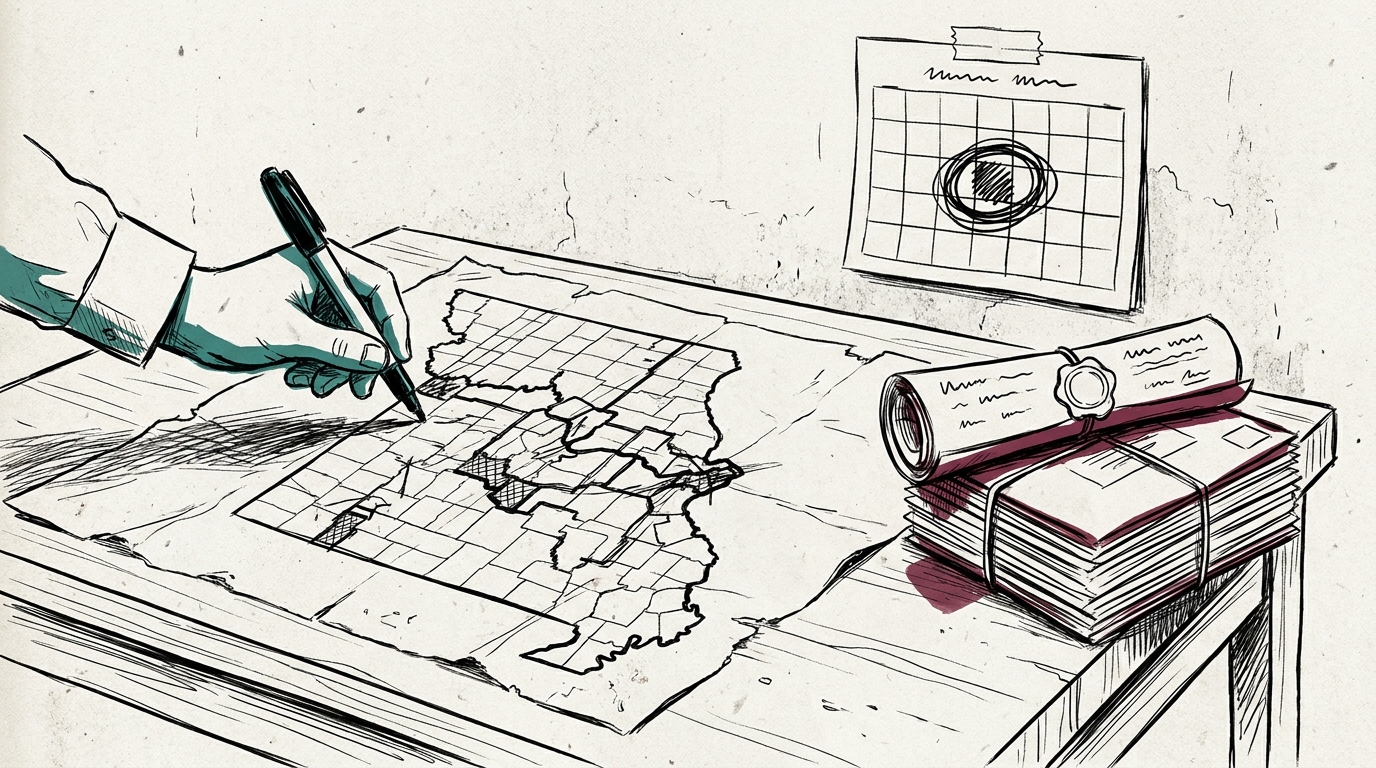
On the evening of Tuesday 2 June, the Supreme Court let Alabama keep its 2023 congressional map for the 2026 elections, throwing out a district-court order that had blocked it only a week earlier 1. The unsigned 6-3 order came through the Court's shadow docket, the channel for emergency rulings decided without oral argument and usually without a signature. Alabama now runs its 11 August primary re-do under the contested lines. Justices Sonia Sotomayor, Elena Kagan and Ketanji Brown Jackson dissented.

The district court had blocked the map on Tuesday 26 May, finding it diluted Black voting strength under the Voting Rights Act, the 1965 federal law whose Section 2 bars rules that deny minority voters an equal chance to elect their candidates. Seven days later the conservative majority stayed that block, writing that the lower court had "interposed itself into Alabama's ongoing efforts to conduct its imminent 2026 congressional elections." The order binds Alabama's calendar while leaving the underlying law formally open.

The mechanism matters more than the single result. On 19 May the same majority vacated an order requiring Alabama to draw a majority-Black district, and Governor Kay Ivey voided the in-progress primary . Read together, the two interventions describe a template: a district court enjoins a map, the majority reverses within days, and the injunction expires before it can touch a filing deadline. The reversal window is now shorter than any state's calendar, which makes a trial-court win functionally moot for 2026.

The practical effect reframes maps already locked elsewhere. The 2 June stay enforces Louisiana v. Callais , the 29 April ruling that Section 2 no longer compels majority-minority districts, with immediate effect ordered on 5 May . Florida's Republican-drawn map, upheld on 26 May , is not merely fixed by a passed deadline; it is being defended on appeal by an emergency docket that answers faster than any trial court can move. Two interventions in a fortnight are a pattern to watch, not yet settled doctrine, and the dissenters have logged the counter-case that these rulings carry no reasoning a future court must follow.

Deep Analysis

In plain English

The US Supreme Court has a regular docket where cases get full written arguments and explanations, and an emergency docket (called the 'shadow docket') where a small group of justices can grant or deny urgent requests quickly, often without explaining why. Alabama had to redraw its election districts for Congress after the Supreme Court ruled in April 2026 that states no longer have to create districts where Black voters form a majority. A district-court judge in Alabama ruled on 26 May 2026 that the new map was suspect and blocked it from taking effect. But the Supreme Court stepped in after just seven days and overruled that block, allowing Alabama to hold its 11 August primary under the new map. The practical effect is that Alabama's congressional election will proceed under lines drawn by the Republican-controlled legislature, without any court having fully examined whether the new map is legal. If the courts later rule the map was wrong, the election will already be over.

Deep Analysis
Root Causes

The Alabama stay rests on a structural gap in federal redistricting enforcement: district courts can issue injunctions, but the Supreme Court's emergency docket operates on a 72-hour briefing cycle with no opinion requirement, creating an asymmetry where a lower-court order requiring map revision can be neutralised before the legislature can comply.

The deeper cause is the Callais immediate-effect order of 5 May 2026, which bypassed the standard 32-day remand wait and forced state calendars to move before any appellate review could occur. Alabama's district court tried to reassert its authority on 26 May; the conservative majority used the shadow docket to extinguish that reassertion in seven days, completing what the immediate-effect order began.

What could happen next?
  • Precedent

    Four unsigned emergency redistricting stays across one cycle normalises shadow-docket map-locking as de facto doctrine, reducing district courts to an advisory role in redistricting challenges.

    Long term · Assessed
  • Consequence

    Alabama's 11 August primary proceeds under the 2023 map, seating whoever wins with no post-election remedy available if a future ruling finds the map unlawful.

    Short term · Assessed
  • Risk

    The two-intervention template (vacatur plus stay) may be replicated in other post-Callais map challenges, further shortening the effective window for district-court injunctive relief.

    Medium term · Reported
First Reported In

Update #8 · Shadow docket shields maps

Roll Call· 6 Jun 2026
Read original
Different Perspectives
Cook Political Report
Cook Political Report published a dated House ratings snapshot on 11 September and changed no seat's rating, holding at 206 Democratic to 208 Republican with 21 tossups since its 3 September batch. Publishing without a change is a dated decision, not an oversight, leaving Republicans ahead on seats while Democrats lead the national vote by 6.6 points.
Department of Justice
A Justice Department official told the Las Vegas Review-Journal that preservation letters like the one sent to Aguilar go to states the department is in active litigation against over incomplete voter registration lists. The department would not answer the paper's specific questions about the personal investigation notice riding inside the same letter.
Francisco Aguilar
Francisco Aguilar
Nevada Secretary of State Francisco Aguilar publicly rejected Justice Department pressure on 12 September, days after a 4 September letter combined a records-preservation demand with a personal notice that he is under investigation. He said he will not fold until a judge orders him to, making his office's compliance a political stand rather than a routine filing.
Brett Kavanaugh
Brett Kavanaugh
Justice Brett Kavanaugh denied Missouri's state-track stay application alone on 8 September without referring it, then sent the separate federal-track application in Onder v. State of Missouri to the full Court, which stayed it on 10 September. His choice of which application to keep and which to share decided how much of the fight one justice controlled.
Robert Onder and the federal plaintiffs
Robert Onder and three other Republican plaintiffs won a temporary restraining order from Chief Judge Stephen R. Clark on 8 September ordering Missouri to use HB 1, then lost it when the Supreme Court stayed it on 10 September. Their federal route ran parallel to Hoskins's own reversal and ended the same way, with the 2022 map governing 3 November.
Richard Von Glahn and People Not Politicians
Richard Von Glahn and People Not Politicians won Von Glahn v. Hoskins on 3 September, persuading the Missouri Supreme Court that their referendum petition stripped HB 1 of effect and sent it to voters as Proposition A. The contempt finding against Hoskins this week confirms their win held even after the state's chief election officer tried to reverse it.