Skip to content
You can now search across every topic, entity and event.What's new
Russia-Ukraine War 2026
18MAR

Ukrainian drone crews deploy in Gulf

3 min read
11:41UTC

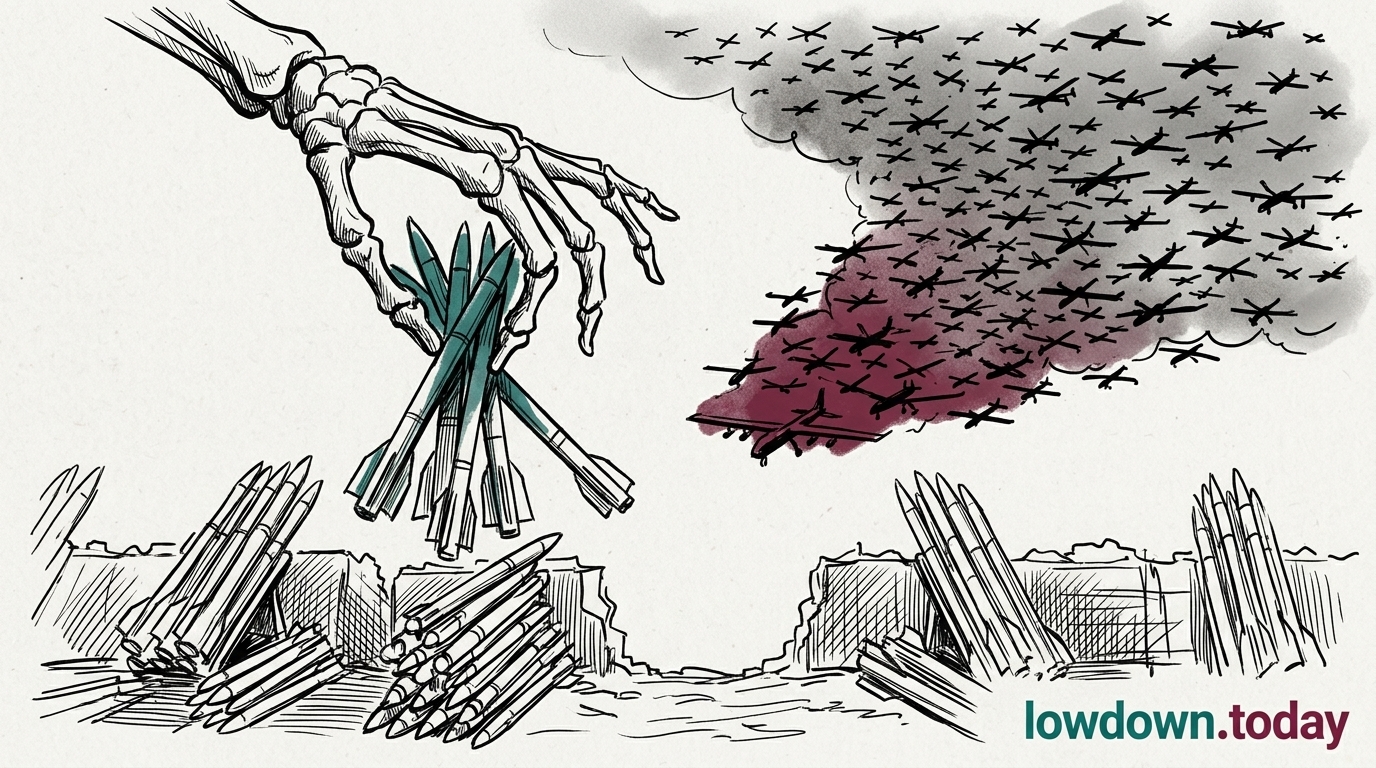
The country that spent three years asking for Patriot batteries is now running counter-drone operations across four Gulf states — against the same drones Russia fires at its own cities.

ConflictDeveloping
Key takeaway

Ukraine's crews are now the world's only battle-hardened counter-Shahed specialists, making their deployment a strategic commodity.

Ukrainian counter-drone crews are now operating in Qatar, Saudi Arabia, the UAE, and at a US military base in Jordan 1. They are intercepting the same Shahed-pattern drones that Russia fires at Ukrainian cities nightly — now launched by Iran at Gulf targets with the aid of Russian satellite intelligence 2.

The timeline compressed fast. On 2 March, Ukraine offered counter-drone expertise to non-NATO states . On 5 March, Trump publicly asked Zelenskyy for help . On 7 March, Zelenskyy called Saudi Crown Prince Mohammed bin Salman directly . By 9 March, Ukrainian personnel were in theatre across four countries. A capability built through three years of defending against nightly Shahed barrages — learning radar signatures, interception angles, electronic warfare countermeasures — became exportable the moment the same drones appeared over Riyadh and Abu Dhabi.

The Foundation for Defense of Democracies reported on 12 March that Russia provides Iran with satellite imagery detailed enough to guide strikes on US command posts and radar sites 3. The FDD is a hawkish advocacy institution and its specific target characterisations should be read accordingly. But the core claim — Russian intelligence support to Iranian targeting — is corroborated by Al Jazeera and Kyiv Independent 4 5. Ukrainian crews are defending installations that Russian satellites help Iran locate. Moscow's partnership with Tehran and its war against Kyiv have converged in the same airspace over the Arabian Peninsula.

A country that watched more Patriot interceptors expended in three days of the Iran war than it received in three years now provides the air defence that Gulf States and the US military need. That operational dependency did not exist a month ago.

Deep Analysis

In plain English

Ukraine's soldiers have spent three years being targeted by Russian-designed drones every night. No other military on Earth has accumulated comparable real combat experience stopping these specific weapons. Gulf states, suddenly facing the same drones, are hiring those crews to defend their oil facilities and military bases. It is the equivalent of a city that survived years of flooding hiring its engineers to build flood defences for wealthier neighbours — while the floods continue at home.

Deep Analysis
Synthesis

Ukraine is monetising its suffering. Three years of forced experimentation under fire produced tactical expertise no training exercise can replicate. That expertise is now a geopolitical currency, enabling Ukraine to build security relationships with wealthy states that can provide financial resources outside Western aid channels.

The deployment transforms Ukraine from aid recipient to security provider — a status shift with significant implications for any future peace negotiation.

Root Causes

Western air defence architecture was designed during the Cold War for peer-state ballistic missiles, not saturation attacks by cheap commercial-component drones. The PAC-3 MSE was never intended to be fired at $200 Shaheds. This structural mismatch — doctrine written for a different threat category — left Gulf states without a cost-viable response when the actual threat materialised.

Escalation

The deployment creates an undeclared three-way confrontation: Russian intelligence guides Iranian drones, Ukrainian crews intercept them on Gulf soil. Neither Moscow nor Kyiv has formally acknowledged this dynamic. A Ukrainian crew casualty in the Gulf — or a successful Russian intelligence operation that defeats a Ukrainian-defended position — could force public acknowledgement of a conflict that currently has no diplomatic framework to manage it.

What could happen next?
  • Precedent

    An active combatant nation deploying operational military crews abroad while under mass bombardment establishes a new template for wartime power projection by smaller states.

    Long term · Assessed
  • Risk

    If a Ukrainian crew is killed or captured in the Gulf, the undeclared Russia–Ukraine proxy confrontation on Gulf soil becomes impossible to manage without a public diplomatic framework.

    Short term · Suggested
  • Opportunity

    Gulf security relationships built on Ukrainian counter-drone expertise could yield financial and diplomatic support that reduces Kyiv's dependence on Western political cycles and appropriation processes.

    Medium term · Suggested
  • Consequence

    Russia must now weigh whether sharing satellite intelligence with Iran is worth accelerating and deepening Ukraine's strategic partnerships with wealthy Gulf states.

    Short term · Assessed
First Reported In

Update #4 · Ukraine pivots to drone exporter

Al Jazeera· 15 Mar 2026
Read original
Different Perspectives
Belarus
Belarus
Minsk announced completion of its own 37th Separate Airborne Assault Brigade near Gomel, under plans dating to August 2025 rather than a response to any single frontline event this window, keeping its hedge of hosting the war without formally joining Russia's mobilisation drive.
European Union / Operation IRINI states
Italy, Greece and Poland boarded the sanctioned tanker Toa Payoh off Pantelleria under a standing EU mandate rather than a national decision, extending enforcement from the Channel and Baltic and the Black Sea and Azov into the Mediterranean. Italian Defence Minister Guido Crosetto praised the crew; the captain's refusal to produce documentation left detention unconfirmed.
Poland and the NATO eastern flank
Warsaw's Coordination Team said explicitly its forces tracked the 30 July missile incursion and were ready to shoot it down, then flew air cover for an EU tanker interdiction three days later. Poland is simultaneously the war's nearest spillover victim and a contributor to enforcing sanctions against the state causing that spillover.
Ukraine (government, defence establishment and civilians)
Kyiv runs its manpower crisis through acting Defence Minister Yevhen Khmara, whose formal appointment waits for parliament's 18 August return, and a fortnight-old Commander-in-Chief, Mykhailo Drapatyi. Reported attacks on enlistment officers rose from 5 cases in 2022 to 341 in 2025, reaching Odesa's Territorial Recruitment Centre staff directly on 2 August.
Kremlin and Russian domestic economic voices
Moscow has not addressed July's advance-rate collapse or Sberbank's OFZ warning; Novak's diary ran to OPEC+ quota diplomacy with no diesel item logged since 15 July. Economist Nikolai Korzhenevsky calls the Central Bank's RUB 2.3tn in bank lending effectively deficit monetisation, a framing Sberbank's Skvortsov, with his own institutional interest, has not disputed.
IAEA (Rafael Grossi)
IAEA inspectors logged Zaporizhzhia's 22nd loss of off-site power, ten of them in the last three months, after a thunderstorm knocked out the plant's sole surviving backup line. Grossi reads the accelerating frequency, not any single outage, as the safety signal now that the plant's redundancy is exhausted.
