Skip to content
Briefings are running a touch slower this week while we rebuild the foundations.See roadmap
Russia-Ukraine War 2026
18MAR

Spring mud cuts engagements to 106

3 min read
11:41UTC

Combat engagements fell to 106 from 145 in two days — mud season, not restraint — as Russia presses three axes toward Kramatorsk and Sloviansk.

ConflictDeveloping
Key takeaway

Spring thaw creates a reconstitution window; summer operations will reveal which side used it better.

106 combat engagements along the front line on 4 March, down from 145 on 2 March 1. The drop coincides with rasputitsa — the seasonal thaw that turns Ukraine's black earth into vehicle-swallowing mud. The pattern is consistent with reduced mechanised mobility, not reduced intent: infantry-led assaults continued across all active sectors.

The heaviest pressure fell on three axes. At Pokrovsk, which fell to Russian forces in December 2025 , attacks targeted Ukrainian positions west of Krasnoarmeysk — the next step in exploiting the city as a forward logistics platform. At Kostiantynivka, nine separate Russian assault actions hit Pleshchiivka, Sofiivka, and the approaches to Illinivka. These settlements sit on the routes to Kramatorsk and Sloviansk, the twin cities anchoring Ukraine's eastern defence; their encirclement has been Russia's stated operational objective for over a year. At Huliaipole, Russian forces pressed the Zaporizhzhia axis — the same sector where Commander-in-Chief Syrskyi reported Ukrainian forces recaptured 300–400 square kilometres during February .

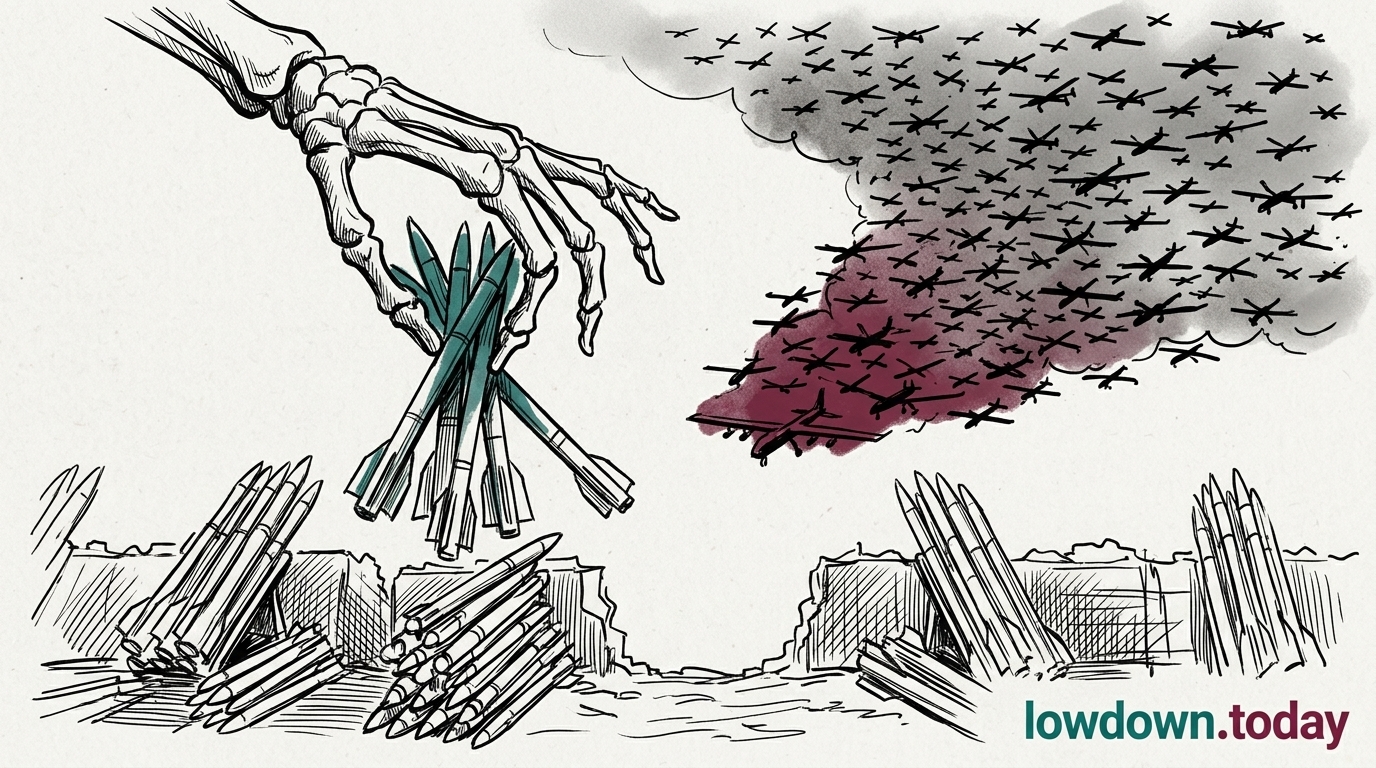
Rasputitsa has constrained operations in this theatre for centuries; what changes is how armies compensate. The 8,828 Russian kamikaze drones launched in a single 24-hour period days earlier — roughly triple the 2025 daily average — suggest Moscow is substituting aerial volume for ground mobility. Drones are unaffected by mud, cheaper per sortie than artillery, and impose constant attrition on Ukrainian positions regardless of whether Russian armour can move. The operational tempo on 4 March was lower. The war of attrition was not.

Deep Analysis

In plain English

The 106 clashes on 4 March is down from 145 two days earlier — but this does not mean the war is cooling. Ukraine's terrain turns to deep mud in spring, making it physically impossible to move tanks and armoured vehicles cross-country. Both sides are still fighting; they simply cannot mass forces for large-scale pushes. The hardest fighting is concentrated on three fronts: near Pokrovsk (which Russia captured in December), near Kostiantynivka in central Donetsk, and at Huliaipole in the south. The Kostiantynivka axis is the most strategically consequential — Russian advances there would place direct pressure on Kramatorsk and Sloviansk, Ukraine's main administrative and logistics hub for the entire Donetsk front. Losing that urban complex would be more operationally damaging than Pokrovsk's fall.

Deep Analysis
Synthesis

Simultaneous Russian pressure on three geographically dispersed axes — Pokrovsk, Kostiantynivka, Huliaipole — reflects a classical economy-of-force attritional design rather than opportunistic advance. Maintaining pressure across all three vectors forces Ukraine to distribute reserves, preventing defensive concentration on any single threatened point. The operational goal is reserve depletion and positional degradation, not rapid breakthrough — consistent with Russian doctrinal preference for attrition over manoeuvre at this phase of the conflict.

Escalation

The engagement reduction is mechanistic, not political. Russian intent on all three axes is unchanged. The Kostiantynivka axis carries the highest strategic consequence: capture would position Russian forces for direct pressure on Kramatorsk-Sloviansk, Ukraine's primary Donetsk administrative and logistics hub. Loss of that complex would be operationally more severe than Pokrovsk's fall in December.

What could happen next?
  • Consequence

    Reduced spring engagement tempo creates a narrow reconstitution window for both sides before ground hardens and summer operational tempo resumes.

    Immediate · Assessed
  • Risk

    Russian success on the Kostiantynivka axis would bring direct pressure on Kramatorsk-Sloviansk, Ukraine's primary Donetsk logistics and administrative hub — operationally more consequential than Pokrovsk.

    Short term · Assessed
  • Meaning

    Three-axis simultaneous pressure indicates Russian force generation capacity remains sufficient for multi-vector attritional operations despite cumulative losses since 2022.

    Medium term · Assessed
First Reported In

Update #2 · Shadow fleet tanker sunk, talks seek venue

Russia Matters· 5 Mar 2026
Read original
Causes and effects
This Event
Spring mud cuts engagements to 106
Russia's offensive tempo toward Kramatorsk and Sloviansk continues across three axes despite seasonal constraints that have historically halted mechanised operations. The shift to infantry-led assault and intensified drone use suggests operational adaptation, not pause.
Different Perspectives
North Korea / DPRK
North Korea / DPRK
ISW confirmed the first mounting of DPRK Type-75 MLRS on Russian autonomous UGVs near Kharkiv on 7 June, the latest step in a supply axis that escalated from shells in 2023 to troops in 2024. Pyongyang gains live battlefield data on its ordnance and on Russia's uncrewed-systems programme.
IAEA / Rafael Grossi
Grossi confirmed Chornobyl structural damage with nuclear material metres away and could not attribute the ZNPP 15-hour blackout during the agreed repair window. Six ceasefires brokered and broken at ZNPP, compounded by Rosatom's May attack on IAEA neutrality, have eroded his ability to enforce the windows he negotiates.
Emmanuel Macron / France
Macron co-signed the E3 framework whose line-of-contact baseline marks Europe's first formal acceptance that 1991 borders are not the opening position. France's role carries weight because Macron had previously proposed a European force for Ukraine, and the framework's multinational force point is the vehicle for that.
Keir Starmer / E3
Keir Starmer / E3
Starmer, Macron and Merz met Zelenskyy on 7 June and backed a five-point framework taking the line of contact as the talks baseline, conceding roughly one fifth of Ukraine in exchange for a multinational force and frozen assets. With US mediation ended, the NATO Ankara summit on 7-8 July is the next test.
Vladimir Putin / Kremlin
Putin used SPIEF to reject Zelenskyy's summit letter, citing 'elements of rudeness', and repeated the pre-agreed treaty precondition that has frozen every diplomatic round since May. The SPIEF platform's message of investor confidence was punctured by naval fires visible from St Petersburg, which Moscow declined to dispute in scale.
Ukraine / Unmanned Systems Forces
Commander Brovdi confirmed USF units tracked and set fire to Boikyi at Kronstadt, while Code 9.2 struck the Chonhar Bridge the following day. Ukraine is sequencing strikes for rear-area interdiction and political timing rather than ground gains, trading the Baltic Fleet's home base for the logistics squeeze Russia cannot absorb without rationing its own occupied territory.
