Skip to content
You can now search across every topic, entity and event.What's new
Russia-Ukraine War 2026
13JUL

Wang Yi warns against Iran regime change

3 min read
10:28UTC

China's foreign minister responded within hours to Netanyahu's regime change declaration — while negotiating exclusive passage through the Strait of Hormuz.

ConflictDeveloping
Key takeaway

By invoking SCO 'colour revolution' language, China is framing Iranian sovereignty as an alliance obligation rather than a preference, while simultaneously positioning itself as the last major economy with functional Gulf energy access — the two manoeuvres are a single integrated strategy, not parallel policies.

Chinese Foreign Minister Wang Yi used his annual National People's Congress press conference on Sunday to deliver Beijing's most direct public intervention in the conflict. "Plotting colour revolution or seeking Regime change will find no popular support. The people in the Middle East are the true master of the region." He called for an "immediate stop to military operations" and stated the sovereignty of Iran and all countries must be respected.

The statement arrived within 12 hours of Prime Minister Netanyahu's Saturday declaration that Israel has "an organised plan to destabilise the regime" — fast by the standards of Chinese diplomacy, which typically delays public responses to assess outcomes before committing. Wang defended the principle of state sovereignty, not the IRGC or President Pezeshkian personally. Beijing is positioning itself as the external guarantor of Iran's statehood while maintaining distance from the conduct of the war.

The diplomatic statement is inseparable from the commercial negotiation. Reuters reported on Saturday that China is in direct formal talks with Iran for exclusive safe passage through the Strait of Hormuz — a deal that would give Chinese-linked vessels access to roughly 60% of Gulf oil exports while Western-bound crude remains blocked . Wang's defence of Iranian sovereignty and his demand for a ceasefire serve the same interest: a stable Iranian state that honours its commercial commitments to Beijing. A collapsed or replaced government in Tehran would void whatever transit arrangements China is building.

Wang's press conference also fell ahead of a tentatively scheduled Trump-Xi summit in late March. The Iran crisis is now the defining issue for that meeting. Beijing holds simultaneous leverage as Iran's potential commercial lifeline and its diplomatic shield — a dual position it has constructed in nine days of war, and one that gives Xi bargaining weight whether the summit produces confrontation or accommodation.


Deep Analysis

In plain English

China's top diplomat used language normally reserved for describing Western attempts to topple governments in former Soviet states — calling Israel's regime-change plans a 'colour revolution.' This is precise, pre-loaded phrasing from a specific alliance framework China uses to defend political systems from outside interference, including its own. China is also separately negotiating to keep its oil tankers moving through the Strait of Hormuz while other countries' tankers cannot get through. Beijing has both an ideological and an immediate financial reason to keep Iran's current government intact, and Sunday's statement serves both simultaneously.

Deep Analysis
Synthesis

Wang Yi's statement and the Hormuz passage negotiation are not parallel policies — they are a single strategy: China is using the role of diplomatic shield as the political justification for preferential commercial access, ensuring that the last major economy with functional Gulf energy supply is also the one that protected Iran's government. The two are structurally inseparable.

Escalation

The 12-hour response time — approximately a quarter of China's typical 48–72 hour diplomatic cycle for major conflict statements — implies pre-prepared messaging, indicating Beijing anticipated Netanyahu's regime-change declaration. This suggests Chinese intelligence awareness of Israeli planning, which may prompt Israeli operational security adjustments that constrain future diplomatic signalling between Jerusalem and Beijing.

What could happen next?
  • Consequence

    Iran becomes the primary agenda item at the anticipated Trump-Xi summit in late March, transforming a trade-focused meeting into a geopolitical bargaining session where Iranian policy may be traded against tariff relief or Taiwan commitments.

    Short term · Assessed
  • Meaning

    SCO language in Wang Yi's statement treats Iran's sovereignty as an alliance obligation, raising the diplomatic price of military escalation against Iran beyond bilateral US-China relations to the broader SCO membership bloc.

    Immediate · Assessed
  • Risk

    If China succeeds in formalising preferential Hormuz passage rights, it establishes a precedent for claiming similar access at other contested chokepoints — Malacca Strait, Taiwan Strait — under the same commercial-protection logic.

    Long term · Suggested
  • Consequence

    The destruction of China's 2023 rapprochement investment by Iran's own attacks on Arab states creates a credibility problem for Beijing's 'responsible broker' self-image in the Global South, complicating its ability to position itself as a neutral mediator in future conflicts.

    Medium term · Suggested
First Reported In

Update #29 · New leader kept secret; Bahrain water hit

MFA PRC· 8 Mar 2026
Read original
Different Perspectives
Turkey
Turkey
Turkey, a major buyer of Russian diesel cargoes, loses that access under Moscow's first producer-binding export ban, in force from 8 July to 31 July. Ankara hosted the same week's NATO summit pledging EUR 70bn to Ukraine, sitting on both sides of the fuel-and-alliance ledger.
NATO
NATO
NATO leaders meeting in Ankara on 7 and 8 July pledged EUR 70bn in equipment, assistance and training for Ukraine across 2026, with a 2027 sustainment commitment and a $40bn Drone Edge counter-drone initiative. European allies now fund the vast majority of that package, filling the gap left by Washington's idled crude waiver.
India
India
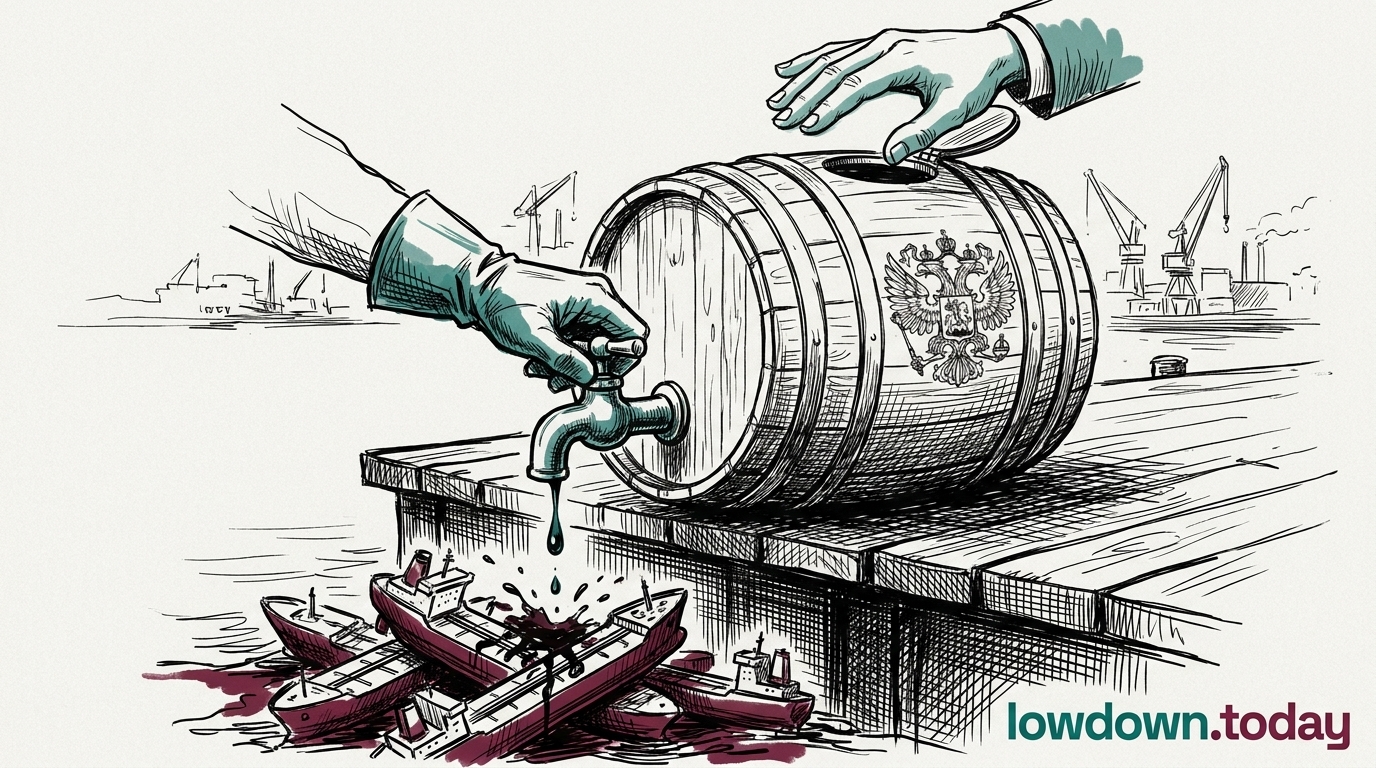
India's state refiners continued buying discounted Urals crude as June's price fell to $63.18 a barrel, insulating New Delhi from the OFAC waiver gap still constraining Western buyers. Indian refiners could pick up diesel-export share as Russia's producer-binding ban shuts out its former customers.
China
China
China's independent refiners kept importing discounted Urals crude through June as the price fell to $63.18 a barrel, down 26% month-on-month per CREA. Beijing has said nothing on Moscow's new diesel ban, leaving Chinese refiners a likely beneficiary if Turkish and Brazilian buyers seek replacement cargoes.
United States
United States
No successor licence has been issued since General License 134C lapsed on 17 June, leaving a 26-day gap, the longest of the war, in the Russian crude waiver. Washington's silence is tightening the channel without any stated decision, as Treasury weighs whether to let it die.
Ukraine
Ukraine
Ukraine's long-range strike campaign shifted from refineries to seaborne fuel tankers crossing the Sea of Azov, cutting tracked vessel traffic 55% between 30 June and 11 July, per Starboard Maritime Intelligence. The shift targets Russia's export revenue directly rather than just domestic supply, adding pressure alongside the collapsing Urals price.



