Skip to content
You can now search across every topic, entity and event.What's new
Russia-Ukraine War 2026
16JUN

Refineries hit 16-year low; drones flip

4 min read
10:25UTC

Russian refinery throughput fell to 4.69 mbpd, the lowest since December 2009; on 2-3 May Ukraine launched 334 drones into Russia against Russia's 268, the first verified overnight reversal of the daily exchange ratio.

ConflictDeveloping
Key takeaway

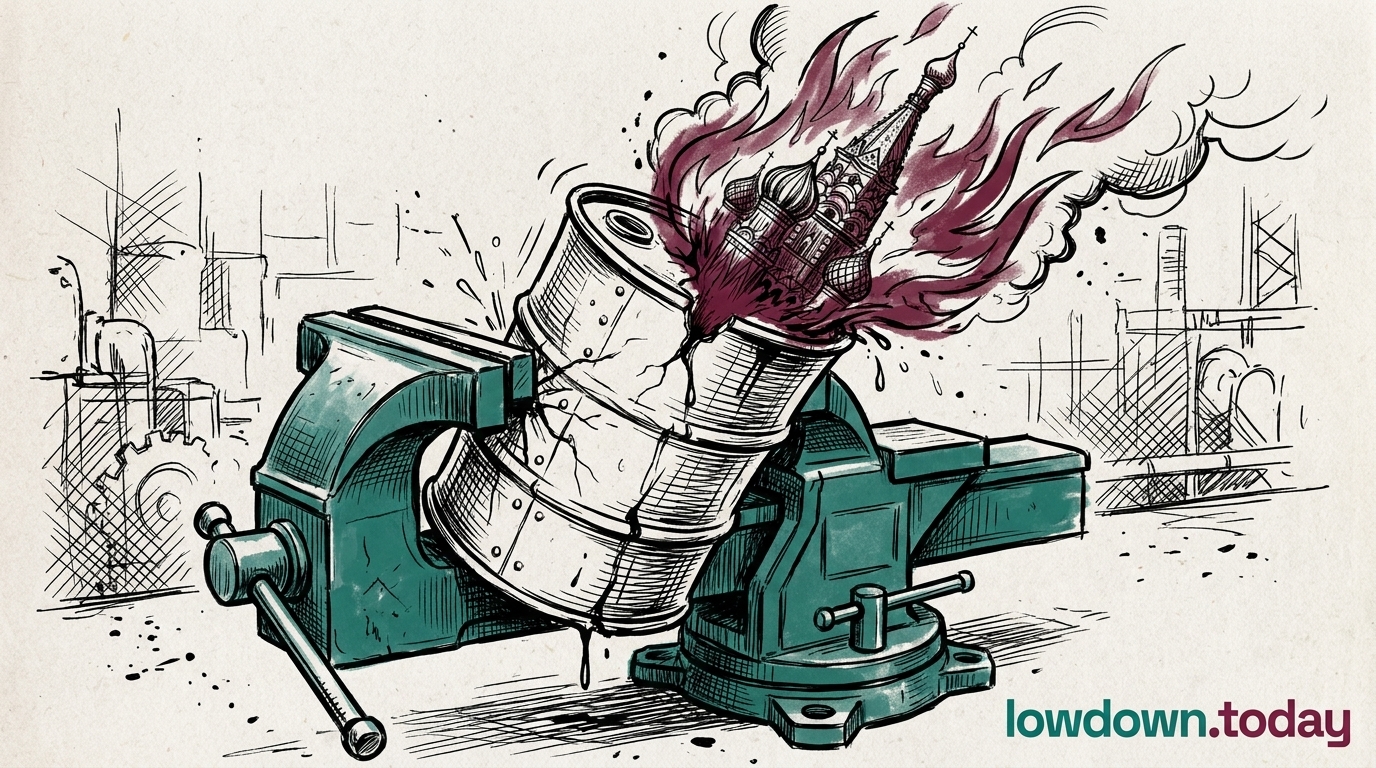
Ukraine's refinery campaign reached every leg of Russia's export chain in one fortnight and outflew Russia for the first time.

Russian average refinery throughput fell to 4.69 million barrels per day (mbpd) in late April, the lowest reading since December 2009. Tuapse refinery on the Black Sea coast was struck for the fourth time in two weeks on 1 May, with fires reigniting after the Russian Emergency Situations Ministry declared them out. Volodymyr Zelenskyy confirmed Ukrainian strikes on two Russian shadow tankers off Novorossiysk on the Black Sea coast. Ukraine's drone forces commander told Meduza on 1 May that 'no part of Russia is safe from strikes'.

On the night of 2-3 May, Ukraine launched 334 drones into Russia against Russia's 268 drones at Ukraine, the first verified overnight reversal of the daily exchange ratio. The reversal sits beside three other shifts in the same week: the move past terminals to refineries to the offloading fleet itself; the Security Service of Ukraine (SBU) Transneft-Privolga strike ; and the underlying tempo build that produced the 22 April mass-launch outlier . Ukraine has now closed every leg of the Russian export chain inside one fortnight.

Pre-war Russian refining norms ran near 5.6 mbpd; the 4.69 mbpd reading implies roughly 0.9 mbpd of lost domestic processing. Russia is fighting an offensive without the petrol and diesel volume its own forces and economy require, and with the gasoline export ban active since the Kirishi shutdown earlier in April, Moscow cannot monetise the refined-product premium when crude is rerouted to export.

CEPA (Center for European Policy Analysis) and RUSI (Royal United Services Institute) put the 2025 strike campaign at 0.46% of Russian annual oil revenue . Two changes have moved that calculus: target diversification across the export chain and the breach of the daily exchange ratio. Zelenskyy told RBC-Ukraine Russia has lost at least $7 billion since January 2026 from long-range strikes, more than fifteen times the 2025 baseline.


Deep Analysis

In plain English

Ukraine's drones and missiles have been striking Russian oil refineries and export facilities for months. This week two developments crossed important thresholds. Russian refineries are now processing oil at their lowest rate since December 2009, meaning Russia is producing less refined fuel than at any point in 16 years. Separately, on the night of 2-3 May, Ukraine launched 334 drones toward Russia overnight; Russia sent 268 toward Ukraine. That was the first time Ukraine sent more drones in a single night than Russia. The Tuapse refinery in southern Russia was struck four times in two weeks, with fires reigniting after Russian authorities said they had put them out. Ukraine also struck two Russian oil tankers off the coast of Novorossiysk, extending the campaign from refineries to the ships that carry Russia's oil to buyers.

Deep Analysis
Root Causes

The drone volume reversal has two structural causes that are separate from simple production numbers. First, Ukraine shifted manufacturing from single-mission Shahed-clone airframes to a mixed fleet of purpose-built low-observable loitering munitions with modular warheads starting in Q4 2025.

That mix allows smaller warheads at higher sortie rate, which is why Tuapse fires reignite: the warhead is sized for fuel-system ignition, not structural destruction, enabling sustained reignition cycles rather than terminal damage.

Second, Ukraine's drone corridor management has adapted to Russian EW (electronic warfare) patterns. Russian R-330Zh Zhitel EW systems were redeployed to protect Moscow oblast following the parade security decision; that redeployment thinned the EW coverage on southern corridors between Ukraine and Krasnodar Krai.

Tuapse sits in that thinned zone. The four strikes in two weeks are therefore partly a product of the same parade-security decision that produced event-00 in this briefing: redirecting EW assets to Moscow created a drone-route window in Krasnodar.

What could happen next?
  • Consequence

    The overnight drone volume reversal, if sustained over a two-week period, would force Russia to deploy more EW and air-defence assets to the interior rather than the front, reducing battlefield coverage.

    Short term · 0.68
  • Risk

    If Russia retaliates for the shadow tanker strikes with attacks on Ukrainian Black Sea infrastructure, the conflict risks drawing in Turkish and Romanian energy transit interests in the Black Sea.

    Short term · 0.55
  • Consequence

    Refinery throughput at 4.69 mbpd compresses Russia's export margin to approximately 1.5 mbpd; sustained at this level, domestic fuel subsidy costs rise and public-facing inflation pressure on the Russian government increases.

    Medium term · 0.75
First Reported In

Update #15 · Hardware-free parade; crude waiver lives on

Al Jazeera· 3 May 2026
Read original
Different Perspectives
Belgium
Belgium
Belgium blocked outright confiscation of the roughly EUR 210bn in frozen Russian assets held at Euroclear in December 2025, because Euroclear would carry the legal liability. Ukraine has since proposed moving custody to the EU instead.
European Commission
European Commission
The Commission said on 2 September that Ukraine has drawn EUR 3.2bn against an EUR 8.35bn annual target, and that a revenue-mobilisation law stuck in the Rada is one of twelve conditions for the next EUR 3.7bn payment.
Steve Witkoff and Jared Kushner
The US envoys met Putin in Moscow on 5 September and Zelenskyy in Kyiv on 6 September without an announced result from more than three hours of talks. Their mediation continues with no public outcome to show for this round.
Robert Brovdi
Robert Brovdi
Brovdi said on 12 September that his Unmanned Systems Forces struck 285 Russian tankers in ten weeks. His own monthly breakdown sums to 79, and he has given no account of the remaining 206.
Sergei Lavrov
Sergei Lavrov
Lavrov said on 12 September that Russia is ready to negotiate but will not suspend military operations while it does. He treats talking and fighting as compatible policies, ruling out a ceasefire as a precondition for further talks.
Belarus
Belarus
Minsk announced completion of its own 37th Separate Airborne Assault Brigade near Gomel, under plans dating to August 2025 rather than a response to any single frontline event this window, keeping its hedge of hosting the war without formally joining Russia's mobilisation drive.


