Skip to content
Briefings are running a touch slower this week while we rebuild the foundations.See roadmap
Russia-Ukraine War 2026
11APR

Russia's wealth fund sheds $4.8bn

2 min read
16:48UTC

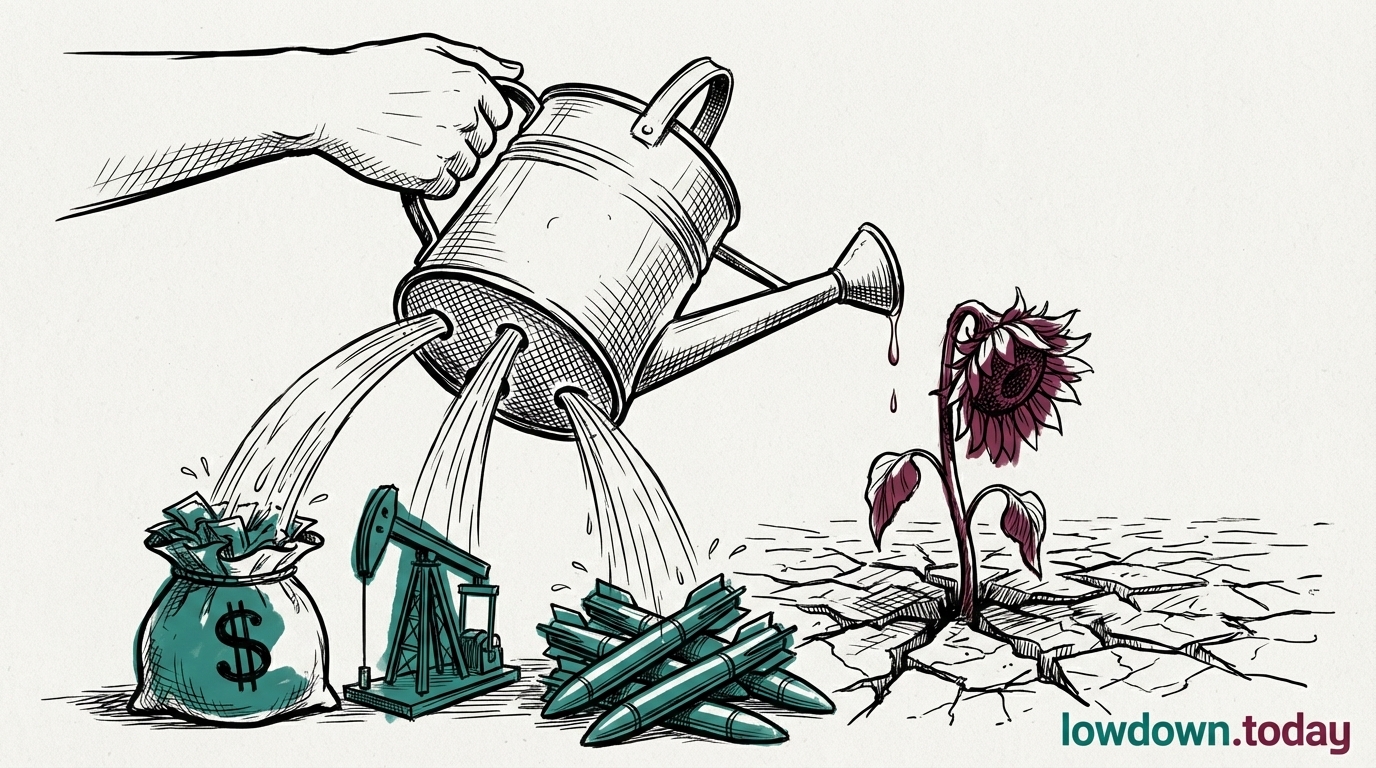
Rising oil prices could not prevent Russia's National Wealth Fund from haemorrhaging reserves as the business climate index turned negative for the first time in three years.

ConflictDeveloping
Key takeaway

Russia's financial buffers are shrinking despite oil prices above budget assumptions.

Russia's National Wealth Fund shed 400 billion roubles ($4.8 billion) in January and February 2026 1. The country's business climate index turned negative in March for the first time since October 2022. Fixed capital investment fell 2.3% in real terms during 2025.

The Urals benchmark has risen $11.30 to $73.24 per barrel, well above Russia's $59 budget assumption. Yet rising prices did not prevent the fund's decline. Russia is spending 38 to 40% of its federal budget on defence, the highest proportion since the Soviet era . Moscow dropped planned 10% cuts to non-military spending after the Iran-war oil price surge, only to face a revenue squeeze from the opposite direction: not low prices, but destroyed export capacity at Baltic ports.

Deep Analysis

In plain English

Russia has a 'rainy day fund' called the National Wealth Fund, similar to a national savings account. It lost $4.8 billion in just two months at the start of 2026, even while oil prices were high. Why? Russia is spending 38-40% of its entire government budget on the military, the highest proportion since the Soviet era. High oil prices were supposed to offset that. But Russia is spending the money faster than it earns it. Now the oil export damage from the Baltic port strikes compounds the problem: Russia has high oil prices but can't ship as much oil. The business climate index turned negative in March for the first time in years, suggesting the civilian economy is feeling the strain.

Deep Analysis
Root Causes

Russia's fiscal deterioration reflects the simultaneous pressure of three forces. First: record defence spending at 38-40% of the federal budget, consuming reserves faster than revenues replenish them.

Second: investment collapse, with fixed capital investment down 2.3% in 2025, meaning Russia is not building the productive capacity needed to sustain long-term revenue growth. Third: the Baltic port disruption now compressing both the volume and revenue sides of the oil export equation simultaneously.

The business climate index turning negative for the first time since October 2022 is the civilian economy signal. It precedes consumer confidence deterioration by two to three quarters. If sustained, it indicates Russian business investment is contracting under war conditions despite high nominal oil prices.

What could happen next?
  • Consequence

    At current NWF depletion rates, Russia may need to cut non-military spending or increase deficit financing within 12-18 months, creating domestic economic pressure on the war effort.

First Reported In

Update #9 · Ukraine halves Russia's Baltic oil exports

Moscow Times· 1 Apr 2026
Read original
Different Perspectives
Rafael Grossi, IAEA Director General
Grossi's Update 349 of 7 May recorded a drone strike on ZNPP's radiation monitoring laboratory on 3 May. Rosatom's 17 May public attack on the Secretariat's neutrality degrades the diplomatic ground Grossi needs for the sixth repair ceasefire at day 60 on the single backup line.
Indian Government / Embassy Moscow
The Indian Embassy in Moscow confirmed on 18 May that an Indian national was killed and three hospitalised at a refinery construction site in the 17 May barrage. India is among the largest buyers of discounted Russian crude; the fatality forces a diplomatic protest without changing the purchasing posture.
Recep Tayyip Erdogan, Turkish President
Erdogan met Zelenskyy in Ankara for nearly three hours on 15 May before the Istanbul session, recovering Turkey's 2022 mediator role and reducing Trump's leverage by hosting bilateral talks without Washington in the room. Turkey hosts the NATO Ankara summit on 7-8 July; the Istanbul format gives Erdogan standing at both tables simultaneously.
Viktor Orban / Hungarian Government
Budapest's new cabinet, formed 12 May, holds the institutional veto point on the EU tranche disbursement ahead of the first-half June window. Hungary has previously leveraged EU loan tranches to extract bilateral concessions; the combination of a fresh cabinet and a tight disbursement timeline makes Budapest the single highest-leverage actor in the EU track this fortnight.
European Council / Commission
The Commission is preparing a three-document disbursement package for the 9.1-billion euro first tranche of the EU loan to Ukraine, targeting first-half June, but delivery depends on the Magyar cabinet, which formed on 12 May, not blocking the mechanism. The 20th sanctions package remains in force against Russia.
Donald Trump / US Treasury
Treasury issued GL 134C with a 48-hour gap after GL 134B expired, confirming the waiver series functions as permanent monthly management rather than a wind-down instrument. Washington was absent from the Istanbul room; Treasury Secretary Bessent framed the Cuba carve-out as protecting 'most vulnerable nations', maintaining the fiction that the 30-day bridge has a humanitarian rationale.
