Skip to content
Welcome, thoughtbot's Giant Robots listeners!Start here
Pandemics and Biosecurity
3OCT

Burned clinic rebuilt as access fails

3 min read
13:42UTC

A treatment centre in eastern DRC was torched by protesters and then rebuilt, the Africa CDC and WHO reported on 29 May. Tedros, who visited Ituri on 28 May, said stopping transmission depends entirely on humanitarian access.

ScienceDeveloping
Key takeaway

A second DRC treatment centre was torched and rebuilt, and Tedros tied the outbreak's fate entirely to humanitarian access.

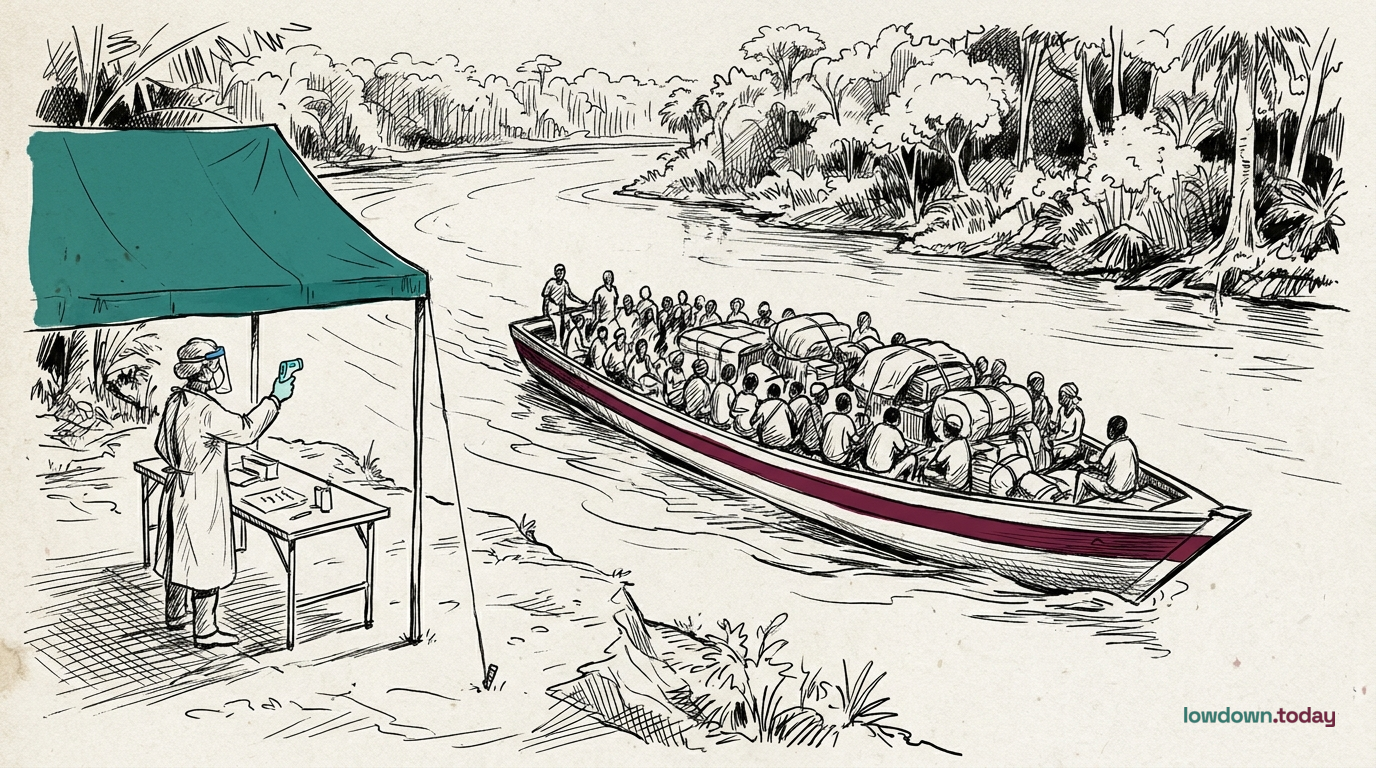
A treatment centre in eastern Democratic Republic of Congo was burned by protesters and then rebuilt, the Africa CDC and WHO response reported on Friday 29 May⁠1. This is a separate incident from the South Kivu facility torched earlier in May, and the repetition is the worrying part: two clinics attacked in two zones points to a pattern of community distrust rather than a single flashpoint.

WHO Director-General Tedros Adhanom Ghebreyesus visited Ituri Province on Thursday 28 May and put the constraint plainly on Wednesday 27 May: "Stopping this Ebola transmission depends entirely on humanitarian access"⁠2. Much of the outbreak zone sits in territory contested by the M23 armed group, a Rwandan-backed force that has held parts of eastern DRC since February 2025; DON605 records attacks on health facilities slowing the response⁠3.

With no vaccine and no licensed treatment, responders cannot vaccinate their way out of distrust as they could in the Zaire outbreaks. Tracing contacts and isolating cases depends on residents accepting responders into their communities, so each torched clinic removes the one tool the response has left. The WHO is leaning on a counter-narrative of recovery: five Bundibugyo patients were discharged on Sunday 31 May⁠4.

Deep Analysis

In plain English

In the DRC outbreak zone, a treatment centre was attacked and set on fire by local residents, then rebuilt. This is not an isolated incident; a separate facility in South Kivu Province was also torched in May (a prior event in this briefing covers that case). Treatment centres are where people with Ebola symptoms are isolated and cared for; without them, sick people remain at home and can pass the virus to family members. The attacks happen because communities sometimes distrust or resent how outbreak responders behave: arriving from outside, taking patients away, and returning bodies for burial. WHO Director-General Tedros Adhanom Ghebreyesus visited Ituri Province on 28 May and stated that stopping transmission depends entirely on communities allowing health workers access. M23, an armed group that controls parts of eastern DRC, is also blocking or slowing the response in the areas it controls.

Deep Analysis
Escalation

Two confirmed treatment-centre arson incidents in eight days (South Kivu in May, Ituri in late May) represent a worsening pattern that follows the Kivu 2018-20 precedent closely. The current contact-tracing rate of 21% of named contacts is already below the 80% threshold associated with containment in modelling studies by the London School of Hygiene and Tropical Medicine. Further infrastructure destruction will drive contact-tracing coverage lower, not higher.

What could happen next?
  • Risk

    Treatment centre arson combined with M23 access restrictions reduces the DRC response's physical infrastructure faster than it can be rebuilt, creating a cyclical coverage gap in the most heavily affected Ituri health zones.

First Reported In

Update #5 · Ebola money arrives, the cure does not

World Health Organization· 2 Jun 2026
Read original →
Causes and effects
This Event
Burned clinic rebuilt as access fails
Against a virus with no vaccine and no treatment, community engagement is the primary tool, and a burned clinic destroys exactly that.
Different Perspectives
IGWG co-chair Tovar da Silva Nunes
The Brazilian co-chair closed the eighth pathogen-sharing session on 18 September without an agreed annex text, the second session in a row to end that way. He presented the outcome as continued commitment, with adoption due at the World Health Assembly in May 2027.
Fraport
Fraport
The Frankfurt Airport operator has told staff to watch for fever, hessenschau reported, after six airport workers caught malaria. Germany does not require insecticide spraying of arriving aircraft cabins, and parasite genotyping to trace the source is due at the end of October.
European Centre for Disease Prevention and Control
ECDC reported the eight Frankfurt Airport malaria cases on 18 September and considers repeated arrivals of infected mosquitoes on aircraft likely. It has not ruled out local mosquitoes, and awaits genotyping due at the end of October.
Pan American Health Organization
PAHO counted 53,957 measles cases in the Americas by 19 September and is supporting Peru's response in Puno and Arequipa. It warns that October's Señor de los Milagros festivities and Pope Leo XIV's November visit could increase transmission.
Bangladesh Directorate General of Health Services
The DGHS recorded 1,030 measles-related deaths and 172,720 suspected cases by 14 September, after a campaign that reached 19.75 million children. Its disease-control director, Halimur Rashid, said further vaccination rounds were expected within two weeks.
Minapharm
Minapharm
The Egyptian drugmaker and its Berlin subsidiary ProBioGen were awarded up to US$16.5m by CEPI on 27 August to take a Bundibugyo vaccine into a Phase 1 trial in Africa. Final manufacture is planned for Cairo, making it CEPI's first Bundibugyo candidate with an African producer.
