Skip to content
Welcome, thoughtbot's Giant Robots listeners!Start here
Pandemics and Biosecurity
3OCT

Ebola crosses into M23-held South Kivu

3 min read
13:42UTC

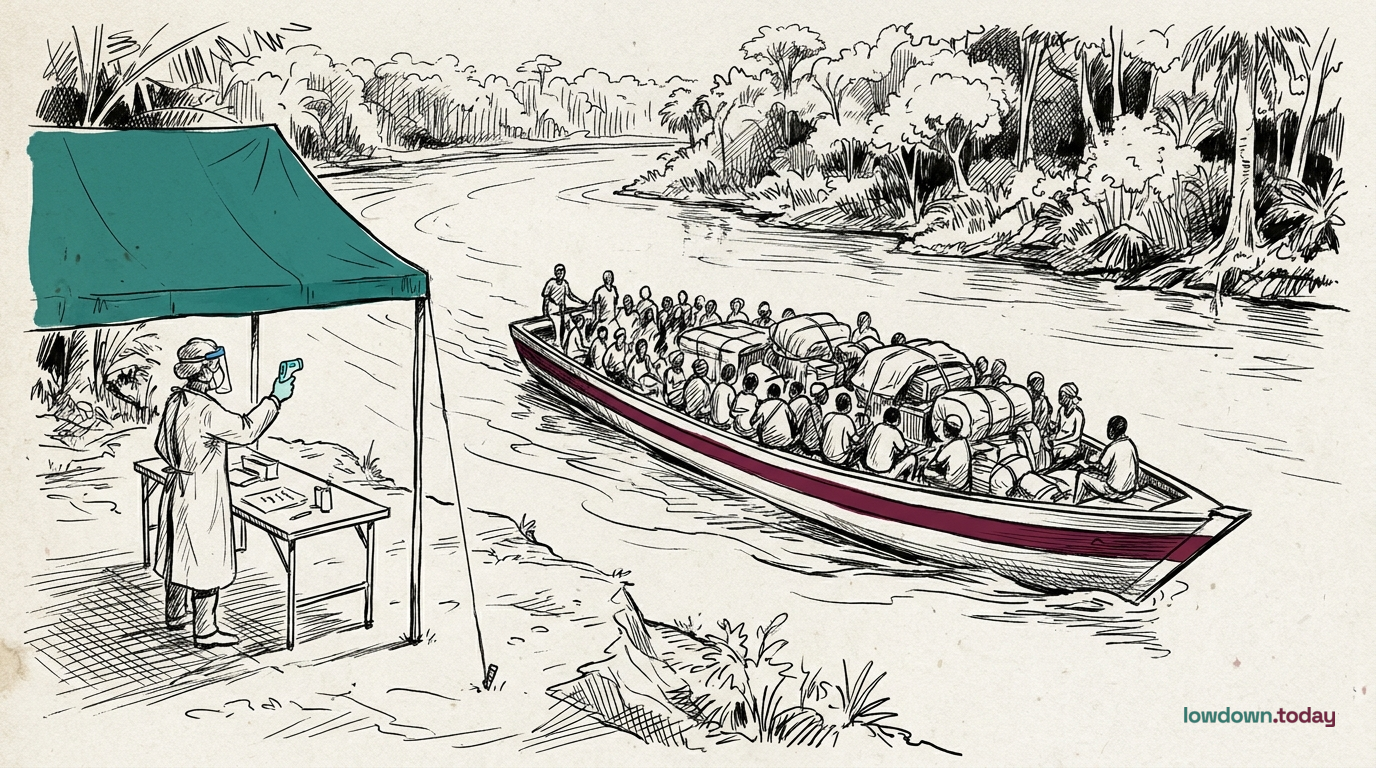
The first confirmed Bundibugyo case in South Kivu appeared in territory held by the M23 rebel movement, where the patient died undiagnosed and residents torched a treatment facility as responders arrived.

ScienceDeveloping
Key takeaway

An outbreak that reaches rebel-held South Kivu outlasts the institutions built to contain it.

The first confirmed Bundibugyo Ebola case outside Ituri has appeared in South Kivu, the eastern DRC province held by the M23 rebel movement since February 2025⁠1. The patient, a 28-year-old, died before the diagnosis could be confirmed, and residents set fire to a treatment facility as responders arrived⁠2. M23 is a Rwandan-backed armed group; the territory it governs has no outbreak-management apparatus and no prior Ebola experience.

The crossing changes what kind of problem this is. Inside Ituri the response is at least a contest, however badly it is going under the 21% tracing ceiling logged in WHO's outbreak data. South Kivu offers no institution to work with at all. The 21-day contact monitoring, isolation wards and safe-burial teams that define an Ebola response all assume a public authority that can compel and protect; a rebel administration provides none of that, and the torched clinic shows the local trust deficit a response would have to overcome before it could begin.

This is the mechanism by which an outbreak outlasts its own emergency declaration. Africa CDC moved early and Uganda contained two imported cases with no onward spread, which shows containment is possible where the state functions. South Kivu removes that precondition. The India-Africa summit was postponed as the geography shifted⁠3, a small diplomatic casualty that signals how quickly a contained DRC health event becomes a regional one once it escapes the zones where anyone can act on it.

Deep Analysis

In plain English

South Kivu is a province in eastern DRC that has been controlled since February 2025 by M23, a rebel armed group backed by Rwanda. M23 has no hospitals, no disease-monitoring systems, and no government health authority. When Ebola crosses into territory they control, the standard outbreak tools cannot be used: tracing WHO a patient has been near, isolating them, monitoring for symptoms. A 28-year-old patient died there before doctors could even confirm the diagnosis. Local residents, frightened by the arrival of health teams in protective equipment, set fire to a treatment facility. This is not unusual: distrust of outside health workers was also a problem during the 2018-2020 DRC Ebola outbreak, the deadliest in that country's history.

Deep Analysis
Root Causes

South Kivu's inclusion in the outbreak corridor follows directly from Ituri's 21% contact follow-up rate (event-00): untraced contacts become the transmission chains that cross provincial and armed-group borders through gold-trade movement corridors.

The INRB (Institut National de Recherche Biomedicale) nine-day species confirmation lag meant the community-to-signal gap was over four weeks; by the time Bundibugyo was identified, transmission chains were already multi-generational. M23 has no public-health counterpart; it has no equivalent of the DRC Ministry of Health's operational reach, however imperfect that reach is in Ituri itself.

What could happen next?
  • Risk

    M23-held territory has no outbreak-management infrastructure; a transmission cluster establishing there would be functionally invisible to WHO and Africa CDC surveillance systems until patients cross into DRC government-held areas.

  • Precedent

    The South Kivu crossing sets a structural precedent for this PHEIC: if a single untraced contact can reach armed-group territory, the IHR Temporary Recommendations on exit screening are inadequate for an outbreak whose geographic perimeter includes ungoverned space.

First Reported In

Update #4 · Ebola triples, response misfires

Al Jazeera· 24 May 2026
Read original →
Different Perspectives
IGWG co-chair Tovar da Silva Nunes
The Brazilian co-chair closed the eighth pathogen-sharing session on 18 September without an agreed annex text, the second session in a row to end that way. He presented the outcome as continued commitment, with adoption due at the World Health Assembly in May 2027.
Fraport
Fraport
The Frankfurt Airport operator has told staff to watch for fever, hessenschau reported, after six airport workers caught malaria. Germany does not require insecticide spraying of arriving aircraft cabins, and parasite genotyping to trace the source is due at the end of October.
European Centre for Disease Prevention and Control
ECDC reported the eight Frankfurt Airport malaria cases on 18 September and considers repeated arrivals of infected mosquitoes on aircraft likely. It has not ruled out local mosquitoes, and awaits genotyping due at the end of October.
Pan American Health Organization
PAHO counted 53,957 measles cases in the Americas by 19 September and is supporting Peru's response in Puno and Arequipa. It warns that October's Señor de los Milagros festivities and Pope Leo XIV's November visit could increase transmission.
Bangladesh Directorate General of Health Services
The DGHS recorded 1,030 measles-related deaths and 172,720 suspected cases by 14 September, after a campaign that reached 19.75 million children. Its disease-control director, Halimur Rashid, said further vaccination rounds were expected within two weeks.
Minapharm
Minapharm
The Egyptian drugmaker and its Berlin subsidiary ProBioGen were awarded up to US$16.5m by CEPI on 27 August to take a Bundibugyo vaccine into a Phase 1 trial in Africa. Final manufacture is planned for Cairo, making it CEPI's first Bundibugyo candidate with an African producer.
