Skip to content
Briefings are running a touch slower this week while we rebuild the foundations.See roadmap
Iran Conflict 2026
11MAY

Tanker MV Skylight hit near Hormuz

3 min read
14:01UTC

The MV Skylight is the first commercial vessel struck since the IRGC declared the strait closed, converting Iran's most powerful strategic lever from a threat into physical reality.

ConflictDeveloping

The oil tanker MV Skylight was struck off the coast of Oman in waters near the strait of Hormuz, injuring four crew members. The attack is the first confirmed hit on a commercial vessel since the IRGC broadcast its "no ships may pass" closure on VHF Channel 16 at the conflict's outset . Two other vessels — MKD Vyom, which suffered an engine room fire from a projectile strike, and Sea La Donna, details still pending — were also attacked in the same period. In hours, the strait moved from a zone shipping companies were avoiding voluntarily to one where vessels were under direct fire.

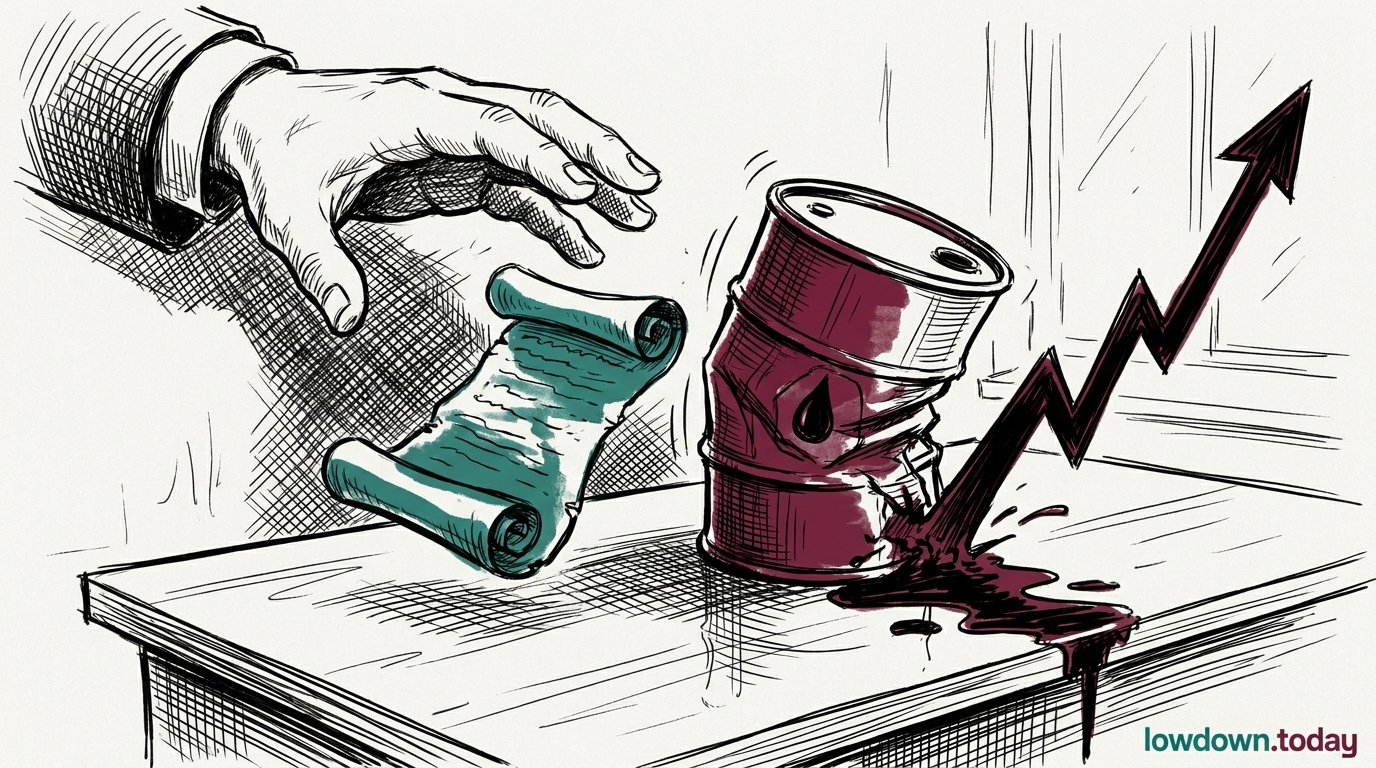
The economic consequences arrived immediately. Vessel traffic through the strait fell 70%. More than 150 tankers sat at anchor in open Gulf waters. CMA CGM, Maersk, Hapag-Lloyd, Nippon Yusen, Mitsui, and Kawasaki Kisen all halted transits. CMA CGM imposed an emergency surcharge of $2,000–$4,000 per container, effective immediately. Brent Crude stood at roughly $73 before the first strikes and opened Saturday at $82.37 (ID:108) — a price set before the tanker attacks. Goldman Sachs had forecast a peak of $110; JP Morgan projected $120–$130 for a prolonged conflict and raised its US recession probability to 35% (ID:111). With merchant vessels now absorbing hits, those figures look like floor estimates rather than worst-case scenarios.

The last sustained military campaign against commercial shipping in these waters was the 1984–88 Tanker War during the Iran-Iraq conflict. Over four years, 546 vessels were struck; insurance premiums tripled; Kuwait reflagged its tankers under the US flag to secure naval escorts. Three vessels have been hit here in 72 hours. The modern global economy is more exposed than it was in the 1980s — roughly 20% of the world's traded oil and a quarter of global LNG transits the strait daily. Alternative routes exist: the Saudi east-west pipeline, the UAE's Habshan-Fujairah bypass. Neither can handle more than a fraction of normal throughput. Mohsen Rezai, secretary of Iran's Expediency Council, had declared the strait "officially open" while simultaneously calling US warships "legitimate targets" . The four injured crew of the MV Skylight are the first evidence of what that contradiction looks like in practice.

Deep Analysis

Deep Analysis
Synthesis

The clustering of tanker attacks with simultaneous strikes on Gulf cities raises a key interpretive question: co-ordinated strategy to make the Gulf economically ungovernable, or simultaneous activation of pre-positioned capabilities by units operating without central direction. Either reading is alarming. Co-ordination implies deliberate escalation to maximum economic pressure. Autonomous execution implies Iran's most strategically significant weapons are in the hands of commanders without current political direction. Regardless of how the immediate conflict resolves, the longer-term consequence may be a permanent re-evaluation by Asian and European energy consumers of Gulf supply dependence, accelerating strategic reserve expansion and energy transition investment.

Root Causes

Attacking the strait distributes economic pressure across non-belligerent states — Japan, South Korea, India, China, European importers — creating an incentive structure for third-party governments to lobby for de-escalation regardless of their own political positions. The costs land primarily on states that had no role in the conflict's initiation. Some attacks may also reflect localised IRGC naval unit decisions rather than centralised direction, which would make them harder to terminate through negotiated agreement even if political will for de-escalation emerged.

Escalation

The US Navy's Fifth Fleet has substantial Gulf assets and a historical doctrine of protecting commercial shipping. However, its forces are currently committed to offensive strikes against Iranian military targets. If tanker attacks continue, the US faces pressure to divert naval resources to escort duties — which creates a direct US-Iran naval confrontation scenario separate from the air campaign already under way.

What could happen next?
2 consequence2 risk1 precedent
  • Consequence

    Vessel traffic through the Strait of Hormuz has fallen 70% within 72 hours of the first tanker attack, removing approximately 12–14 million barrels per day of oil transit from global supply chains.

    Immediate · Reported
  • Risk

    If tanker attacks continue at the observed pace, US naval doctrine creates pressure for escort operations that could generate a direct US-Iran naval confrontation, independent of the air campaign dynamic.

    Short term · Assessed
  • Consequence

    Consumer energy prices in Europe, Asia, and North America are likely to begin rising within weeks as current supply stockpiles are drawn down and the forward curve in oil futures reprices.

    Short term · Assessed
  • Risk

    If Iranian military units are operating without central command authority, the political mechanism required to order a halt to tanker attacks — and thus to restore shipping confidence — may not currently exist, making the economic disruption structurally harder to terminate than in a conventional state-directed confrontation.

    Short term · Suggested
  • Precedent

    The return of active combat against commercial shipping in the Strait of Hormuz for the first time since the 1980s Tanker War will permanently elevate risk premiums and insurance costs for Gulf transit, incentivising long-term investment in alternative supply routes and strategic reserve capacity regardless of how this conflict resolves.

    Long term · Assessed
First Reported In

Update #7 · Hezbollah enters; tankers burn in Hormuz

gCaptain· 2 Mar 2026
Read original
Causes and effects
This Event
Tanker MV Skylight hit near Hormuz
The attack on commercial shipping transforms the Hormuz crisis from a broadcast closure — which markets could treat as potentially temporary — into an active combat zone where merchant vessels face direct military attack. This converts a geopolitical risk premium into sustained physical supply disruption.
Different Perspectives
Israel
Israel
Israeli strikes on Hezbollah positions in Lebanon continued through the weekend, maintaining the secondary front. The IDF has publicly named Mojtaba Khamenei as an assassination target; his courier-governance mode complicates targeting but does not remove him from the order.
Russia
Russia
Putin told a Moscow press conference that Washington, not Tehran or Moscow, killed the Russia-custody uranium arrangement by demanding US-territory-only storage. Neither Tehran nor Washington has corroborated the account, which appeared in second-tier outlets only, consistent with a trial balloon rather than a formal position.
United Kingdom
United Kingdom
HMS Dragon was redeployed from the Eastern Mediterranean to the Middle East on 9 May, the first physical European platform commitment to the Gulf. The Ministry of Defence called it "prudent planning" while publishing no rules of engagement, no tasking order, and no vessel name, committing a named asset to a conflict zone before the political instrument authorising it exists.
United Arab Emirates
UAE air defences intercepted two Iranian drones over its territory on 10 May, a kinetic escalation six days after the Fujairah oil terminal strike that drew no formal protest. The three-state simultaneous operation, not the severity of individual strikes, appears to have crossed the threshold at which the GCC states collectively began responding.
Saudi Arabia
Saudi Arabia
Riyadh issued the first formal Gulf-state protest of the conflict on 10 May, demanding an "immediate halt to blatant attacks on territories and territorial waters of Gulf states", ending 10 weeks of channelling displeasure through OPEC+ quota discussions. The protest forecloses Saudi Arabia's preferred quiet-channel role and reduces the functioning back-channel architecture to Pakistan alone.
Qatar
Qatar
Doha is simultaneously a strike target, the site of the Safesea Neha attack 23 nautical miles offshore, and an active MOU mediator: Qatar's prime minister met Rubio and Vance in Washington the same weekend. Whether Qatar issues its own formal protest or maintains its dual role is the critical escalation indicator for the week of 11 May.