Skip to content
Briefings are running a touch slower this week while we rebuild the foundations.See roadmap
Iran Conflict 2026
1MAY

Tasnim claims IRGC drones hit US vessels

2 min read
10:38UTC

Lowdown Bureau / Military. Tehran's state wire announced the strike; Washington has neither confirmed nor denied it. The ambiguity is the point.

ConflictDeveloping
Key takeaway

Unconfirmed or not, the Tasnim claim voids the ceasefire in fact while both capitals still reference it in rhetoric.

Tasnim News Agency, the state-linked wire close to the Islamic Revolutionary Guard Corps (IRGC), reported on Monday that IRGC drones had attacked US military vessels in the Sea of Oman in retaliation for the USS Spruance's boarding of the Iranian cargo ship Touska the night before . The Tasnim dispatch gave no target name, no damage claim, and no casualty figure. US Central Command (CENTCOM), the Pentagon's Middle East combatant command, issued neither confirmation nor denial.

Both sides benefit from the ambiguity. If the IRGC launch happened, it becomes the first Iranian kinetic action against the US Navy since the 8 April ceasefire took effect, and the War Powers Resolution clock would arguably reset. If it did not happen, Tehran has for the first time under this ceasefire claimed an action it may not have carried out, which preserves Donald Trump's discretion on whether to respond. Tasnim has form as the IRGC's preferred outlet for announcements that front-run official confirmation; it carried the IRGC Navy's four-condition transit order before Iranian state media generalised it .

The absence of any published rules of engagement around the blockade makes every kinetic incident a separate judgement call by two commands that have not agreed a text. A blockade written on Truth Social with no presidential instrument in the Federal Register, a ceasefire announced the same way, and a Touska boarding conducted under orders nobody has published. Both navies are firing on the other's flagged vessels inside an agreement both governments still cite in public.

Deep Analysis

In plain English

Iran's state-linked news agency Tasnim reported that Iran's Revolutionary Guards (a powerful military force separate from the regular army) launched drones at US Navy ships near the Gulf of Oman. The US military neither confirmed nor denied this happened. This matters because Iran had just lost a cargo ship seized by a US destroyer the day before. Reporting a counterattack, even one the US will not confirm, allows Iranian state media to tell domestic audiences that the country hit back. Tasnim published the claim without specifying numbers, targets, or damage, giving it maximum domestic reach at minimum verifiable risk. The timing is delicate: a formal US-Iran ceasefire expires in two days, and both sides have reasons to avoid a confirmed military exchange that would force an official response.

Deep Analysis
Root Causes

The IRGC's organisational incentive structure explains the claim regardless of whether drones were actually launched. The Touska seizure was the first kinetic capture of an Iranian vessel since 1988, producing a reputational deficit the IRGC Quds Force must answer to its own provincial units.

The Decentralised Mosaic Defence devolved launch authority to 31 autonomous units; a unit commander who reports an unanswered provocation faces internal accountability pressure that outweighs the diplomatic cost of an unverified claim in Tasnim.

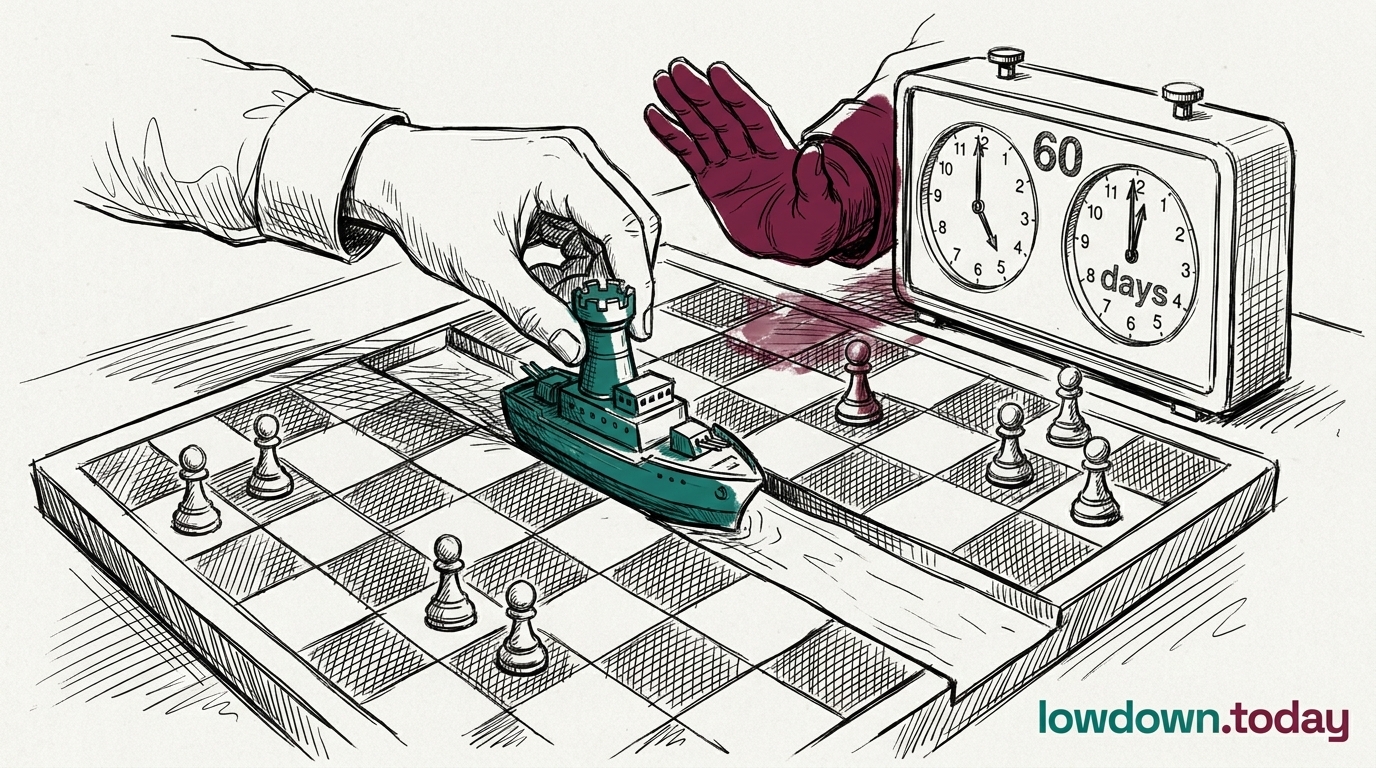
CENTCOM's neither-confirm-nor-deny posture reflects a parallel structural constraint: acknowledging the claim opens a formal incident report that could accelerate the War Powers Resolution 60-day clock, which expires 29 April . Both sides have bureaucratic reasons to leave the claim in an unresolved state.

Escalation

Low-to-medium immediate risk. The mutual ambiguity benefits both sides before Wednesday's ceasefire expiry. If no ceasefire extension is agreed, an unresolved drone claim becomes a negotiating liability rather than a tactical advantage for Iran.

What could happen next?
  • Risk

    If ceasefire talks collapse Wednesday and CENTCOM subsequently confirms the 20 April exchange, the drone incident becomes the first acknowledged kinetic contact between US and Iranian forces, triggering mandatory Congressional notification under the War Powers Act.

  • Precedent

    Tasnim's drone claim establishes a template for the IRGC to assert retaliatory capacity through state media without incurring a confirmed escalatory exchange, at a diplomatic cost of zero.

First Reported In

Update #75 · Ceasefire ends in the water, a day early

The National· 21 Apr 2026
Read original
Different Perspectives
Oil markets
Oil markets
Brent fell $1.05 to $106.0 on summit Day 1 but remains $5-7 above the post-ceasefire equilibrium analysts modelled in March; the market is pricing a holding pattern, not a breakthrough. OilPrice.com and Aramco CEO Nasser converge on buffer-exhaustion before Hormuz reopens if the blockade extends past mid-June.
Iranian dissidents and human rights monitors
Hengaw documented a five-prison simultaneous execution cluster on 13 May, with Gorgan appearing for the first time in the wartime register. Espionage charges framed as Israel-linked moharebeh now extend across Mashhad, Karaj, and Gorgan, using the war as judicial cover for protest-era detainees.
BRICS / Global South
Araghchi's Delhi appearance positioned Iran as a victim of US aggression before non-Western foreign ministers, with Deputy FM Bagheri Kani calling on BRICS to act against US aggression. India, as the largest non-Chinese user of Iranian-routed crude, faces pressure to balance bloc solidarity against its own shipping and sanctions exposure.
China
China
Beijing accepted the Nvidia chip clearance on summit Day 1 and gave Rubio verbal acknowledgement of Iran as an Asian stability concern, having already put Pakistan on paper as the mediatory channel on 13 May (ID:3253), deflecting the US ask for direct Chinese action without refusing it.
Iran (government and civilian diplomatic track)
Araghchi denied any Hormuz obstruction at BRICS Delhi on 14 May while Iran's SNSC had finalised a Hormuz security plan the day before. Israel Hayom's single-sourced 15-year freeze offer gives Tehran a deployable figure in non-Western forums regardless of corroboration; the state attributed 3,468 wartime deaths with no independent verification.
United States (Trump administration and Senate moderates)
Trump signed a chip clearance for 10 Chinese firms on summit Day 1 and zero Iran instruments across 76 days; Rubio and Vance made verbal Iran asks without paper. Murkowski voted yes on the 49-50 war-powers resolution after Hegseth told the Senate that Article 2 makes an AUMF unnecessary.