Skip to content
Briefings are running a touch slower this week while we rebuild the foundations.See roadmap
Iran Conflict 2026
1MAY

Brent at $94.79: markets price the gap

3 min read
10:38UTC

Lowdown Newsroom

ConflictDeveloping
Key takeaway

Brent has priced partial enforcement and two catalysts this week can move it either way.

Brent Crude closed at $94.79 on Tuesday, down from the blockade-day peak in the previous session , still roughly two-fifths above the pre-war baseline. The move is consistent with traders watching the operational order rather than the admiral's lectern. Interdiction of Iranian-port traffic is priced in; the continuing carve-out for sanctioned non-Iranian-port tankers, documented when Windward tracked sanctioned dark-fleet vessels using scrapped ship identities , caps the upside by keeping partial supply flowing.

For drivers and consumers, that premium is what a partial blockade feels like at the pump. Brent has held in a narrow band this week because neither a full-closure path nor a resolution path is the base case. Two catalysts inside the coming week could shift the balance. The sanctions licence expiring mid-week, covered in the Senate vote cluster above, would tip enforcement risk sharply higher if Treasury lets it lapse without a successor; a spike back through Monday's peak is the likely response. A credible multilateral Hormuz framework published out of the Paris summit on Friday would tip the other way; a pullback towards the eighties becomes plausible.

Both catalysts arrive before the weekend. The dual-chokepoint scenario, a Houthi closure of Bab el-Mandeb on top of a continued Hormuz operation, is not priced at all. If it becomes a planning variable rather than a rhetorical threat, the repricing towards the deep triple-digit range would not be gradual.

Deep Analysis

In plain English

Brent crude; the main global price for oil; closed at about $95 on 14 April. That is 40 per cent above where it was before the Iran war started, but it has also come down from above $103 when the blockade was first announced. The price is stuck in the middle because markets are pricing a partial blockade: some ships are being stopped, some are getting through. Two things could move it significantly this week. On Sunday (19 April), a US government permit that legally allowed certain ships to deliver Iranian oil expires. If the US government does not renew it, about 325 tankers suddenly face legal problems with their cargoes; and oil prices could spike. But if France and the UK's conference on Friday produces a credible plan to reopen the strait after the war, prices could fall. The market is watching both events and has not yet committed to a direction.

Deep Analysis
Root Causes

Oil markets price the scenario they can model. The $94 band reflects a market that can see the CENTCOM operational order's carve-out (published, verifiable) but cannot see the GL-U renewal decision (unpublished, unannounced).

The 28 days of Treasury silence on Iran sanctions is the structurally anomalous element: OFAC routinely signals general licence renewals 10-15 days in advance; the absence of any signal four days before expiry is unusual enough to embed a non-renewal risk premium in Brent that has not yet fully resolved into price.

The deeper structural driver is that the blockade was announced without a sanctions architecture to match: GL-U was issued before the blockade, authorising the same oil the blockade aims to stop. The logical contradiction; a general licence enabling delivery of Iranian oil during a declared blockade; was never resolved in print, and Treasury's silence means it remains unresolved.

What could happen next?
  • Risk

    GL-U lapse without Treasury successor on 19 April triggers a $10-15 Brent spike as 325 tankers' legal cover evaporates, potentially reaching $104-109 by 20 April

    Immediate · 0.7
  • Opportunity

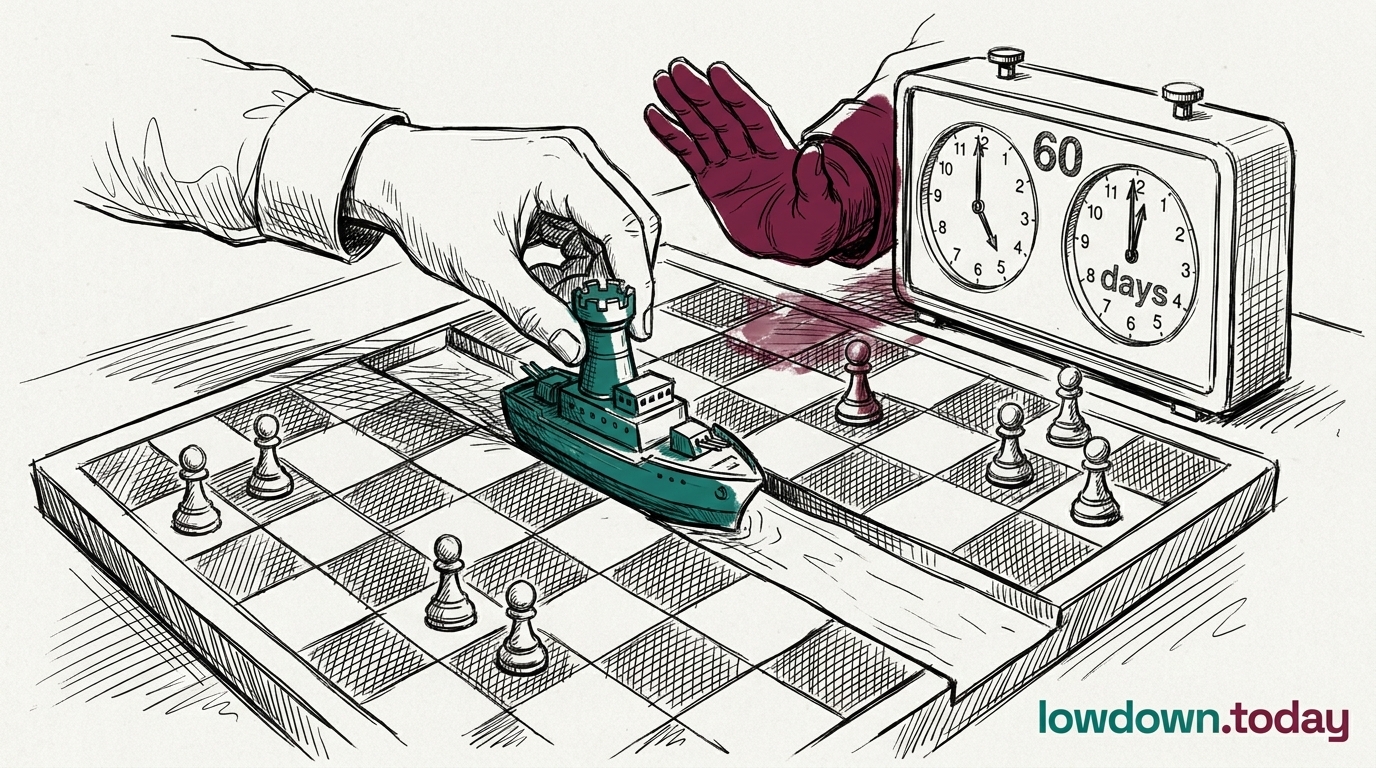
    A credible Macron-Starmer summit framework on 17 April provides the first post-war resolution pathway markets can price, likely pulling Brent toward $82-88 in a 60-day scenario

    Short term · 0.65
  • Risk

    Dual-chokepoint scenario; Houthi Bab el-Mandeb activation on top of partial Hormuz closure; remains entirely unpriced in the $94 band, implying catastrophic repricing to $130-150 if it materialises

    Medium term · 0.55
First Reported In

Update #69 · Cooper joins the instrument gap

Reuters Commodities· 15 Apr 2026
Read original
Different Perspectives
Oil markets
Oil markets
Brent fell $1.05 to $106.0 on summit Day 1 but remains $5-7 above the post-ceasefire equilibrium analysts modelled in March; the market is pricing a holding pattern, not a breakthrough. OilPrice.com and Aramco CEO Nasser converge on buffer-exhaustion before Hormuz reopens if the blockade extends past mid-June.
Iranian dissidents and human rights monitors
Hengaw documented a five-prison simultaneous execution cluster on 13 May, with Gorgan appearing for the first time in the wartime register. Espionage charges framed as Israel-linked moharebeh now extend across Mashhad, Karaj, and Gorgan, using the war as judicial cover for protest-era detainees.
BRICS / Global South
Araghchi's Delhi appearance positioned Iran as a victim of US aggression before non-Western foreign ministers, with Deputy FM Bagheri Kani calling on BRICS to act against US aggression. India, as the largest non-Chinese user of Iranian-routed crude, faces pressure to balance bloc solidarity against its own shipping and sanctions exposure.
China
China
Beijing accepted the Nvidia chip clearance on summit Day 1 and gave Rubio verbal acknowledgement of Iran as an Asian stability concern, having already put Pakistan on paper as the mediatory channel on 13 May (ID:3253), deflecting the US ask for direct Chinese action without refusing it.
Iran (government and civilian diplomatic track)
Araghchi denied any Hormuz obstruction at BRICS Delhi on 14 May while Iran's SNSC had finalised a Hormuz security plan the day before. Israel Hayom's single-sourced 15-year freeze offer gives Tehran a deployable figure in non-Western forums regardless of corroboration; the state attributed 3,468 wartime deaths with no independent verification.
United States (Trump administration and Senate moderates)
Trump signed a chip clearance for 10 Chinese firms on summit Day 1 and zero Iran instruments across 76 days; Rubio and Vance made verbal Iran asks without paper. Murkowski voted yes on the 49-50 war-powers resolution after Hegseth told the Senate that Article 2 makes an AUMF unnecessary.