Skip to content
You can now search across every topic, entity and event.What's new
Iran Conflict 2026
18APR

P&I deadline passes; Strait sealed

4 min read
14:57UTC

Every major P&I club has withdrawn war risk cover. More than 150 vessels sit at anchor with no insurance, no escorts, and no legal mechanism to move.

ConflictDeveloping
Key takeaway

The Hormuz closure is now a legal and contractual fact independent of military conditions — P&I club reinstatement requires weeks of independent risk reassessment that no ceasefire can accelerate.

At midnight Thursday, the deadline set by Gard, NorthStandard, and three other Protection & Indemnity clubs expired . No new commercial transits through the strait of Hormuz were documented overnight. More than 150 vessels sit at anchor in The Gulf of Oman and Arabian Sea, with no legal mechanism to move.

P&I insurance is the legal foundation of commercial shipping — without it, a vessel cannot be chartered, cannot enter most ports, and in many flag-state jurisdictions cannot lawfully sail. Every major P&I provider has now withdrawn war risk cover for The Gulf, Hormuz, and Iranian waters. The closure is no longer military-contingent. It is an insurance event. Vessel traffic had already fallen 80% below normal by Tuesday ; after Thursday midnight, the remaining trickle stopped.

President Trump announced Tuesday that the US Development Finance Corporation would provide government-backed political risk insurance and Navy escorts . Neither is operational. The US Navy told industry leaders it lacks sufficient assets for a regular convoy programme , according to Lloyd's List and US News. The last comparable effort — Operation Earnest Will during the 1987–88 tanker war — escorted 11 re-flagged Kuwaiti tankers over 14 months; the current crisis involves more than 150 vessels from dozens of flag states with no re-flagging framework in place.

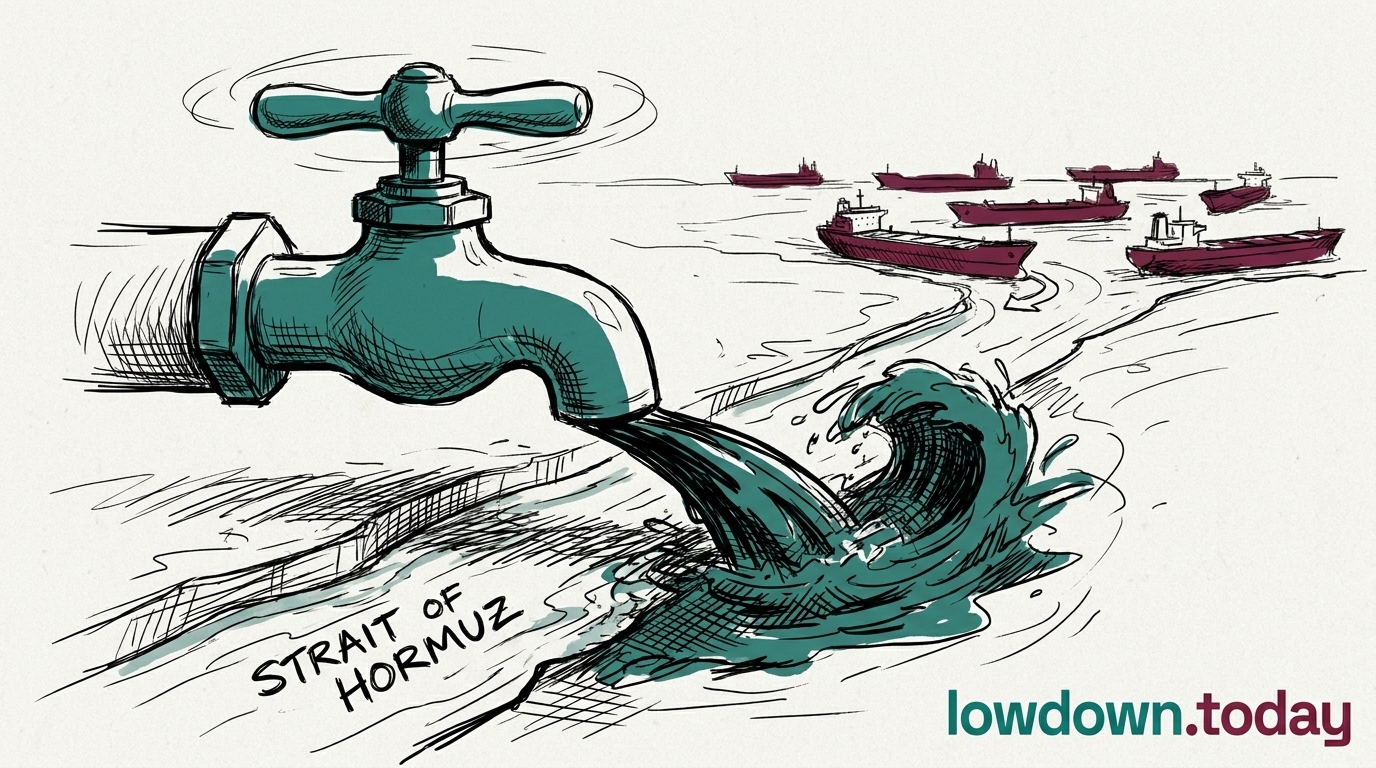
The structural consequence extends beyond the fighting. P&I clubs require weeks of risk reassessment, surveyor access, and underwriting review before reinstating coverage. Every day the closure holds adds days to the post-war reopening timeline — a self-reinforcing dynamic in which the economic damage of the war increasingly detaches from the war itself. Roughly 20% of the world's traded oil transits through Hormuz. The chokepoint is sealed not by mines or warships but by the absence of a signature on an insurance certificate.


Deep Analysis

In plain English

Shipping insurance clubs are mutuals owned by shipowners that insure vessels, cargo, and crew. They cannot offer coverage they cannot reinsure. When the reinsurance market — the companies that insure the insurers — stops pricing Hormuz transits, P&I clubs must withdraw entirely. Without P&I coverage, ships cannot obtain port clearance, crew insurance, or cargo acceptance anywhere in the world, regardless of whether they are physically able to transit. The US government announced two solutions — a DFC insurance backstop and Navy convoy escorts — but neither has been operationalised. Even a ceasefire announced today would not reopen the strait commercially: P&I clubs would need to reassemble risk models, obtain fresh reinsurance placements, and issue new certificates of entry — a process that takes weeks at minimum.

Deep Analysis
Synthesis

Both the DFC insurance programme and the Navy convoy announcement were made as deterrent signals rather than operational commitments — a pattern now exposed because shipping markets called the bluff. The administration has no short-term mechanism to restore commercial transit confidence, and the longer the gap between political announcement and operational delivery persists, the more credibility the deterrence framework loses with Gulf partners who are weighing their own exposure.

Root Causes

P&I clubs are legally bound to protect member shipowners from unlimited liability; they cannot retain risk they cannot reinsure. The DFC programme would require either a statutory federal war risk insurance backstop — analogous to the Air Transportation Safety and System Stabilization Act (2001), which cost approximately $300 million for aviation alone and required emergency legislation — or an executive indemnity instrument of uncertain legal authority. Neither has been issued. The Navy convoy gap reflects a structural under-investment in escort assets since the post-Cold War drawdown; the US surface fleet lacks the hulls to run a systematic Gulf convoy programme alongside existing Indo-Pacific and Atlantic commitments.

Escalation

The insurance closure creates a secondary pressure vector on Gulf host states — Qatar, UAE, and Bahrain — whose port revenues and LNG export economics depend on Hormuz passage. Sustained closure may push these states toward de-escalation rather than strikes on Iran, adding a quiet counterweight to the joint statement's 'option to respond' language.

What could happen next?
  • Risk

    Without a statutory federal war risk insurance backstop, the DFC programme cannot operationalise — leaving the administration's primary economic mitigation tool non-functional for the duration of the conflict.

    Immediate · Assessed
  • Consequence

    Asian LNG importers face spot market pressure as contracted Qatari deliveries halt, pushing structural renegotiation toward US and Australian LNG at a persistent price premium.

    Short term · Assessed
  • Consequence

    Each additional day of closure extends the post-ceasefire reopening timeline, as P&I clubs must conduct fresh risk assessments and obtain reinsurance placements before reinstating coverage.

    Medium term · Assessed
  • Precedent

    If P&I clubs enforce a commercially effective blockade independent of military action, this mechanism becomes available as a low-attribution economic pressure tool in future maritime chokepoint crises — Taiwan Strait, Black Sea.

    Long term · Suggested
First Reported In

Update #20 · Hormuz sealed; Senate war powers bill fails

Gas Outlook· 5 Mar 2026
Read original
Causes and effects
This Event
P&I deadline passes; Strait sealed
The Hormuz closure has shifted from military contingency to insurance law. With every major P&I club having withdrawn war risk cover, no vessel can legally transit regardless of military conditions. Trump's announced government-backed insurance and Navy escorts remain non-operational. The closure is self-sustaining: P&I clubs require weeks of reassessment to reinstate coverage, meaning every day of war adds days to the post-war reopening timeline.
Different Perspectives
Hengaw and Iranian protest detainees
Hengaw documented three secret executions of protest-linked detainees at Isfahan and Karaj on 15 and 16 July, including Mohammad Amini Dehaghani, hanged over a January arson charge with no public trial record. Tehran is carrying out capital punishment against 2026 protesters while global attention stays fixed on the war with the US.
Russia
Russia
OFAC named Moscow aviation firm Avratek OOO and its principals Mariya Selina and Vadim Druzhbin directly for the first time in this war's Iran arms track, under an Executive Order 13382 designation issued 15 July. The designation converts years of rhetorical claims about Russian arms supply to Iran into named, sanctionable individuals and a documented company.
Bahrain
Bahrain
Bahrain sounded air-raid sirens during Iran's 14 July Gulf-wide barrage and was struck again in the 16 July Artesh claim against Sheikh Isa air base, home to the US Fifth Fleet. Manama's air-defence stocks were already reported near-exhausted before this second strike claim against the same base in a week.
Kuwait
Kuwait
Kuwait's armed forces intercepted the drones Iran's Army claimed against Ali Al Salem air base on 16 July and separately reported intercepting missiles and drones in Iran's Gulf-wide barrage on 14 July. Kuwait now absorbs strikes from two rival Iranian commands while hosting Camp Arifjan, the US logistics base Iran also claims to have destroyed.
Iran (Artesh and IRGC)
Iran's regular Army claimed the 16 July drone strikes on Kuwait's Ali Al Salem and Bahrain's Sheikh Isa air bases under its own banner, Operation Saeqeh phase ten, while the IRGC separately claimed a mine strike closing Hormuz on 18 July. Two Iranian institutions are now claiming parallel operations, with neither claim confirmed by Kuwait, Bahrain or CENTCOM.
United States
United States
CENTCOM bombed the interior cities of Ahvaz and Yazd for the first time overnight into 17 July, Marines began boarding vessels including the tanker Wen Yao, and Treasury let General License X1 lapse at 12:01am the same day. Washington closed every remaining channel for de-escalation without a new executive action, a posture of attrition rather than a wind-down.



