Skip to content
Briefings are running a touch slower this week while we rebuild the foundations.See roadmap
Iran Conflict 2026
14APR

Oil surges past $103 on blockade

3 min read
09:22UTC

Brent crude jumped 8% past $103 on Monday, reversing the post-ceasefire drop and making Goldman Sachs's $120 Q3 severe scenario the operative frame.

ConflictDeveloping
Key takeaway

Goldman Sachs's $120 severe scenario is now the operative frame, not the tail risk.

Brent Crude surged 8% above $103 on the blockade announcement, reversing the post-ceasefire drop that had taken prices to $92.21 . Goldman Sachs had cut its Q2 Brent forecast to $90 after the ceasefire was announced. The blockade made that forecast obsolete within a day. Goldman's severe scenario, $120 by Q3, is now the operative frame rather than the tail risk .

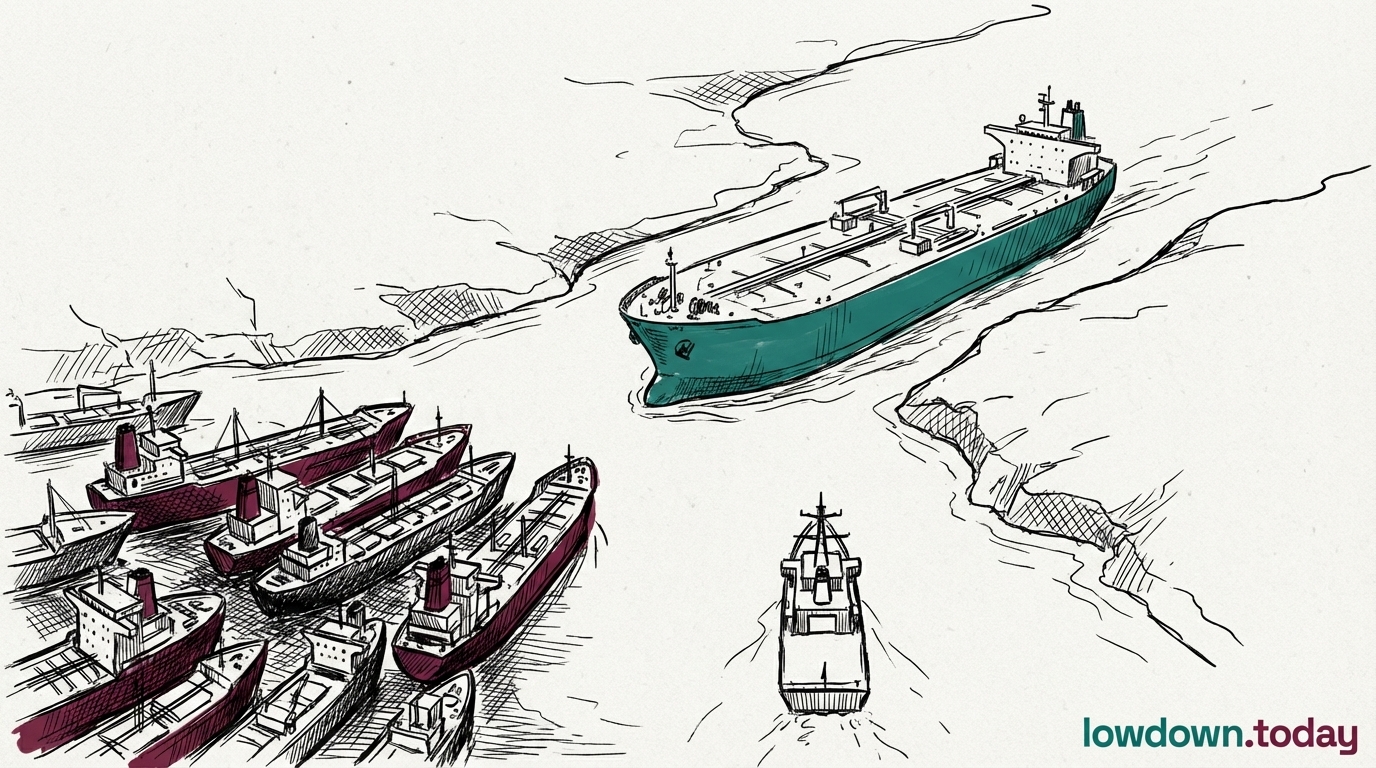
Approximately a dozen Iranian supertankers carrying an estimated $2.4 billion of crude sit stationary in the Gulf of Oman, caught between CENTCOM's blockade from one side and Iran's own mine and vetting regime from the other . The $2.4 billion figure derives from operational analysis rather than wire-service confirmation. 325 tankers remain stranded in the Gulf. Hormuz traffic, which had climbed to 17 transits by Saturday, dropped to near zero when enforcement started 1. 20,000 sailors aboard roughly 2,000 vessels are stranded.

Saudi Arabia has insulated itself: its Petroline pipeline, restored to full capacity, now routes all exports via the Red Sea, bypassing Hormuz. That protects Riyadh's revenue but does nothing for the 21 million bpd that normally transits the strait .

Deep Analysis

In plain English

Oil prices shot up sharply on Monday when the blockade was announced. Brent crude , the international benchmark for oil pricing , jumped 8% above $103 per barrel. For context, it had fallen to $92 after the ceasefire last week. Why does this matter to you? Oil prices feed into fuel prices at petrol stations, heating costs, and the cost of transporting goods. When oil goes up, almost everything gets slightly more expensive with a delay of a few weeks. Goldman Sachs, one of the world's largest banks, had previously predicted oil could reach $120 in the worst case. Before Monday, that seemed unlikely. Now analysts say it is possible without anything further going wrong.

What could happen next?
  • Consequence

    April CPI will layer blockade-driven fuel costs on top of March's 0.9% monthly rise , the largest since 1967 , creating a two-month compounding effect that central banks cannot offset without rate rises that would further damage consumer confidence.

    Short term · 0.85
  • Risk

    If Goldman's $120 scenario materialises, US Federal Reserve rate policy is constrained: cutting rates to support the economy while inflation is energy-driven would be politically untenable, forcing a stagflationary choice between growth and price stability.

    Medium term · 0.72
  • Opportunity

    Saudi Arabia, now exporting via Petroline and insulated from Hormuz disruption, benefits from elevated prices without the supply constraint , strengthening Riyadh's fiscal position and reducing its incentive to mediate a Hormuz resolution.

    Short term · 0.8
First Reported In

Update #67 · Trump blockades Iran on a tweet

CENTCOM / Al Jazeera· 13 Apr 2026
Read original
Different Perspectives
Qatar
Qatar
Qatar holds approximately $12 billion in frozen Iranian assets that Tehran named as the precondition for any Hormuz reopening sequence; with Oman sidelined and no agreed HEU custodian, the asset-routing architecture that any deal requires has no operational channel and no neutral financial intermediary to run it through.
Hengaw and Iranian civilian population
Iranians face an internet capped at 40 per cent by hardware their president cannot dismantle, field killings that leave no court record, and judicial executions running in parallel; Hengaw, based in Norway, is the primary remaining monitor of a repression system the IRGC is deliberately moving beyond auditable records. The real toll is higher than any single monitor's count.
China
China
China supplied deep-packet-inspection hardware that caps Iran's internet at 40 per cent and enables an instant on-demand blackout, and was barred by Trump as a potential HEU custodian on 27 May. Beijing gains from Iran's continued non-alignment with the West while the DPI sale extends Chinese surveillance-technology exports as a geopolitical instrument.
Pakistan
Pakistan
Foreign Minister Ishaq Dar met Rubio in Washington on 29 May, formally inheriting the role of sole active mediator after Oman's forced withdrawal. Pakistan lacks Oman's banking infrastructure for frozen-asset routing and carries its own regional stakes, making it a less structurally neutral broker for the Qatar-held $12 billion sequencing.
Kuwait
Kuwait
Kuwait invoked Article 51 of the UN Charter after absorbing an Iranian ballistic-missile strike on Ali Al Salem Air Base on 28 May, becoming the first Gulf state to make a formal individual self-defence claim in the war. The invocation creates a legal record enabling a future bilateral defence-pact activation without yet triggering it.
Oman
Oman
Oman denied any Hormuz toll plan within hours of Bessent's 28 May threat, absorbing a sanctions warning from the country it has brokered for since 1981. The rapid capitulation preserved the channel formally, but Tehran now knows Washington will threaten its own mediator, which changes Muscat's calculus on how far it can lean into any joint-management architecture.