Skip to content
Briefings are running a touch slower this week while we rebuild the foundations.See roadmap
Iran Conflict 2026
14APR

Bessent threat fails; Brent ignores Treasury

4 min read
09:22UTC

The US Treasury Secretary described secondary sanctions as the financial equivalent of bombing. Oil markets priced the statement as rhetoric and Brent drifted lower.

ConflictDeveloping
Key takeaway

Compliance officers priced the Treasury Secretary's threat as rhetoric because no designation list has been filed.

US Treasury Secretary Scott Bessent announced on 15 April that OFAC General Licence U (GL-U), the Treasury authorisation covering Iranian-origin crude loaded before 20 March, would not be renewed when it lapses on 19 April, and described secondary sanctions as "the financial equivalent of the bombing campaign". Brent crude closed near $95 a barrel the same day and drifted lower on 16 April. A Lowdown audit of the White House presidential-actions page found zero Iran-related executive orders, proclamations or memoranda since 6 February across 47 days of war.

The Office of Foreign Assets Control (OFAC), Treasury's sanctions enforcement agency, published no designations alongside Bessent's remarks. Secondary sanctions work by putting named entities on a list that triggers US dollar-access risk at any non-US bank that touches them; without a list, compliance desks cannot price the exposure. The instrument-free US record, confirmed at 45 days and now extended to 47, has moved from a presidential pattern to a Cabinet one. OFAC last published an Iran designation 25 days ago while amending Russia and Venezuela general licences during the same window.

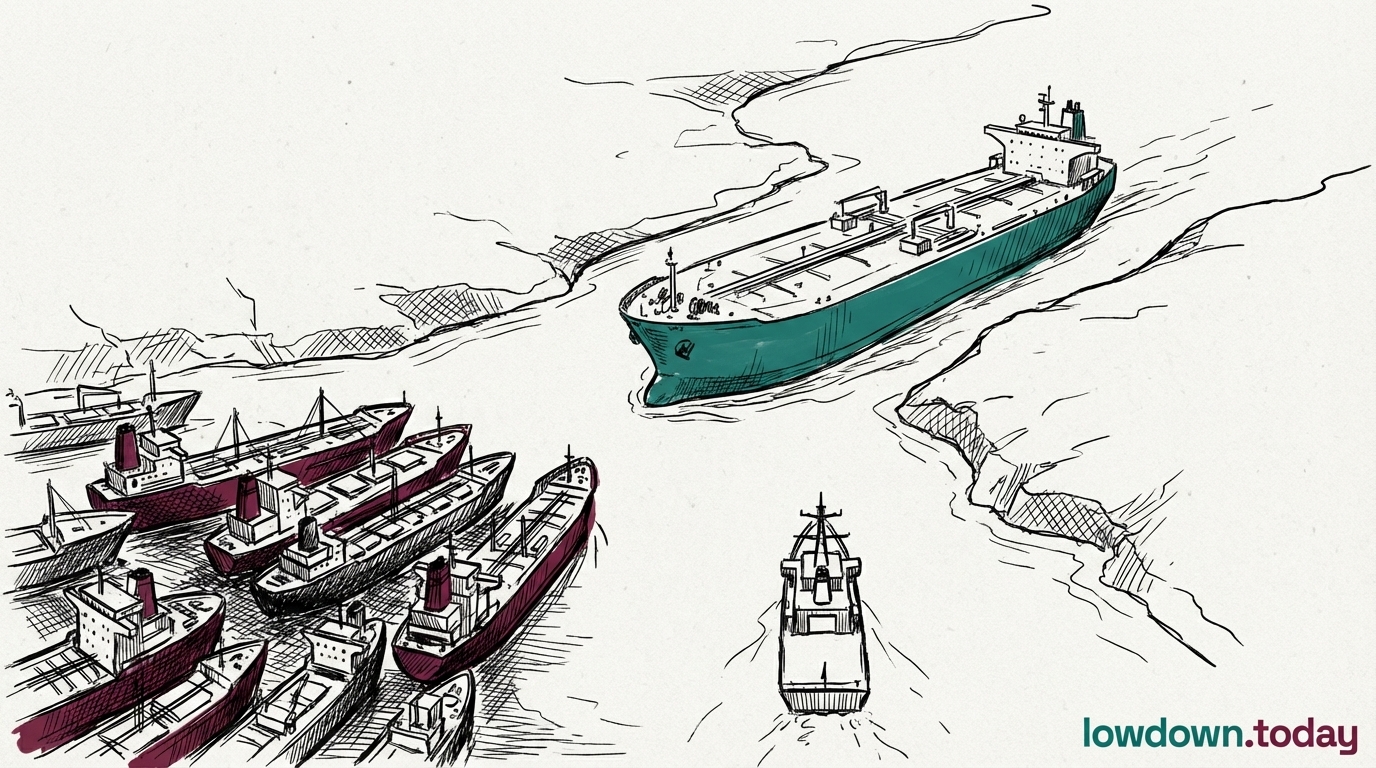
GL-U lapsing on 19 April, first flagged nine days before expiry , removes legal cover from roughly 325 tankers and 140 million barrels of Iranian crude three days before the ceasefire window closes on 22 April. No successor instrument has been filed. Markets have now observed two consecutive verbal escalations, Trump's Truth Social blockade order and Bessent's sanctions threat, followed by no matching text, and are pricing the partial blockade plus the licence lapse rather than the maximum-pressure posture announced.

The diagnostic is mechanical, not rhetorical. If a designation list appears before 19 April, repricing begins at the scope of the named entities. If it does not, the Bessent threat will read like the blockade order: maximum-pressure language, minimum-pressure text. Any subsequent designation then carries less shock value, because the threat was pre-announced and the market chose not to believe it.

Deep Analysis

In plain English

The US Treasury runs a system called OFAC that enforces financial sanctions, essentially a list of banned transactions and entities that any company doing dollar business globally must comply with. In March, OFAC issued a special licence called GL-U that temporarily allowed certain transactions involving Iranian oil already loaded onto ships. That licence expires on 19 April. Treasury Secretary Scott Bessent announced on 15 April it would not be renewed, implying that companies still involved in Iranian oil after that date could face US sanctions. The problem is that OFAC has not actually published any new sanctions against any specific company or individual for 25 days, and the wider Iran sanctions regime has not been signed into a formal presidential order. The announcement, in other words, is a threat without the paperwork behind it, which is why oil markets barely moved.

Deep Analysis
Root Causes

The GL-U expiry without a successor instrument has one structural cause: the war has been conducted without any published presidential legal framework. Every escalation order, from the blockade to the ceasefire to the enrichment ultimatum, exists as a Truth Social post .

OFAC cannot issue designations against a sanctions regime whose geographic and legal scope has not been defined in a signed executive order. The 25-day OFAC silence is not inaction; it is the operational consequence of the absent instrument.

A second cause is the dual-track pressure design. The Trump administration simultaneously conducted military operations and sanctions pressure against Iran in 2018-2019 and discovered the two tracks competed: tightening sanctions while signalling willingness to negotiate undermined both. The current pattern, verbal escalation from Bessent with no OFAC follow-through, may reflect awareness of that dynamic at the Treasury level even while the White House rhetoric implies escalation.

Escalation

The GL-U non-renewal without designations creates a legal cliff on 19 April that will test whether Bessent's rhetoric is backed by enforcement infrastructure. A spike in OFAC activity before 19 April would confirm the threat is real; continued silence would confirm the market's current scepticism. The 29 April WPR clock and 22 April ceasefire expiry arrive in the same week, creating a convergence of deadlines any one of which could produce rapid price or diplomatic movement.

What could happen next?
  • Risk

    If OFAC publishes no designations before 19 April, secondary-sanctions credibility collapses and Chinese buyers interpret the lapse as tacit permission to resume Iranian crude purchases at scale.

    Immediate · 0.75
  • Consequence

    325 tankers lose P&I insurance backing when GL-U lapses, creating stranded-cargo litigation that will outlast the conflict itself.

    Short term · 0.85
  • Precedent

    Conducting a war through social-media posts without signed executive instruments establishes that a US president can impose financial penalties on foreign actors without formal legal architecture.

    Long term · 0.7
First Reported In

Update #70 · Europe signs what America won't

Bloomberg· 16 Apr 2026
Read original
Different Perspectives
Qatar
Qatar
Qatar holds approximately $12 billion in frozen Iranian assets that Tehran named as the precondition for any Hormuz reopening sequence; with Oman sidelined and no agreed HEU custodian, the asset-routing architecture that any deal requires has no operational channel and no neutral financial intermediary to run it through.
Hengaw and Iranian civilian population
Iranians face an internet capped at 40 per cent by hardware their president cannot dismantle, field killings that leave no court record, and judicial executions running in parallel; Hengaw, based in Norway, is the primary remaining monitor of a repression system the IRGC is deliberately moving beyond auditable records. The real toll is higher than any single monitor's count.
China
China
China supplied deep-packet-inspection hardware that caps Iran's internet at 40 per cent and enables an instant on-demand blackout, and was barred by Trump as a potential HEU custodian on 27 May. Beijing gains from Iran's continued non-alignment with the West while the DPI sale extends Chinese surveillance-technology exports as a geopolitical instrument.
Pakistan
Pakistan
Foreign Minister Ishaq Dar met Rubio in Washington on 29 May, formally inheriting the role of sole active mediator after Oman's forced withdrawal. Pakistan lacks Oman's banking infrastructure for frozen-asset routing and carries its own regional stakes, making it a less structurally neutral broker for the Qatar-held $12 billion sequencing.
Kuwait
Kuwait
Kuwait invoked Article 51 of the UN Charter after absorbing an Iranian ballistic-missile strike on Ali Al Salem Air Base on 28 May, becoming the first Gulf state to make a formal individual self-defence claim in the war. The invocation creates a legal record enabling a future bilateral defence-pact activation without yet triggering it.
Oman
Oman
Oman denied any Hormuz toll plan within hours of Bessent's 28 May threat, absorbing a sanctions warning from the country it has brokered for since 1981. The rapid capitulation preserved the channel formally, but Tehran now knows Washington will threaten its own mediator, which changes Muscat's calculus on how far it can lean into any joint-management architecture.