Skip to content
Briefings are running a touch slower this week while we rebuild the foundations.See roadmap
Iran Conflict 2026
12APR

Trump Replaces Own Deadline With Fourth Ultimatum

2 min read
08:59UTC

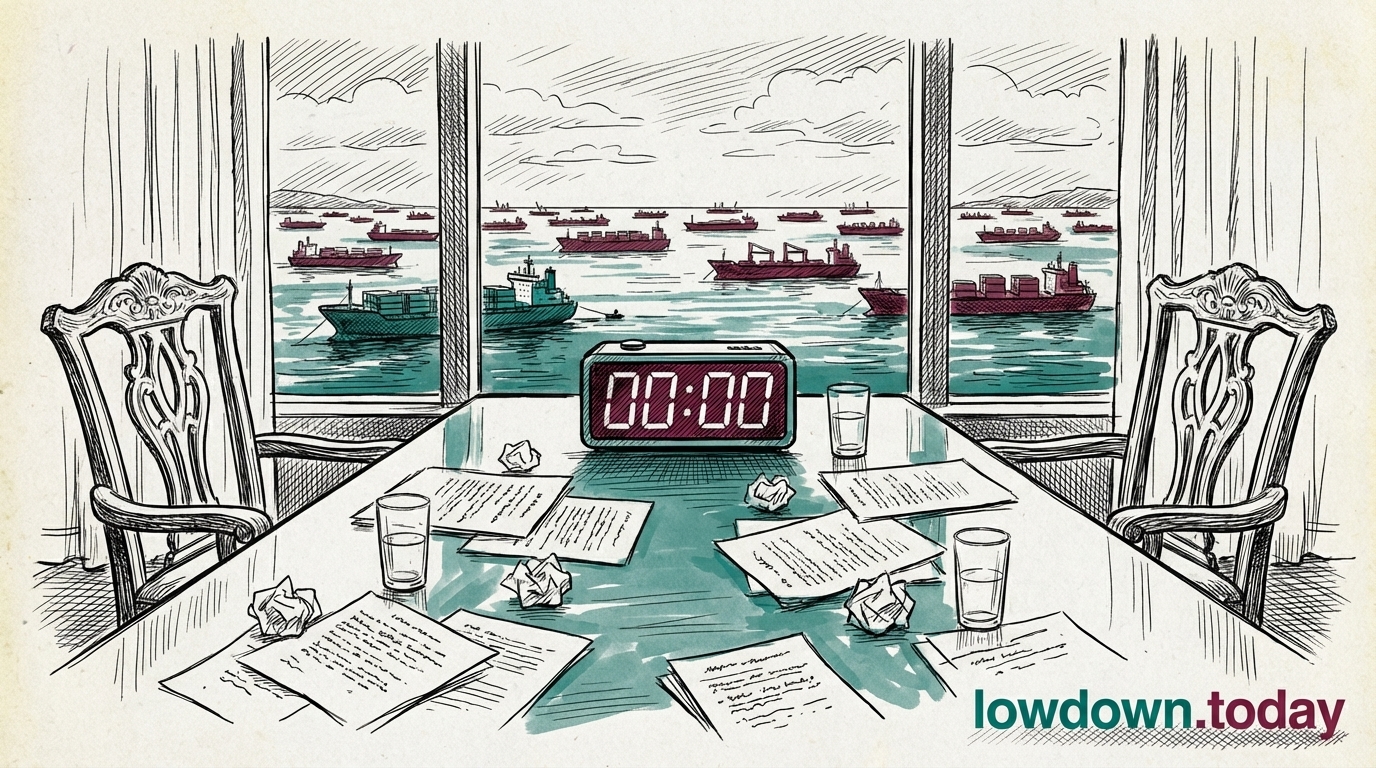
The 6 April power-grid threat has been displaced by a 48-hour Hormuz demand expiring Monday. It is the fourth reformulation in six weeks.

ConflictAssessed
Key takeaway

Four deadlines in six weeks with zero enforcement has exhausted the threat's credibility.

Donald Trump issued a new 48-hour Hormuz ultimatum via Truth Social on 4 April, superseding his own 6 April power-grid deadline : "Time is running out, 48 hours before all Hell will reign down on them." The new expiry is Monday 7 April. 1

The threat changed shape again. The March deadline targeted 15 identified power grid nodes. The April formulation threatens power plants, oil facilities, and "possibly all desalination plants." The 16 March deadline was extended to 23 March. The 23 March deadline was extended to 6 April. The 6 April deadline was displaced, not extended, by an entirely new ultimatum issued 24 hours before its expiry. Four coercive ultimatums in 42 days, none acted upon.

Ceasefire talks are at a "dead end" per the Wall Street Journal on 3 April. 2 Iran refused to meet US officials in Islamabad. Iran's conditions (reparations, US base withdrawal, guarantees against future attacks) and Washington's single demand (reopen Hormuz) share no overlap. General Aliabadi dismissed Trump as "helpless, nervous, unbalanced and stupid." The deadline mechanism no longer functions as coercive leverage. It functions as domestic political communication.

Deep Analysis

In plain English

In the past six weeks, the US president has set four separate deadlines for Iran to reopen a critical shipping lane, each time threatening to attack Iranian infrastructure if the deadline was not met. None of the four deadlines has been enforced. This is a problem for whoever issues the next threat. In diplomacy, a threat only works if the other side believes you will actually do it. Four unanswered threats suggest you might not, which makes the fifth threat easier to ignore.

What could happen next?
  • Consequence

    The credibility of US coercive diplomacy toward Iran has been materially degraded by four unenforced ultimatums. Restoring it requires either enforcement or a fundamentally different coercive instrument.

First Reported In

Update #59 · Day 37: A Ground War Inside Iran That Nobody Will Name

Jerusalem Post· 5 Apr 2026
Read original
Different Perspectives
Qatar
Qatar
Qatar holds approximately $12 billion in frozen Iranian assets that Tehran named as the precondition for any Hormuz reopening sequence; with Oman sidelined and no agreed HEU custodian, the asset-routing architecture that any deal requires has no operational channel and no neutral financial intermediary to run it through.
Hengaw and Iranian civilian population
Iranians face an internet capped at 40 per cent by hardware their president cannot dismantle, field killings that leave no court record, and judicial executions running in parallel; Hengaw, based in Norway, is the primary remaining monitor of a repression system the IRGC is deliberately moving beyond auditable records. The real toll is higher than any single monitor's count.
China
China
China supplied deep-packet-inspection hardware that caps Iran's internet at 40 per cent and enables an instant on-demand blackout, and was barred by Trump as a potential HEU custodian on 27 May. Beijing gains from Iran's continued non-alignment with the West while the DPI sale extends Chinese surveillance-technology exports as a geopolitical instrument.
Pakistan
Pakistan
Foreign Minister Ishaq Dar met Rubio in Washington on 29 May, formally inheriting the role of sole active mediator after Oman's forced withdrawal. Pakistan lacks Oman's banking infrastructure for frozen-asset routing and carries its own regional stakes, making it a less structurally neutral broker for the Qatar-held $12 billion sequencing.
Kuwait
Kuwait
Kuwait invoked Article 51 of the UN Charter after absorbing an Iranian ballistic-missile strike on Ali Al Salem Air Base on 28 May, becoming the first Gulf state to make a formal individual self-defence claim in the war. The invocation creates a legal record enabling a future bilateral defence-pact activation without yet triggering it.
Oman
Oman
Oman denied any Hormuz toll plan within hours of Bessent's 28 May threat, absorbing a sanctions warning from the country it has brokered for since 1981. The rapid capitulation preserved the channel formally, but Tehran now knows Washington will threaten its own mediator, which changes Muscat's calculus on how far it can lean into any joint-management architecture.