Skip to content
Briefings are running a touch slower this week while we rebuild the foundations.See roadmap
Iran Conflict 2026
11APR

Trump claims Hormuz prize; Iran silent

4 min read
11:03UTC

The president declared victory on the same day the Pentagon ordered the 82nd Airborne to the Middle East and Iran denied that any negotiations were taking place.

ConflictDeveloping
Key takeaway

Trump's Hormuz 'prize' framing reveals the deal's economic core: Iranian navigation guarantees exchanged for comprehensive sanctions relief.

"We've won this," President Trump told reporters on Monday. Iran, he said, had offered "a very significant prize" related to the strait of Hormuz. He provided no detail of what the prize was, who conveyed it, or under what conditions.

The claim arrived on a day that contradicted it. The Pentagon ordered the 82nd Airborne Division headquarters to the Middle East, with 1,000 to 2,000 additional troops preparing to deploy. Three Pentagon sources confirmed active planning for the seizure of Kharg Island, which handles 90% of Iran's oil exports 1. Hours later, Iran resumed hourly missile barrages against Israeli cities. Trump's rhetoric has followed an escalating arc: on 19 March, the US was "getting very close" to its objectives ; on 23 March, he cited "very good and productive conversations" ; on 24 March, outright victory. Each statement preceded further military escalation rather than de-escalation.

The Hormuz claim carries weight because markets respond to it before verification arrives. Brent Crude crashed 10.9% to $99.94 on Sunday's talks announcement — its first close below $100 since 11 March — then rebounded to $102–$104 on Monday as claimed progress failed to materialise on the ground. Traders are pricing presidential rhetoric as if it were established fact, then correcting when the battlefield does not follow. The resulting volatility compounds the war's economic costs independently of the underlying supply disruption.

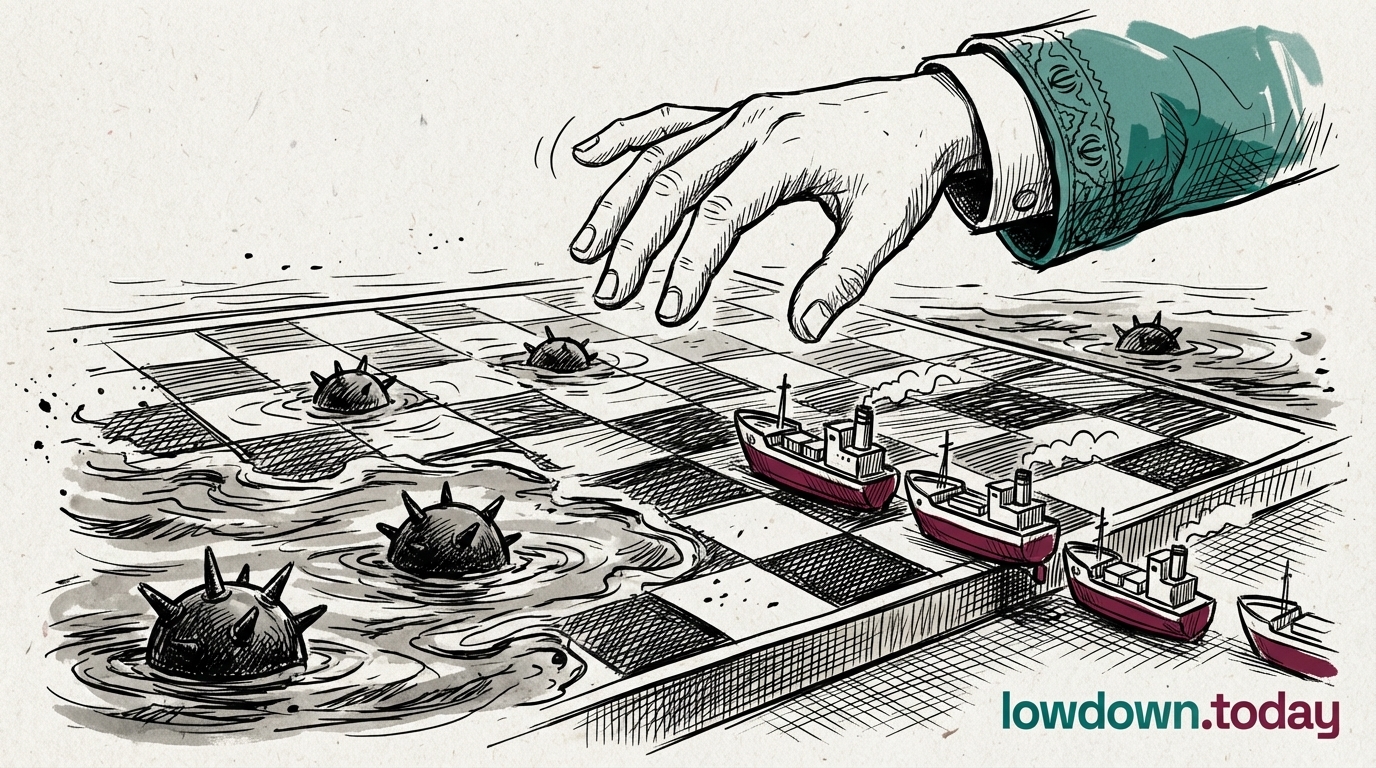
Iran's position on the strait has not visibly shifted. The IRGC toll system remains operational, with approximately 90 vessels transiting under Iranian clearance in the first two weeks of March . Foreign Minister Araghchi articulated a selective blockade — open to non-hostile nations, closed to "enemies" . Iran's Defence Council threatened to mine all Gulf access routes if Iranian coasts or islands are attacked . Tehran denied any negotiations. Ghalibaf called Trump's claims an effort to "manipulate the financial and oil markets." The sole data point that does not flatly contradict the president: a senior foreign ministry official told CBS News that US proposals conveyed through mediators "are being reviewed" 2. That formulation acknowledges receipt of a message, not agreement to a deal.

Deep Analysis

In plain English

Trump told reporters the US had won the war and that Iran had offered something significant relating to the Strait of Hormuz — the narrow channel through which roughly one-fifth of the world's daily oil supply passes. This suggests Iran is offering guarantees that it will not close or threaten the strait in exchange for a ceasefire and sanctions lifting. The statement appears designed simultaneously to project domestic strength and to talk down energy prices, which have risen sharply under the conflict. Iranian attacks resumed the same day, immediately undermining the claim.

Deep Analysis
Synthesis

The Hormuz reference is the most analytically significant element of Trump's statement and is absent from the narrative's main diplomatic analysis. The strait carries approximately 21 million barrels per day — roughly 21% of global oil supply. An Iranian non-interference commitment would allow war-risk insurance premiums to normalise, unlocking the largest structural cost driver embedded in current oil pricing. This explains the magnitude of Sunday's Brent collapse: markets priced in not merely a ceasefire but the removal of the Hormuz closure premium. The 'prize' framing also reveals Tehran's negotiating logic — Iran is trading its most powerful remaining non-nuclear economic lever in exchange for comprehensive sanctions relief and implicit US recognition of regime survival.

Root Causes

Trump's victory declaration serves a specific domestic political function distinct from its diplomatic role. With US petrol averaging $3.98 per gallon — the largest single-month increase in 30 years — projecting imminent success is simultaneously an attempt to talk down commodity prices. Sunday's 10.9% Brent crash on the ceasefire announcement confirmed this transmission mechanism is operating: presidential rhetoric is now functioning as a commodity market instrument.

What could happen next?
1 meaning1 consequence2 risk1 opportunity
  • Meaning

    The Hormuz framing reveals the deal's economic architecture: Iran trades navigation guarantees — its most powerful non-nuclear leverage — for sanctions relief and implicit recognition of regime continuity.

    Immediate · Assessed
  • Consequence

    The 10.9% Brent crash on Trump's announcement confirms presidential statements are functioning as a commodity market instrument, creating incentives for continued optimistic rhetoric regardless of ground reality.

    Immediate · Assessed
  • Risk

    A premature victory declaration followed by continued Iranian attacks could collapse domestic Congressional support for further war funding at precisely the moment the $200 billion supplemental faces bipartisan opposition.

    Short term · Suggested
  • Risk

    If the deal fails after Trump declared victory, domestic political costs may constrain future escalation options and embolden Iranian negotiators to harden their terms.

    Medium term · Suggested
  • Opportunity

    If a deal closes within weeks, the premature framing becomes retrospectively accurate — Nixon's 1972 precedent suggests premature claims do not necessarily become permanent political liabilities.

    Short term · Suggested
First Reported In

Update #47 · 82nd Airborne to Gulf; Trump claims victory

CBS News· 25 Mar 2026
Read original
Causes and effects
This Event
Trump claims Hormuz prize; Iran silent
Presidential declarations of victory that are not matched by battlefield facts create a self-undermining cycle: markets move on the rhetoric, then correct when reality intrudes, producing volatility that compounds the war's economic damage independently of the underlying supply disruption.
Different Perspectives
Qatar
Qatar
Qatar holds approximately $12 billion in frozen Iranian assets that Tehran named as the precondition for any Hormuz reopening sequence; with Oman sidelined and no agreed HEU custodian, the asset-routing architecture that any deal requires has no operational channel and no neutral financial intermediary to run it through.
Hengaw and Iranian civilian population
Iranians face an internet capped at 40 per cent by hardware their president cannot dismantle, field killings that leave no court record, and judicial executions running in parallel; Hengaw, based in Norway, is the primary remaining monitor of a repression system the IRGC is deliberately moving beyond auditable records. The real toll is higher than any single monitor's count.
China
China
China supplied deep-packet-inspection hardware that caps Iran's internet at 40 per cent and enables an instant on-demand blackout, and was barred by Trump as a potential HEU custodian on 27 May. Beijing gains from Iran's continued non-alignment with the West while the DPI sale extends Chinese surveillance-technology exports as a geopolitical instrument.
Pakistan
Pakistan
Foreign Minister Ishaq Dar met Rubio in Washington on 29 May, formally inheriting the role of sole active mediator after Oman's forced withdrawal. Pakistan lacks Oman's banking infrastructure for frozen-asset routing and carries its own regional stakes, making it a less structurally neutral broker for the Qatar-held $12 billion sequencing.
Kuwait
Kuwait
Kuwait invoked Article 51 of the UN Charter after absorbing an Iranian ballistic-missile strike on Ali Al Salem Air Base on 28 May, becoming the first Gulf state to make a formal individual self-defence claim in the war. The invocation creates a legal record enabling a future bilateral defence-pact activation without yet triggering it.
Oman
Oman
Oman denied any Hormuz toll plan within hours of Bessent's 28 May threat, absorbing a sanctions warning from the country it has brokered for since 1981. The rapid capitulation preserved the channel formally, but Tehran now knows Washington will threaten its own mediator, which changes Muscat's calculus on how far it can lean into any joint-management architecture.