Skip to content
Briefings are running a touch slower this week while we rebuild the foundations.See roadmap
Iran Conflict 2026
9APR

Trump demands Iran's surrender

3 min read
11:02UTC

Trump invoked the language of total war last used against Japan in 1945. Iran has no authority capable of accepting the terms, and no military mechanism exists to compel them.

ConflictDeveloping
Key takeaway

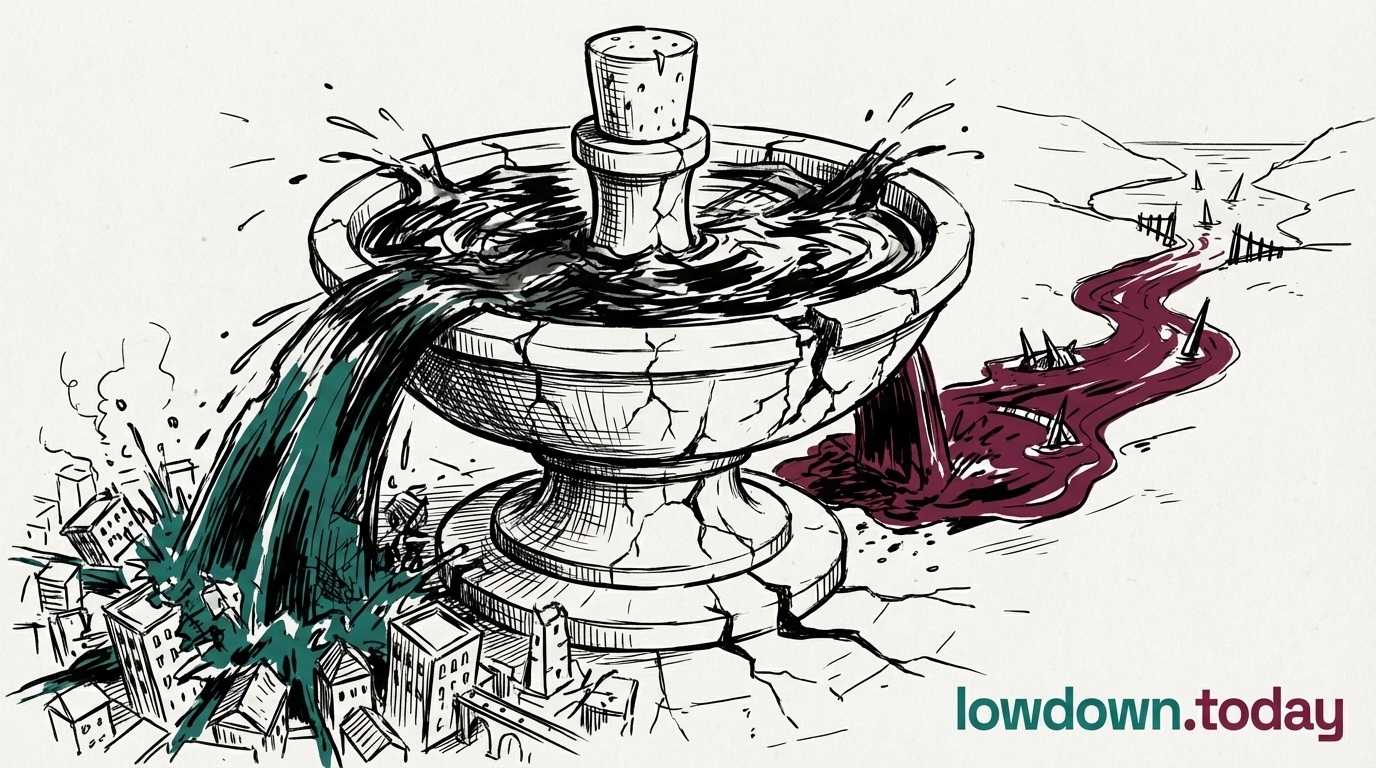
Trump's unconditional surrender demand creates a war aim with no legal mechanism for fulfilment under the UN Charter framework and no identifiable recipient in Iran's present governance vacuum — potentially guaranteeing indefinite military operations with no defined endpoint.

President Trump declared on Friday that "there will be no deal with Iran except UNCONDITIONAL SURRENDER," posted on Truth Social and repeated in public remarks. He simultaneously claimed Iran has "no air force, no air defence, no navy." The demand has escalated in a documented sequence over seven days: the campaign opened on 28 February targeting nuclear infrastructure; by mid-week, CENTCOM received orders to "dismantle the Iranian regime's security apparatus" — a directive encompassing the IRGC, Basij, MOIS, and internal security forces. Unconditional surrender goes further. It is the language of total state defeat, last demanded by an American president when the Potsdam Declaration of July 1945 required Japan's capitulation.

The historical parallel exposes the distance between the demand and the means available to enforce it. Japan's surrender followed two atomic bombings, a total naval blockade, the Soviet Union's entry into the Pacific war, and the imminent prospect of a ground invasion planned to involve over a million troops. Even then, the Japanese cabinet split evenly on whether to accept, and Emperor Hirohito's personal intervention was required to break the deadlock. Germany's unconditional surrender required Allied armies to physically occupy every square kilometre of the country. No air campaign in modern history has produced unconditional surrender. NATO bombed Serbia for 78 days in 1999 and achieved a negotiated withdrawal from Kosovo — not capitulation. Operation Desert Storm's air war expelled Iraq from Kuwait but left Saddam Hussein's government intact for twelve more years. The Vietnam air campaign, sustained for eight years, ended in a negotiated agreement Washington later could not enforce.

The demand defines success as something the current operation cannot deliver — and the absence of any functioning diplomatic channel means there is no mechanism to receive a capitulation even if one were offered. Ayatollah Khamenei is dead, his funeral postponed indefinitely . Mojtaba Khamenei's succession remains unannounced, the Assembly of Experts session subject to boycott threats from at least eight members . Foreign Minister Araghchi — once the most flexible senior Iranian voice, the official who told Oman Tehran was "open to serious de-escalation efforts"publicly closed the door on negotiations . The CIA back-channel was rejected within hours of its disclosure . Acting President Mokhber stated Iran has "no intention" of negotiating . The unconditional surrender demand has, at present, no recipient and no delivery mechanism. It is a war aim that requires either ground occupation or diplomatic negotiation to achieve, and The Administration has foreclosed both.

Deep Analysis

In plain English

When a country demands 'unconditional surrender,' it means the other side must give up completely with no conditions or guarantees — the way Germany and Japan surrendered in 1945. The problem is that this only works when there is a functioning government with the authority and willingness to sign those terms. Iran's supreme leader has just died with no confirmed successor, its military is under active bombardment, and its chief diplomat has publicly closed the door on any talks. There is no one with both the authority and the capacity to formally surrender. This means the demand may be structurally impossible to meet — which could extend the war indefinitely, since the US has set a threshold it cannot force anyone to cross.

Deep Analysis
Synthesis

The demand creates a structurally self-fulfilling condition: since Iran cannot offer unconditional surrender under any realistic scenario, the US retains perpetual justification for continued operations without ever having to declare its aims achieved or acknowledge failure. The impossibility may be a deliberate feature — it removes the administration's obligation to accept any outcome short of total Iranian state collapse as sufficient.

Root Causes

The unconditional surrender framing serves a domestic political function independent of its strategic feasibility: it forecloses any future accusation that the administration accepted a weak deal. By setting an effectively unachievable threshold, the administration retains permanent justification for continued military action and cannot be held to a specific, falsifiable definition of victory. This is political insurance, not strategic war-aim setting.

What could happen next?
  • Risk

    Third-party mediators — Qatar, Oman, Turkey — who operate within a 'deal' framework have no role when the stated US position excludes any deal; every diplomatic off-ramp is structurally closed by the demand itself.

    Immediate · Assessed
  • Precedent

    First use of 'unconditional surrender' language by a US president since 1945 resets expected thresholds for US war termination — adversaries in future crises will recalibrate their assumptions about Washington's willingness to accept negotiated outcomes.

    Long term · Assessed
  • Consequence

    Gulf Arab states and European governments privately pressing for a negotiated off-ramp find their diplomatic leverage negated by a US position that refuses any deal — reducing their influence to post-conflict reconstruction rather than conflict termination.

    Short term · Assessed
First Reported In

Update #24 · Trump demands unconditional surrender

Al Jazeera· 6 Mar 2026
Read original
Different Perspectives
Civilians and prisoners inside Iran
Mojtaba Kian was hanged in under 50 days from arrest, the fastest wartime espionage case in Hengaw's record, as Trump announced a peace deal. Amnesty places Iran's 2026 execution count above 200 at its fastest pace in 44 years; the diplomatic track has not altered the internal enforcement tempo.
China
China
Beijing accepted a Pakistani civilian briefing mission on the same day OFAC's GL V expired, keeping itself inside the deal architecture without being a named signatory. How Chinese banks respond to Monday's Hengli dollar-clearing decision is the first real-world test of whether the verbal MOU carries any institutional weight.
Pakistan
Pakistan
Islamabad split its highest-level delegation: army chief Munir to Tehran on the security track, Prime Minister Sharif and Foreign Minister Dar to Beijing before Monday's GL V-driven bank compliance decision. The architecture routes the deal's hardest problem, IRGC buy-in, through the general-officer channel that has extracted every wartime concession.
Israeli government
Israeli government
An unnamed Israeli official told the Times of Israel that Trump privately told Netanyahu the deal will dismantle Iran's nuclear programme and remove all its uranium, terms incompatible with what Tehran and a Reuters source describe. If Netanyahu believes he was promised full dismantlement and the deal delivers less, Israel holds a sabotage veto before any signature.
Iranian Foreign Ministry
Spokesman Esmail Baghaei told state agency IRNA that nuclear issues are 'not in the current negotiations text' and the sequencing is: end the war first, then negotiate nuclear over two months. Baghaei's formulation preserves Khamenei's 21 May uranium-stay directive while letting the civilian diplomacy track continue.
Donald Trump / White House
Trump declared the Iran deal 'largely negotiated' on 23 May via Truth Social and signed nothing; the White House's only paper was a Memorial Day proclamation. The verbal-track method converts maximum political signalling into minimum legal exposure: no congressional notification, no Senate treaty ratification, no instrument for Iran to formally reject.