Skip to content
Briefings are running a touch slower this week while we rebuild the foundations.See roadmap
Iran Conflict 2026
28MAR

Brent at $94.79: markets price the gap

3 min read
17:06UTC

Lowdown Newsroom

ConflictDeveloping
Key takeaway

Brent has priced partial enforcement and two catalysts this week can move it either way.

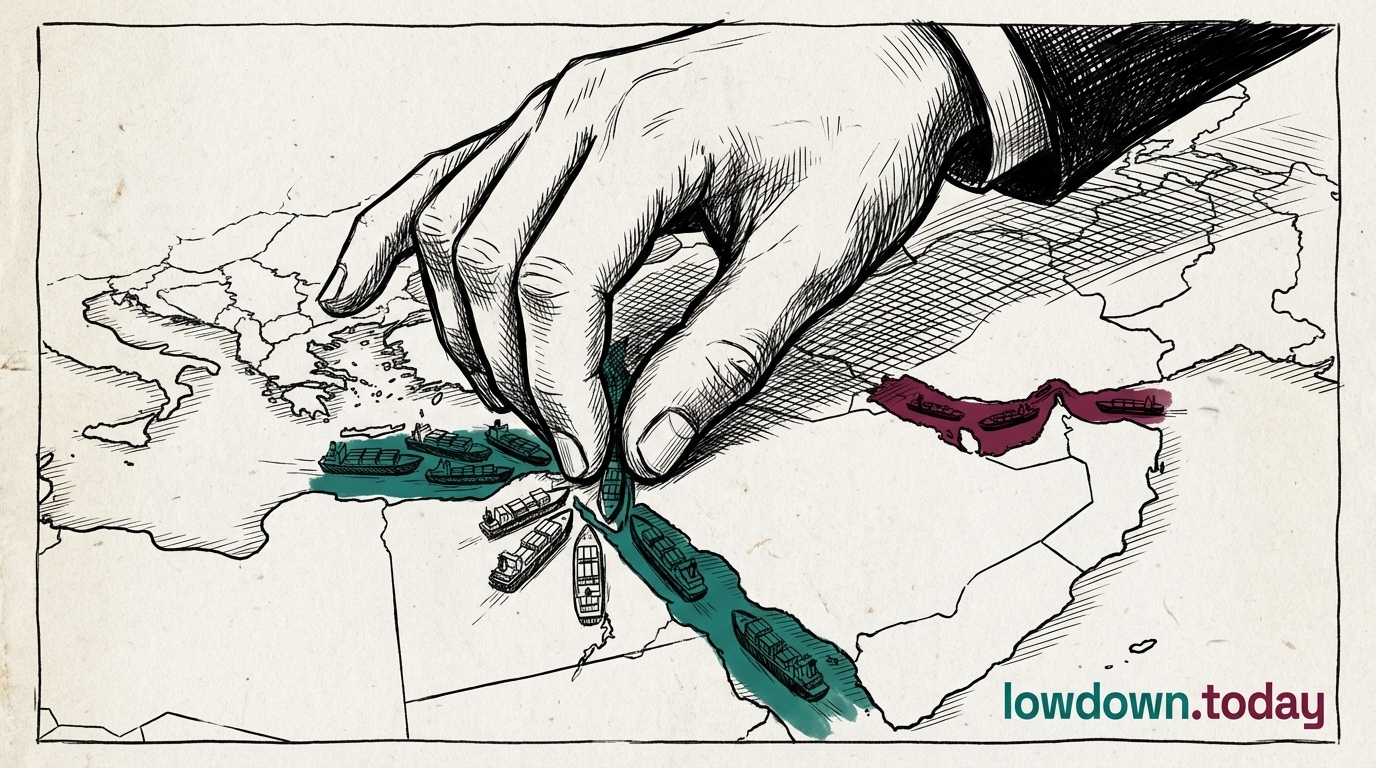
Brent Crude closed at $94.79 on Tuesday, down from the blockade-day peak in the previous session , still roughly two-fifths above the pre-war baseline. The move is consistent with traders watching the operational order rather than the admiral's lectern. Interdiction of Iranian-port traffic is priced in; the continuing carve-out for sanctioned non-Iranian-port tankers, documented when Windward tracked sanctioned dark-fleet vessels using scrapped ship identities , caps the upside by keeping partial supply flowing.

For drivers and consumers, that premium is what a partial blockade feels like at the pump. Brent has held in a narrow band this week because neither a full-closure path nor a resolution path is the base case. Two catalysts inside the coming week could shift the balance. The sanctions licence expiring mid-week, covered in the Senate vote cluster above, would tip enforcement risk sharply higher if Treasury lets it lapse without a successor; a spike back through Monday's peak is the likely response. A credible multilateral Hormuz framework published out of the Paris summit on Friday would tip the other way; a pullback towards the eighties becomes plausible.

Both catalysts arrive before the weekend. The dual-chokepoint scenario, a Houthi closure of Bab el-Mandeb on top of a continued Hormuz operation, is not priced at all. If it becomes a planning variable rather than a rhetorical threat, the repricing towards the deep triple-digit range would not be gradual.

Deep Analysis

In plain English

Brent crude; the main global price for oil; closed at about $95 on 14 April. That is 40 per cent above where it was before the Iran war started, but it has also come down from above $103 when the blockade was first announced. The price is stuck in the middle because markets are pricing a partial blockade: some ships are being stopped, some are getting through. Two things could move it significantly this week. On Sunday (19 April), a US government permit that legally allowed certain ships to deliver Iranian oil expires. If the US government does not renew it, about 325 tankers suddenly face legal problems with their cargoes; and oil prices could spike. But if France and the UK's conference on Friday produces a credible plan to reopen the strait after the war, prices could fall. The market is watching both events and has not yet committed to a direction.

Deep Analysis
Root Causes

Oil markets price the scenario they can model. The $94 band reflects a market that can see the CENTCOM operational order's carve-out (published, verifiable) but cannot see the GL-U renewal decision (unpublished, unannounced).

The 28 days of Treasury silence on Iran sanctions is the structurally anomalous element: OFAC routinely signals general licence renewals 10-15 days in advance; the absence of any signal four days before expiry is unusual enough to embed a non-renewal risk premium in Brent that has not yet fully resolved into price.

The deeper structural driver is that the blockade was announced without a sanctions architecture to match: GL-U was issued before the blockade, authorising the same oil the blockade aims to stop. The logical contradiction; a general licence enabling delivery of Iranian oil during a declared blockade; was never resolved in print, and Treasury's silence means it remains unresolved.

What could happen next?
  • Risk

    GL-U lapse without Treasury successor on 19 April triggers a $10-15 Brent spike as 325 tankers' legal cover evaporates, potentially reaching $104-109 by 20 April

    Immediate · 0.7
  • Opportunity

    A credible Macron-Starmer summit framework on 17 April provides the first post-war resolution pathway markets can price, likely pulling Brent toward $82-88 in a 60-day scenario

    Short term · 0.65
  • Risk

    Dual-chokepoint scenario; Houthi Bab el-Mandeb activation on top of partial Hormuz closure; remains entirely unpriced in the $94 band, implying catastrophic repricing to $130-150 if it materialises

    Medium term · 0.55
First Reported In

Update #69 · Cooper joins the instrument gap

Reuters Commodities· 15 Apr 2026
Read original
Different Perspectives
IAEA
IAEA
Director General Rafael Grossi appeared in person at the UNSC on 19 May and warned that a direct hit on an operating reactor 'could result in very high release of radioactivity'. The session produced a condemnation record but no resolution, and the Barakah perimeter was already struck on 17 May.
Hengaw (Kurdish rights monitor)
Hengaw documented three judicial executions and the detention of Kurdish writer Majid Karimi in Tehran on 19 May, establishing Khorasan Razavi province as the newest geography in Iran's wartime judicial record. The organisation's Norway-based operation continues to surface a domestic repression track running in parallel with every diplomatic and military development.
India
India
Six India-flagged vessels conducted a coordinated cluster transit under PGSA bilateral assurances during the 17 May window, paying no yuan tolls. New Delhi's inclusion in Iran's state-to-state passage track insulates Indian energy supply without requiring endorsement of the PGSA's yuan-toll architecture or alignment with the US coalition.
Pakistan
Pakistan
Pakistan is the only functioning diplomatic bridge between Tehran and Washington. Its role is relay, not mediation in the settlement sense: it conveyed Iran's 10-point counter-MOU in early May, relayed the US rejection, and is now passing 'corrective points' in the third documented exchange of this sub-cycle without either side working from a shared text.
UK and France (Northwood coalition)
Twenty-six coalition members have published no rules of engagement eight days after the Bahrain joint statement; Lloyd's underwriters have conditioned war-risk reopening on written ROE from either Iran or the coalition. Italian and French mine-countermeasures deployments are operating on the in-water clearance task CENTCOM Admiral Brad Cooper's 90% mine-stockpile claim does not address.
Saudi Arabia
Saudi Arabia
Riyadh has not publicly commented on the Barakah strike or the 50-47 discharge vote. Saudi output feeds the IEA's $106 base case; the $5 Brent premium above that model reflects institutional uncertainty no Gulf producer can compress through supply adjustment alone.