Skip to content
Welcome, thoughtbot's Giant Robots listeners!Start here
Iran Conflict 2026
7SEP

CENTCOM disables five Iranian oil tankers

3 min read
14:39UTC

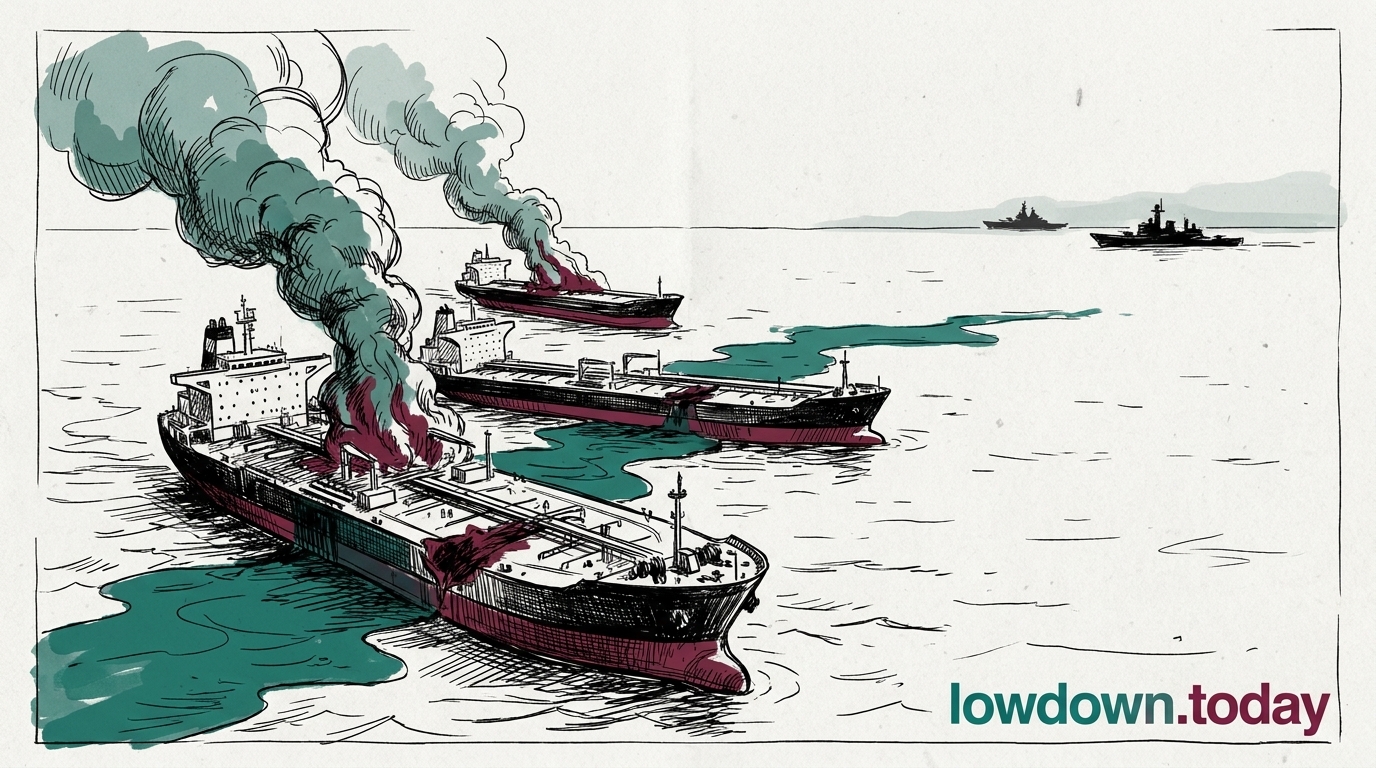
CENTCOM disabled five Iranian crude carriers on 8 September after two ballistic-missile attempts against one US warship missed. Three days earlier the same exchange ran at a ratio of three.

ConflictAssessed
Key takeaway

Every Iranian launch now costs tanker hulls, whether or not the missile finds its target.

US Central Command (CENTCOM) said on Tuesday 8 September that American forces had rendered five Iranian crude carriers inoperable after ordering their crews to abandon ship: Kaviz, Charminar, Horizon 1 and Riesco in the Gulf of Oman, and Derya near Kharg Island⁠1. The trigger was two ballistic-missile attempts against a single unnamed US warship over 7 and 8 September, both of which CENTCOM says failed, with no American casualties⁠2.

Three days earlier the same exchange ran at a different ratio. Missiles fired at a carrier and a destroyer on 5 September brought three Iranian tankers in reply, one of them destroyed, after anonymous officials described a tanker-for-tanker rule to a US news site on 1 September. The two vessels named in that earlier release, Downy and Stark 1, were Iranian crude carriers disabled by US forces, not the American warships Iran had aimed at⁠3.

Both attempts over 7 and 8 September missed, and CENTCOM took five hulls anyway. It is charging for the attempt rather than for the damage, and an underwriter can price that rule directly: every Iranian launch, hit or miss, costs hulls from a sanctioned export fleet that cannot be replaced through open broking. A shipowner outside the conflict can buy a replacement in London or Singapore within days. A designated Iranian operator cannot, because the broking, classification and insurance chains that move a secondhand tanker all touch jurisdictions that enforce the designations. Each hull removed is removed for the duration.

The bill also lands in the wrong department for Tehran. The Islamic Revolutionary Guard Corps (IRGC) fires the missiles; the crude that pays for the state is sold by a different arm of government, and it is that arm that absorbs the loss. Any escalation decision inside Iran now has to be argued between two ministries with opposite exposure to it.

Deep Analysis

In plain English

CENTCOM is the US Central Command, the American military headquarters responsible for the Middle East. The IRGC is Iran's Islamic Revolutionary Guard Corps, a parallel military force separate from Iran's regular army. On 8 September, the US said an American warship avoided two Iranian missile attacks. In response, US forces put five Iranian oil tankers out of action on 8 September, first ordering their crews to abandon ship. This has become a pattern since early September: when Iran tries to hit a US warship and fails, the US responds by disabling Iranian tankers rather than striking back at the missile launchers themselves, a trade that costs Iran ships without costing either side more lives.

Deep Analysis
Root Causes

The ratio Cooper announced in early September, three tankers per failed attempt, has widened to five against the same or fewer missiles fired, which points to CENTCOM expanding its target list beyond direct retaliation into a standing campaign against Iran's tanker fleet, using each attempted strike as the stated trigger.

Iran's ballistic-missile accuracy against manoeuvring naval targets has produced no confirmed hit across the two most recent attempts, while Jordan intercepted 18 of 20 missiles fired at its own territory the same week. A force with a low hit rate against defended targets still has an incentive to keep firing, since the domestic political cost of visible inaction outweighs the material cost of a further tanker loss.

What could happen next?
  • Consequence

    A widening tanker-per-attempt ratio, from three to five between the two most recent exchanges, suggests the US response has moved from proportionate retaliation towards a broader campaign against Iran's remaining tanker fleet.

First Reported In

Update #177 · 23 to 3: Iran goes to the Security Council

U.S. Central Command· 11 Sept 2026
Read original →
Different Perspectives
Wang Yi
Wang Yi
China's foreign minister and Djibouti's issued a joint communique on 21 October saying the war should not reach the Horn of Africa and stressing free navigation through Bab al-Mandeb. The text names neither Iran nor the Houthis, and Djibouti hosts China's only overseas military base, opposite the Yemeni coast.
Ministry of External Affairs
India's foreign ministry called the attacks on Saudi civilian and energy sites "unacceptable" on 22 October and said they must stop at once. An Indian died at Dammam, Indians were injured there and at Shaybah, and about 4,000 Umrah pilgrims remain stranded by one MP's count.
Iraq
Iraq
Iraq closed the al-Sheeb crossing with Iran to travellers and trucks from 21 October and said other crossings would close gradually. Unlike September's closure, which ended on a staged timetable, this one has none, and Iran's interior ministry said it received no notice.
Abdel Fattah el-Sisi
Egypt's president said on 21 October that Cairo's support would "defend Saudi territory, and does not include an attack on Yemen". Araghchi warned that Egyptian involvement would further complicate the situation, and Cairo's limit matches the one Ankara set on 8 October against attacking another state's soil.
UK Ministry of Defence
The MoD said on 20 October that RAF Typhoons over Saudi Arabia will not strike the Houthis, but extended tanker support to Saudi operations including against Houthi targets in Yemen. The tanker line sets no limit on strikes, so British aircraft may now refuel Saudi jets on bombing runs.
Turkey
Turkey
Ankara sent the Mecca Joint Defence Agreement to parliament around 20 October, and its published text treats an attack on one party as an attack on all. Article 16 brings it into force only on the last ratification, so the 5 October invocation in Riyadh could not yet bind Turkey.

Written with AI from Lowdown's published reporting. Not individually reviewed by an editor. Editorial standards.
