Skip to content
Welcome, thoughtbot's Giant Robots listeners!Start here
Iran Conflict 2026
7SEP

IRGC claims six vessels, concedes its own losses

2 min read
14:39UTC

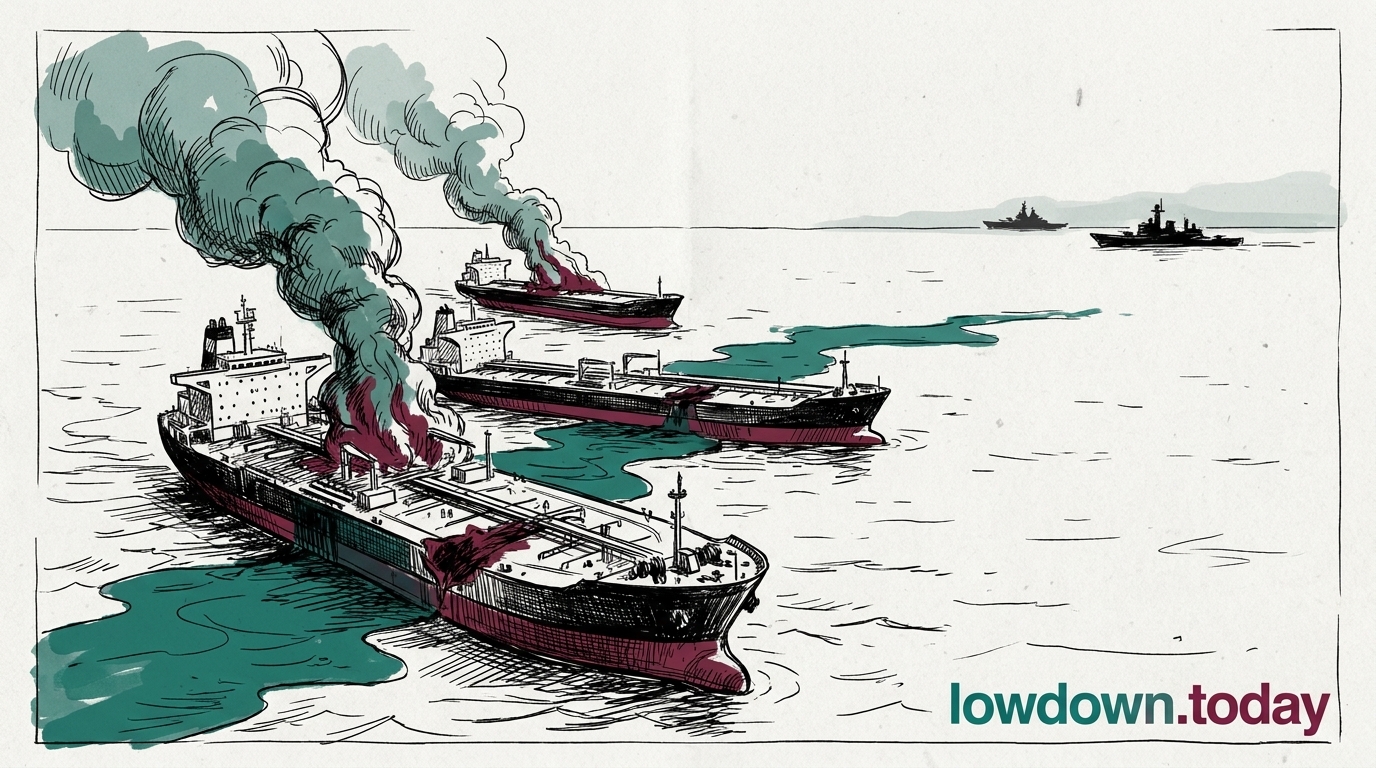
The IRGC Navy said it had attacked three oil tankers on an unauthorised Hormuz route and three vessels it called American-affiliated. The same statement acknowledged damage to Iranian tankers.

ConflictDeveloping
Key takeaway

Iran claimed an attack in the strait by name, and admitted its own tankers were damaged.

The IRGC Navy said its forces had attacked three oil tankers "traveling along an unauthorized route through the strait of Hormuz" and three vessels it described as affiliated with "the child-killing America", in a statement carried by Iran's state broadcaster Press TV on the evening of 5 September⁠1. The statement names no vessel and gives no coordinates. None of the six claimed attacks has been independently confirmed.

Tehran has rarely put its name to an attack in this strait. Projectiles struck the Saudi tanker Sidr and the Sinokor-managed Senegal Prosperity near Khasab on 1 September and nobody has claimed them since; an unknown projectile killed a crew member aboard a Hormuz-transiting vessel on 18 August with the same silence afterwards. Attacks in this strait have mostly arrived without an author. This one arrived with one.

The same statement acknowledges damage to Iranian tankers. A government announcing a good day does not usually concede its own losses in the same breath, and the admission runs against Tehran's interest in the argument it is having with Washington. It names no hull and locates nothing, so it confirms none of the three vessels CENTCOM listed. It is still the single point in the whole exchange where both capitals agree that Iranian tankers were hit.

For a master and an underwriter, an attribution changes the calculation more than a hull count does. An unclaimed strike could be Iranian, a proxy, a mine or a mistake, and there is nobody to deter or to negotiate with. A claimed one has a return address.

Deep Analysis

In plain English

The IRGC's naval branch put out a statement saying its forces had hit six vessels in one day: three oil tankers travelling a route it called unauthorised through the strait of Hormuz, and three more it described as linked to the United States. The statement names no ship and gives no coordinates for any of the six. In the same statement, the IRGC admitted some of its own tankers had been damaged. That is unusual. A military claiming a successful day of attacks does not normally use the same breath to admit its own losses, which makes the admission harder to dismiss as pure propaganda even though the attack claims themselves remain unverified.

Deep Analysis
Root Causes

Iran signed the UN Convention on the Law of the Sea on 10 December 1982 and has never ratified it, so it remains a signatory rather than a party to the treaty that guarantees transit passage through international straits.

Calling a Hormuz route "unauthorized" asserts a licensing right over that water that Iran's own treaty status does not establish.

What could happen next?
  • Consequence

    A claim naming no vessel and no coordinates cannot be checked against a shipping registry, an insurance claim, or a port record, so unless a named ship surfaces with matching damage, the six-vessel claim is likely to remain a statement rather than a documented event.

First Reported In

Update #176 · Three tankers for two warships

Press TV· 7 Sept 2026
Read original →
Different Perspectives
Wang Yi
Wang Yi
China's foreign minister and Djibouti's issued a joint communique on 21 October saying the war should not reach the Horn of Africa and stressing free navigation through Bab al-Mandeb. The text names neither Iran nor the Houthis, and Djibouti hosts China's only overseas military base, opposite the Yemeni coast.
Ministry of External Affairs
India's foreign ministry called the attacks on Saudi civilian and energy sites "unacceptable" on 22 October and said they must stop at once. An Indian died at Dammam, Indians were injured there and at Shaybah, and about 4,000 Umrah pilgrims remain stranded by one MP's count.
Iraq
Iraq
Iraq closed the al-Sheeb crossing with Iran to travellers and trucks from 21 October and said other crossings would close gradually. Unlike September's closure, which ended on a staged timetable, this one has none, and Iran's interior ministry said it received no notice.
Abdel Fattah el-Sisi
Egypt's president said on 21 October that Cairo's support would "defend Saudi territory, and does not include an attack on Yemen". Araghchi warned that Egyptian involvement would further complicate the situation, and Cairo's limit matches the one Ankara set on 8 October against attacking another state's soil.
UK Ministry of Defence
The MoD said on 20 October that RAF Typhoons over Saudi Arabia will not strike the Houthis, but extended tanker support to Saudi operations including against Houthi targets in Yemen. The tanker line sets no limit on strikes, so British aircraft may now refuel Saudi jets on bombing runs.
Turkey
Turkey
Ankara sent the Mecca Joint Defence Agreement to parliament around 20 October, and its published text treats an attack on one party as an attack on all. Article 16 brings it into force only on the last ratification, so the 5 October invocation in Riyadh could not yet bind Turkey.

Written with AI from Lowdown's published reporting. Not individually reviewed by an editor. Editorial standards.
