Skip to content
You can now search across every topic, entity and event.What's new
Iran Conflict 2026
23AUG

Trump strikes Iran with no war authority

3 min read
19:02UTC

Donald Trump ordered missiles onto Iranian soil with no AUMF and no UN notice, days after both chambers of Congress moved to constrain him.

ConflictDeveloping
Key takeaway

Trump executed an act of war while every document that would normally authorise it stayed unsigned.

Donald Trump ordered strikes on sovereign Iranian territory with no Article 51 notification to the UN Security Council and no new AUMF (authorisation for use of military force), the statute Congress would normally pass to sanction a war 1. He acted as both chambers moved against him. The House voted 215-208 on 3 June to wind down US involvement , and Senate cloture on a parallel war-powers resolution fell ten votes short . Congress voted to limit the president; the strike order on 9 June bypassed that vote within days of it.

Washington's legal defence rests on Article II self-defence: a president may protect US forces under fire without prior congressional authorisation, and the downed AH-64 Apache supplies the trigger 2. Critics will counter that striking radar sites across four locations on Iranian soil exceeds the immediate defence of one aircraft's crew, both of whom had already been recovered. Whether "self-defence" describes the rescue or the retaliation is the hinge on which the whole claim turns.

The self-defence framing matters because it sidesteps the AUMF question entirely. A defensive strike needs no fresh authorisation, so the recovered Apache crew become the legal pivot rather than a vote on the floor. Trump spent 100 days pairing optimistic deal talk with an unsigned MOU; his first instrument of consequence on Iran arrived as ordnance, not a signature. That distinction is the point. An act of war was executed while every document that would normally precede it stayed unsigned, which leaves Congress legislating against a fact already on the ground.

Deep Analysis

In plain English

In the United States, Congress has the power to declare war. Since 1973 there has also been a law called the War Powers Resolution that says the President must notify Congress within 48 hours of starting a military operation and must stop within 60 days unless Congress approves. President Trump ordered the 9 June strikes without asking Congress for permission, without notifying the United Nations, and days after the House of Representatives voted 215-208 to tell him to wind down the Iran conflict. The administration's legal argument is that the President can order strikes in self-defence as Commander-in-Chief without needing Congress. Critics, including Georgetown Law professors, argue that argument has never been tested in a case where Congress had just voted against the action.

Deep Analysis
Root Causes

Three converging structural conditions made the legal collision on 9 June inevitable. First, the Trump administration's deliberate policy of keeping all Iran-related authority on the verbal track rather than signed paper meant that when it needed a legal basis for strikes, Article II was the only instrument in the field. An AUMF would have required specifying objectives and constraints Congress could hold the administration to.

Second, the War Powers Resolution's own enforcement gap, demonstrated across three consecutive lapse cycles at Days 60, 72 and 93, signalled to the executive that Congress lacked both the votes and the institutional will to constrain it. A resolution that lapses unremedied three times becomes, in practice, a dead letter regardless of its statutory force.

Third, the House 215-208 margin was too thin and too recent to survive a Senate cloture test. With ten senators absent from the cloture count, the administration calculated, correctly in the short term, that no enforcement mechanism would activate before the strikes could be executed.

First Reported In

Update #123 · Trump orders strikes on Iranian soil

Al Jazeera· 10 Jun 2026
Read original
Different Perspectives
Hizballah
Hizballah
Has not commented on the US Treasury's 20 August designation of ten people, including named couriers, over a cash network Treasury says moved money to it from the IRGC-Qods Force. ACLED recorded a sharp rise in attacks around it the same day.
Kuwait
Kuwait
Kuwait's Chief of the General Staff, Lieutenant General Khaled al-Shriaan, co-chaired the 16th US-Kuwait Joint Military Commission at the Pentagon on 21 August. Kuwait has not published what was agreed; only a summary of the meeting's existence and attendees is sourced.
Qatar
Qatar
Has not commented publicly on the $4.5bn KC-46A tanker Foreign Military Sale notification the State Department approved on 20 August. The notification opens a sale process; Doha has not confirmed whether it will proceed to a signed transfer.
Mohammad Bagher Ghalibaf
Told a Baghdad business meeting on 20 August that Iran will not endure a hungry population regardless of its military strength, against 87.9% point-to-point inflation and 128.1% food inflation for Tir. His fellow Majlis Economic Committee member Samsami separately warned a petrol price rise would ignite unrest.
US Navy
US Navy
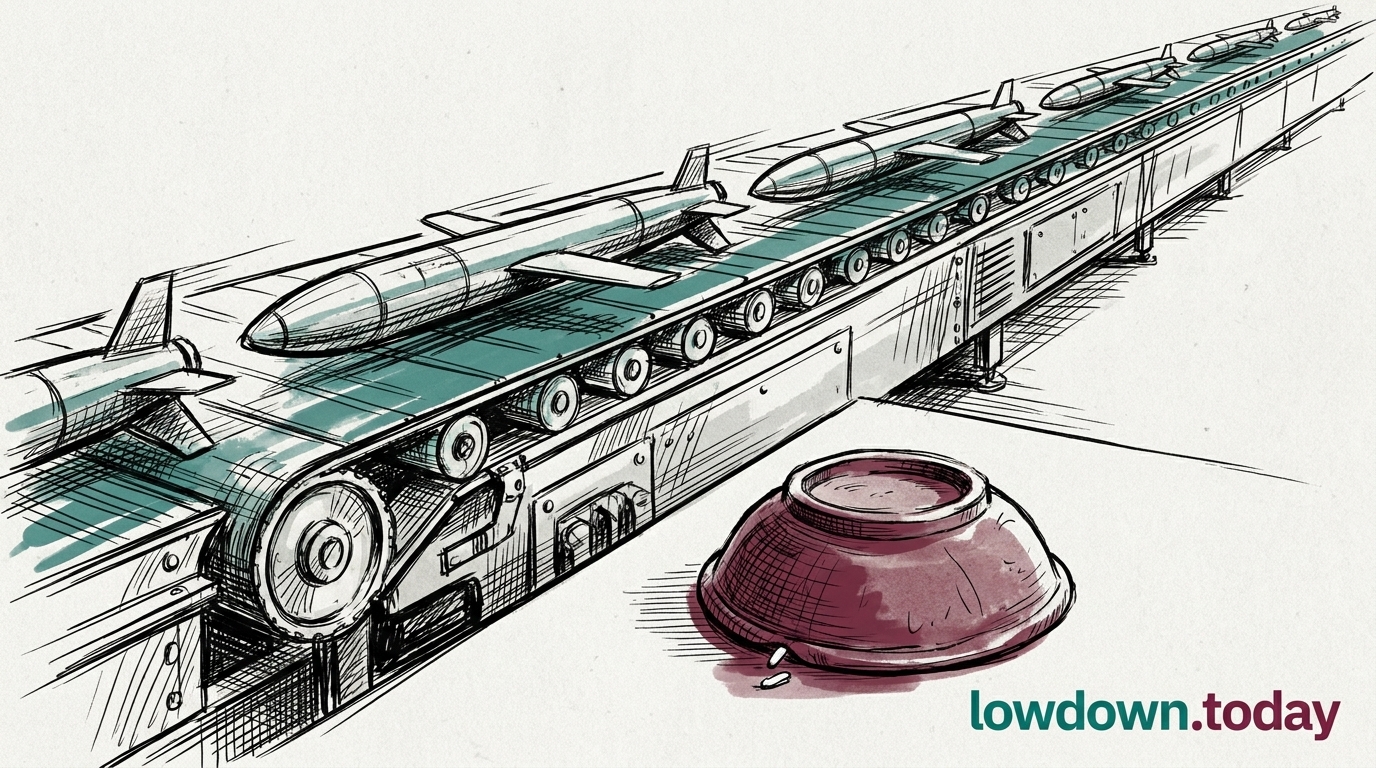
Signed a $22.9bn, seven-year contract with Raytheon on 17 August to raise Tomahawk output from about 60 a year to more than 1,000. The Acting Navy Secretary, quoted via an X post, framed it as the "Arsenal of Freedom" initiative; it replaces the 850 missiles fired by 1 April in about ten months at the new rate.
UK Maritime Trade Operations
UKMTO logged six armed men boarding a tanker 136 nautical miles east of Al Mukalla on 20 August and redirecting it toward Somalia. A vessel steered toward the Somali coast reads as an attempted seizure, a distinct hazard from the stand-off strikes the same lane has seen before.