Skip to content
You can now search across every topic, entity and event.What's new
Iran Conflict 2026
20AUG

Hormuz down 70%; 150 tankers at anchor

3 min read
16:36UTC

Vessel traffic through the Strait of Hormuz has fallen 70%. Six of the world's largest shipping lines have halted transits. The waterway that carries a fifth of global traded oil is, for commercial purposes, closed.

ConflictDeveloping

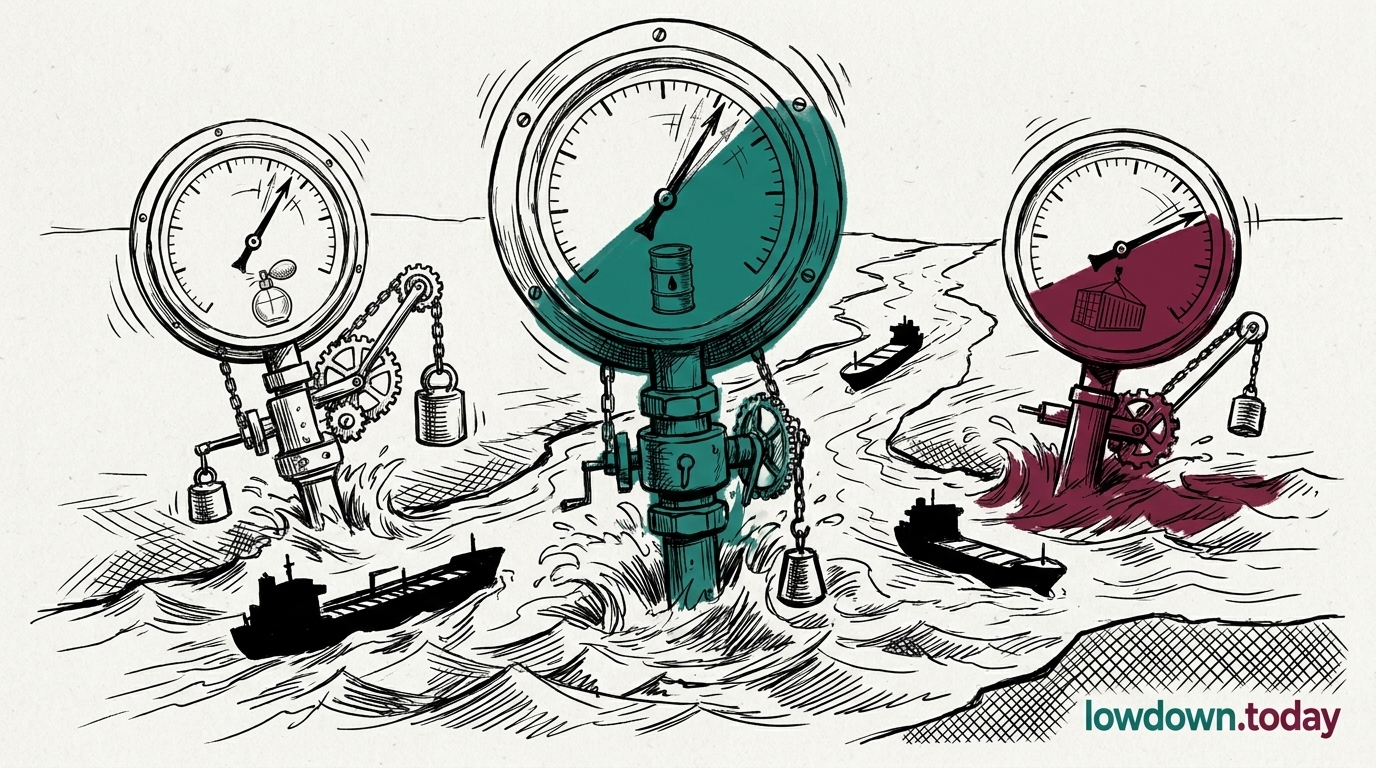
Vessel traffic through the strait of Hormuz has fallen 70%. More than 150 tankers sit at anchor in open Gulf waters rather than attempting transit. CMA CGM, Maersk, Hapag-Lloyd, Nippon Yusen, Mitsui, and Kawasaki Kisen have all suspended sailings. CMA CGM imposed an emergency surcharge of $2,000–4,000 per container, effective immediately — a cost that will propagate through global supply chains within weeks.

the strait carries roughly 20% of the world's traded oil and approximately a quarter of global liquefied natural gas. Brent Crude sat at $73 before the strikes ; it opened Saturday at $82.37 , an 11% rise driven by risk pricing rather than physical shortage. If the 70% traffic reduction holds, markets will begin pricing actual supply loss. Goldman Sachs had forecast Brent at $110; JP Morgan projected $120–130 under prolonged disruption and raised its US recession probability to 35% . With tankers under direct fire, those figures describe a midpoint, not a ceiling.

The alternative — routing around the Cape of Good Hope — adds roughly 15 sailing days per laden tanker voyage, with proportional increases in fuel, crew, and scheduling costs. Import-dependent economies in Asia absorb the worst of this: Japan, South Korea, and India source between 60% and 80% of their crude from Gulf producers, all of it transiting Hormuz.

The global economy has not experienced a sustained physical closure of the strait in the post-globalisation era. The closest precedent — the 1984–88 Tanker War — disrupted traffic but never stopped it; the US Navy's Operation Earnest Will ensured a minimum flow of escorted tankers. Here, the US Navy is engaged in offensive operations, not convoy protection, and Gulf States that might otherwise support escort missions are themselves under bombardment — the UAE alone has absorbed 137 missiles and 209 drones . The chokepoint the global economy treated as permanently open is, for the first time since it became the world's primary oil artery, functionally shut.

Deep Analysis

Deep Analysis
Synthesis

The 150 anchored tankers represent a stress test of the international maritime order — the system of commercial insurance, flag-state protection, and US naval deterrence that has kept Hormuz open through previous crises. If vessels at anchor begin to be targeted directly, states with commercial interests currently standing aside — Japan, South Korea, India — face direct pressure to act. The 70% traffic reduction already constitutes the strategic effect of a blockade; Iran need not close the strait completely to achieve its objectives.

Root Causes

Three forces compound simultaneously: direct Iranian attacks provide the kinetic trigger; war-risk insurance requirements amplify the effect far beyond what physical interdiction alone produces; and voluntary carrier suspensions crystallise the disruption into a structural withdrawal. The behavioural mechanism is the critical one: Iran need not sink every tanker, only enough to make operators unwilling to risk their vessels, crews, and insurability. A handful of attacks achieves a disproportionate commercial effect.

Escalation

If the US or allied navies deploy convoy escorts, the strait becomes a military operation area, raising the prospect of direct confrontation between escort vessels and Iranian naval forces. Gulf states that might otherwise support escort missions are themselves under bombardment. Oman — the traditional diplomatic back-channel — has not publicly indicated activation, and no mediator currently holds leverage over both parties.

What could happen next?
2 consequence2 risk1 meaning
  • Consequence

    With 14–15 million barrels per day of Gulf oil flows at risk, oil-importing nations in Asia and Europe face immediate supply shortfalls that strategic reserves can buffer for weeks to months but cannot replace indefinitely.

    Short term · Assessed
  • Risk

    If the remaining 30% of Hormuz traffic is deterred by further attacks, the effective closure of the strait would constitute a global economic emergency comparable in magnitude to the 1973 oil shock.

    Short term · Suggested
  • Consequence

    150 tankers at anchor represent an enormous deferred supply inventory that will create a price-suppressing glut when — and if — the strait re-opens, complicating economic recovery planning for oil-producing states.

    Medium term · Suggested
  • Risk

    Anchored vessels in open Gulf waters may themselves become targets, as the conflict has already demonstrated willingness to strike commercial shipping without apparent discrimination.

    Immediate · Suggested
  • Meaning

    The scale of voluntary commercial withdrawal signals that US naval presence in the region has failed to deter Iranian anti-shipping operations in practical terms, regardless of its continued strategic deterrent value.

    Immediate · Assessed
First Reported In

Update #7 · Hezbollah enters; tankers burn in Hormuz

gCaptain· 2 Mar 2026
Read original
Different Perspectives
UK Maritime Trade Operations
UKMTO logged six armed men boarding a tanker 136 nautical miles east of Al Mukalla on 20 August and redirecting it toward Somalia. A vessel steered toward the Somali coast reads as an attempted seizure, a distinct hazard from the stand-off strikes the same lane has seen before.
Mohammad Bagher Ghalibaf
Iran's Majlis speaker received Iraq's Hormuz carve-out request in Baghdad on 19 August, a request that treats passage as Tehran's to grant. Ghalibaf's authority over that grant sits alongside the Revolutionary Guard's separate transit rules, which have moved independently of Iran's foreign ministry before.
Haibat al-Halbousi
Haibat al-Halbousi
Iraq's parliament speaker asked Iran for special consideration on Iraqi Hormuz oil exports during Ghalibaf's 19 August Baghdad visit. Iraq presses the request from a weak position: Iran's central bank is simultaneously demanding Baghdad release Iranian reserves parked in Iraqi accounts.
Federal Department of Economic Affairs, Education and Research
Switzerland's economics ministry updated the Article 21 forms governing lawful Iran money transfers on 19 August, with only the revised forms accepted from 26 August. Bern operates one of the few remaining legal Iran payment channels and has just set a hard cutover on its control point.
Motegi Toshimitsu
Motegi Toshimitsu
Japan's foreign minister said in Muscat on 20 August that Tokyo wants closer coordination with Oman on safe Hormuz and Bab el-Mandeb passage. Japan has no naval presence of its own in the strait, so it is routing the ask through the state negotiating with Iran instead.
Badr bin Hamad Al Busaidi
Oman's foreign minister joined Japan's in Muscat on 20 August to call for intensified coordination on Hormuz and Bab el-Mandeb navigation. Oman also runs the mediation track with Tehran, so the appeal travels through the same channel as the negotiation.