Skip to content
You can now search across every topic, entity and event.What's new
Iran Conflict 2026
20AUG

Brent jumps as Iran fires from empty coffers

4 min read
16:36UTC

Brent crude rose to $96.34 on 10 June, erasing a week of deal optimism, even as Iran's oil exports run dry below 300,000 barrels a day.

ConflictDeveloping
Key takeaway

Iran is trading military risk for coalition pressure because it can no longer break the blockade economically.

Brent Crude rose to $96.34 on 10 June, up about 2.2 per cent, after shedding more than 7 per cent across the week on optimism about a possible US deal and the Iran-Israel halt 1. The exchange of US strikes and Iranian counter-strikes wiped the week's deal-optimism discount in a single session, repricing the Strait of Hormuz risk premium overnight. Brent sets the price of roughly two-thirds of internationally traded crude, so the move ripples straight into import bills well beyond the Gulf.

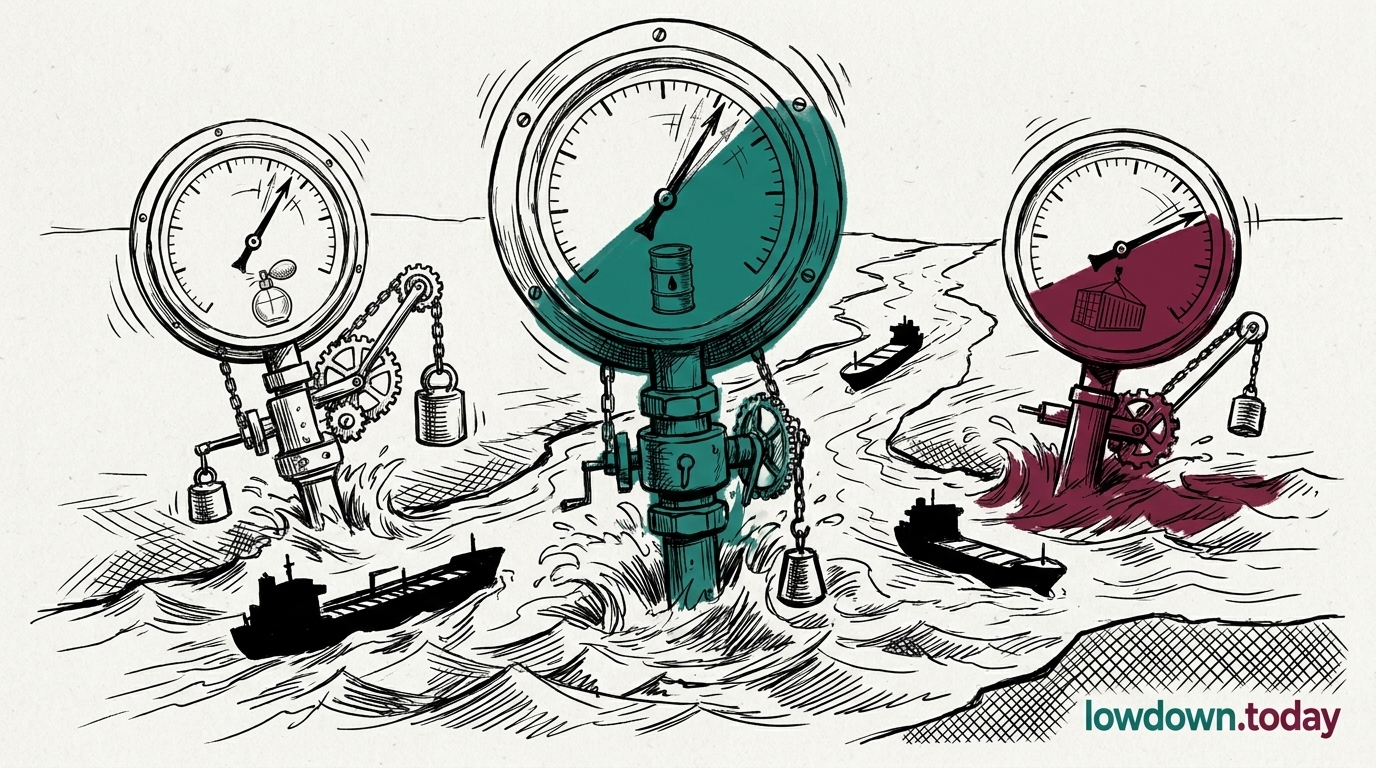
Iran fired missiles across three countries this week from an empty balance sheet. The US naval blockade has cut Iranian oil exports below 300,000 barrels per day, down from 1.84 million in March, and erased roughly $5.8bn in revenue since April, with Kpler data showing a runway of weeks, not months, for the China-bound trade 2. A regime striking US bases in three countries while it cannot move its own crude is buying military leverage it has no economic means to sustain.

That weakness cuts two ways, which is where the night's contained outcome meets a darker read. Iran failed to inflict real damage, Jordan intercepted every missile aimed at it, and no US personnel were hurt, the markers of a calibrated exchange rather than the opening of a campaign. Yet a government with this little left to lose at sea may find escalation cheaper than restraint. The same empty coffers that cap Tehran's options also lower the price of crossing a threshold a second time, which is precisely what makes a cornered adversary hard to deter.

Deep Analysis

In plain English

Oil prices jumped about 2 per cent on 10 June after the US strikes on Iran. To understand why this matters, it helps to know that about one-fifth of the world's oil flows through the Strait of Hormuz, the narrow waterway near Iran. When that passage looks more dangerous, traders pay more for oil as a precaution. What makes this situation unusual is that Iran was already in serious economic trouble before the 10 June escalation. The US naval blockade had cut Iranian oil exports from about 1.84 million barrels a day before the war to below 300,000 barrels a day by June. Iran had lost roughly $5.8 billion in oil revenue since April. Iran's IRGC was firing ballistic missiles at US bases while its oil revenue had collapsed by 84 per cent since March.

What could happen next?
  • Consequence

    Iran's escalation from a position of 84 per cent export collapse and $5.8 billion in lost revenue signals the IRGC has concluded the economic cost of further military action is marginal: it cannot lose oil revenues it no longer has.

    Immediate · Assessed
  • Risk

    CENTCOM's 9 June radar suppression at Qeshm and Bandar Abbas targets the sensor layer Iran uses to identify and intercept vessels for toll collection; if the IRGC toll mechanism collapses, Tehran loses its last functioning hard-currency inflow, removing any remaining economic incentive to keep Hormuz partially open.

    Short term · Assessed
  • Opportunity

    Saudi Arabia and the UAE, as swing producers with fiscal breakeven points above current Brent levels, benefit from the Hormuz risk premium sustaining Brent above $95; both have an indirect incentive to see the conflict persist at a level of tension that supports oil prices without triggering a full strait closure.

    Medium term · Suggested
First Reported In

Update #123 · Trump orders strikes on Iranian soil

OilPrice.com· 10 Jun 2026
Read original
Different Perspectives
UK Maritime Trade Operations
UKMTO logged six armed men boarding a tanker 136 nautical miles east of Al Mukalla on 20 August and redirecting it toward Somalia. A vessel steered toward the Somali coast reads as an attempted seizure, a distinct hazard from the stand-off strikes the same lane has seen before.
Mohammad Bagher Ghalibaf
Iran's Majlis speaker received Iraq's Hormuz carve-out request in Baghdad on 19 August, a request that treats passage as Tehran's to grant. Ghalibaf's authority over that grant sits alongside the Revolutionary Guard's separate transit rules, which have moved independently of Iran's foreign ministry before.
Haibat al-Halbousi
Haibat al-Halbousi
Iraq's parliament speaker asked Iran for special consideration on Iraqi Hormuz oil exports during Ghalibaf's 19 August Baghdad visit. Iraq presses the request from a weak position: Iran's central bank is simultaneously demanding Baghdad release Iranian reserves parked in Iraqi accounts.
Federal Department of Economic Affairs, Education and Research
Switzerland's economics ministry updated the Article 21 forms governing lawful Iran money transfers on 19 August, with only the revised forms accepted from 26 August. Bern operates one of the few remaining legal Iran payment channels and has just set a hard cutover on its control point.
Motegi Toshimitsu
Motegi Toshimitsu
Japan's foreign minister said in Muscat on 20 August that Tokyo wants closer coordination with Oman on safe Hormuz and Bab el-Mandeb passage. Japan has no naval presence of its own in the strait, so it is routing the ask through the state negotiating with Iran instead.
Badr bin Hamad Al Busaidi
Oman's foreign minister joined Japan's in Muscat on 20 August to call for intensified coordination on Hormuz and Bab el-Mandeb navigation. Oman also runs the mediation track with Tehran, so the appeal travels through the same channel as the negotiation.