Skip to content
You can now search across every topic, entity and event.What's new
Iran Conflict 2026
7AUG

140m barrels of Iran crude sanctioned

4 min read
12:08UTC

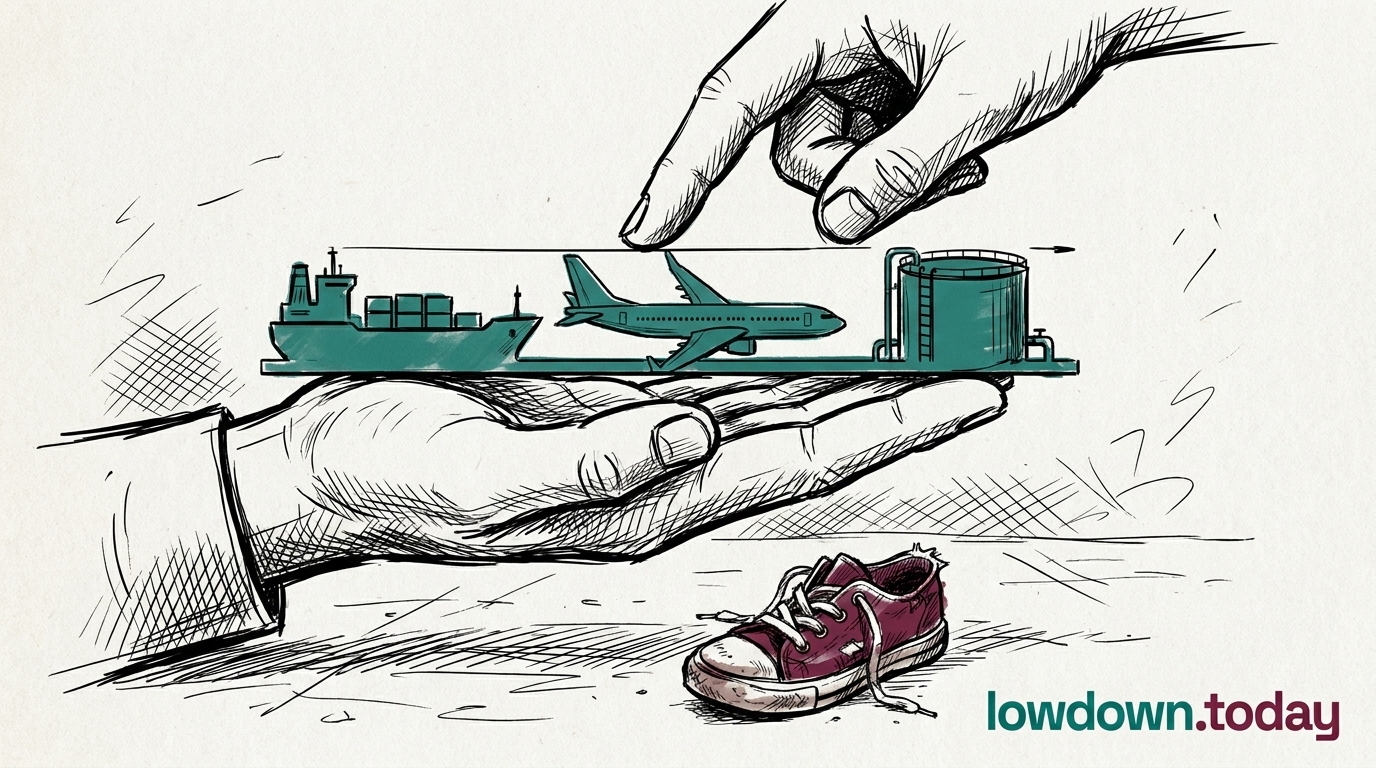
The administration prosecuting the war against Iran has freed 140 million barrels of Iranian crude to contain prices that war created — enough to cover roughly a day and a half of global consumption.

ConflictDeveloping
Key takeaway

Freeing Iranian oil mid-war reveals that domestic petrol prices constrain US sanctions more than strategic doctrine does.

The US Treasury lifted sanctions on 140 million barrels of Iranian crude already loaded on tankers worldwide, granting a 30-day waiver through 19 April. The volume — enough to cover roughly 1.5 days of global consumption — enters a market where the daily supply shortfall from the Hormuz closure runs into the millions of barrels.

The waiver is the administration's third emergency supply-side intervention in three weeks. On 15 March, Trump issued a 30-day waiver on Russian oil sanctions — a move six of seven G7 members opposed, and that Ukrainian President Zelenskyy estimated could deliver Russia $10 billion in revenue . On 18 March, Treasury authorised Venezuela's PDVSA to sell crude on global markets and Trump suspended the Jones Act's US-flagged vessel requirement for 60 days . Each measure has been larger and more politically costly than the last. None addresses the underlying supply disruption: the strait of Hormuz remains effectively closed to commercial traffic, with more than 300 ships stranded.

The policy is internally contradictory. Washington has struck more than 7,000 targets in Iran since 28 February while simultaneously releasing Iranian crude to prevent the domestic price shock that campaign has produced. Treasury Secretary Bessent had already acknowledged the administration was allowing Iranian tankers through Hormuz to "supply the rest of the world" . The waiver formalises that trade-off: degrading Iran's military capacity and maintaining affordable energy are competing objectives, and the administration has chosen to pursue both at once. The 19 April expiry creates a decision point near the IDF's disclosed Passover operational planning horizon , after which renewal becomes another variable in an already crowded political calculus.

At 140 million barrels, the waiver sounds substantial in isolation. Against daily global consumption of roughly 100 million barrels, it provides about 36 hours of supply. Gulf oil exports have dropped at least 60% since late February . Iraq has declared Force majeure on all foreign-operated fields. Qatar has lost 17% of its LNG export capacity for an estimated three to five years . Goldman Sachs, Wood Mackenzie, and Vanda Insights have each forecast oil above $150 if the disruption persists . The waiver buys days, not weeks, and the supply deficit it attempts to fill is widening faster than emergency measures can close it.


Deep Analysis

In plain English

The US is simultaneously conducting military strikes against Iran and permitting Iranian oil to be sold on global markets. Treasury has told tanker operators that for 30 days they will not be penalised for trading 140 million barrels of Iranian crude already loaded before or shortly after the war began. The reason is politically straightforward: oil prices are high enough domestically that the White House needs any available supply relief, even from the country it is bombing. The catch is that this window expires on 19 April — creating a hard deadline that coincides with ongoing hostilities.

Deep Analysis
Synthesis

A wartime sanctions waiver on an active adversary's export revenue signals that the administration has concluded domestic inflation risk outweighs strategic coherence. Future adversaries will register that US maximum-pressure campaigns contain an embedded price ceiling beyond which they become domestically self-defeating — reducing deterrence credibility in subsequent crises.

Root Causes

The US economy's structural dependence on globally liquid oil markets creates a ceiling on how far economic warfare against a large producer can be sustained. No administration can maintain a pure sanctions posture when domestic petrol prices approach politically destabilising levels — a constraint Tehran has previously studied and exploited in prior pressure cycles.

Escalation

The 30-day limit creates a hard deadline on 19 April. If Hormuz remains disrupted at that point, the administration faces a binary choice: renew the waiver and appear to be subsidising the adversary's war finances, or allow prices to spike further. Either option carries acute political cost with no neutral path available.

What could happen next?
  • Consequence

    Up to $15.7 billion in Iranian crude revenue could be released into the global financial system within the 30-day waiver window.

    Immediate · Suggested
  • Risk

    Waiver expiry on 19 April creates a price cliff if Hormuz remains disrupted and renewal is withheld for strategic reasons.

    Short term · Assessed
  • Precedent

    Wartime sanctions relief on a combatant's exports establishes that US economic coercion contains a domestic price ceiling, reducing deterrence credibility in future crises.

    Long term · Assessed
  • Opportunity

    China and India can lock in Iranian crude at relative discount during the window, deepening non-Western supply chains independent of US financial infrastructure.

    Medium term · Suggested
First Reported In

Update #43 · Trump floats wind-down, deploys 2,200 more

Bloomberg· 21 Mar 2026
Read original
Causes and effects
This Event
140m barrels of Iran crude sanctioned
The waiver is the third emergency supply-side intervention in three weeks — after Russian sanctions relief and Venezuelan authorisation — and the most politically contradictory: freeing Iranian crude to offset prices driven up by the US campaign against Iran. At 1.5 days of global consumption, the volume is dwarfed by the supply deficit the war has created.
Different Perspectives
Turkiye
Turkiye
Erdogan followed the Pakistani delegation to Jeddah for an instrument that has not been signed. Ankara's entry widens Saudi Arabia's defence architecture beyond the existing Pakistan pact, adding a second non-Gulf military partner mid-conflict.
Oman
Oman
Muscat is the corridor's broker but has published nothing about the arrangement Fars describes on its behalf. The account leaves Oman administering outbound traffic only, a narrower role than the shared route its mediation has rested on since 1979.
Pakistan
Pakistan
Islamabad sent Sharif, Munir and Dar to Jeddah to widen a defence commitment it has honoured in cheaper registers since March, when Dar invoked the Saudi mutual defence pact. Jeddah tests whether that hedge becomes a binding trilateral instrument with Turkiye.
United States
United States
Washington rejected the Majlis Hormuz bill outright while CENTCOM's own tally kept climbing to 49 vessels redirected since 14 July. Both instruments tightened in the same week Trump promised the strait would reopen soon.
Iran
Iran
Iran's foreign ministry is selling a phased Hormuz corridor through Oman and denying any percentage cargo tariff, while its own Majlis is legislating fines to 20% and a bar on Israeli-linked cargo. The two accounts, from the same government, do not agree with each other.
Saudi Arabia
Saudi Arabia
Riyadh published a target forecast, not an attribution, for the campaign it says the Najran strike previewed. That keeps an Article 51 case available while it formalises a trilateral defence architecture with Pakistan and Turkiye.



