Skip to content
You can now search across every topic, entity and event.What's new
Iran Conflict 2026
23JUL

Russia's oil price down, revenue up

2 min read
19:27UTC

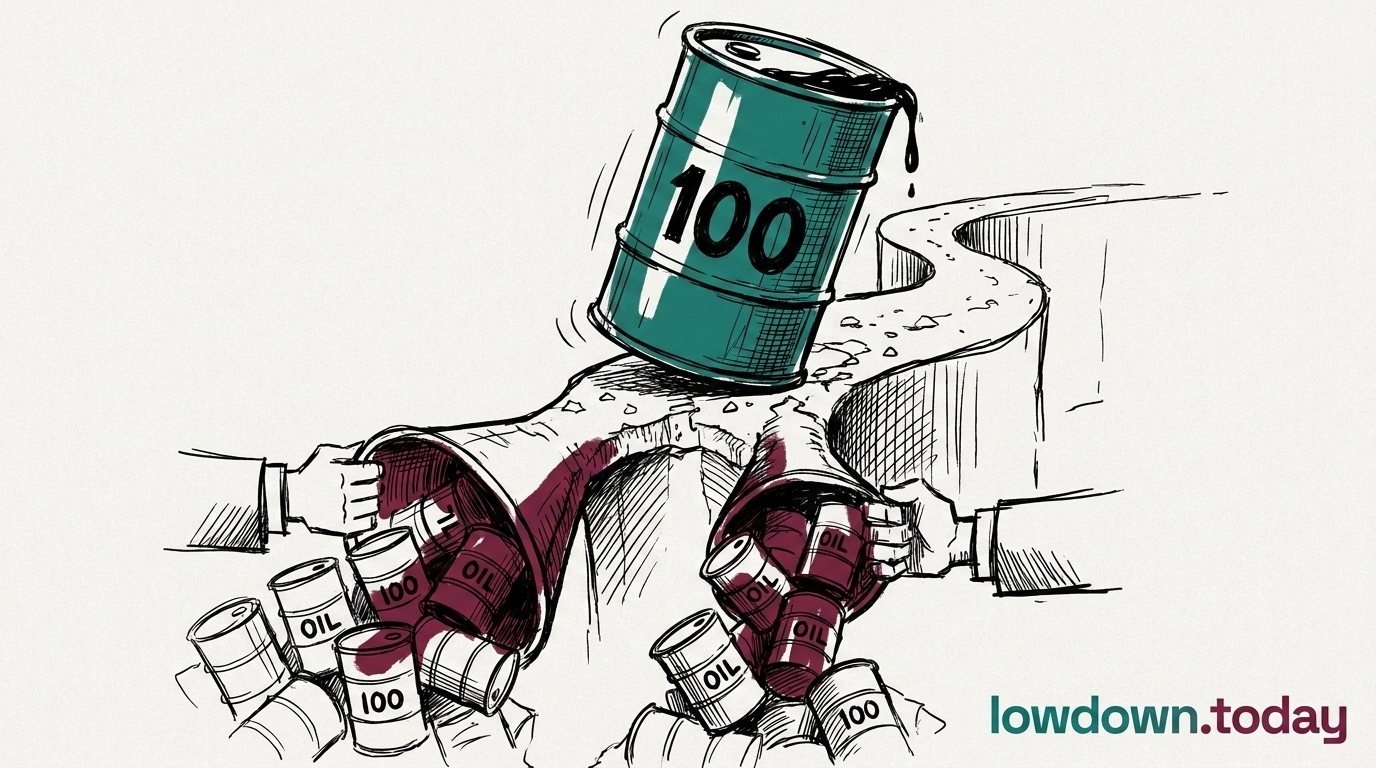
CREA reported Urals crude averaged $63.18 a barrel in June, down 26%, yet Russian oil-product revenue rose 14% as tight global supply lifted prices.

ConflictDeveloping
Key takeaway

Urals crude fell 26% to $63.18 in June, yet Russian oil-product revenue rose 14% on tight supply.

CREA, the Centre for Research on Energy and Clean Air, reported that Urals crude, the benchmark grade for Russian exports, averaged $63.18 a barrel in June, down 26% month-on-month 1. That compounds May's 12% fall from $82.02 , and seaborne oil-product loadings dropped 21% to a record low as the refinery strikes bit 2.

The ledger has another side. CREA found that oil-product revenue rose 14% month-on-month in June, its highest since June 2024, because tight global supply lifted prices even as Russian volumes fell 3. The rise means Moscow banked more per tonne on a smaller flow of exports.

Demand held up in Asia. China took 41% of the top-five buyers' Russian crude in June, and India, the second-largest buyer, lifted its imports 34% to a record 4. The pressure falls on volume and on the state's ability to guarantee supply at home, not yet on the headline cash.

Deep Analysis

In plain English

CREA, a research group that tracks Russian energy exports, reported that the price Russia gets for its main crude oil grade, Urals, fell 26% in June to $63.18 a barrel, on top of a 12% fall in May. At the same time, the amount of refined fuel Russia managed to ship by sea hit a record low, even though the money it earned from that fuel actually rose, because global fuel prices were higher. This matters because it shows two different pressures squeezing Russia's oil revenue at once: falling crude prices and a shrinking ability to physically move fuel. China took 41% of top-five buyer purchases in June, and India's imports rose 34% to a record, both buying without Western sanctions enforcement applying to them.

Deep Analysis
Root Causes

The price cap only constrains Russian crude sales when the market price would otherwise exceed $44.10 a barrel; at $63.18, Urals remains comfortably above that floor, so the cap is not the mechanism doing the work in June's fall. The real driver is physical: Ukrainian strikes on refining and export infrastructure cut seaborne oil-product loadings to a record low, a supply constraint that shows up as falling volumes and revenue pressure regardless of where the price sits relative to any cap.

China and India's expanding share, 41% and a record 34% month-on-month rise respectively, reflects a structural condition of the cap regime itself: it creates no penalty for buyers outside the G7/EU insurance and shipping ecosystem, so the two largest non-aligned economies can absorb discounted volumes with no exposure to Western enforcement.

What could happen next?
  • Meaning

    Urals trading above the price cap floor while still falling sharply shows physical disruption, not sanctions enforcement, is now the dominant pressure on Russian oil revenue.

First Reported In

Update #23 · Moscow rations diesel as US cover lapses

CREA (Centre for Research on Energy and Clean Air)· 13 Jul 2026
Read original
Different Perspectives
India
India
India buys more Saudi crude than any other country and has 2.5 million nationals working in the kingdom, so a $100 Brent and a live strike on Saudi tankers reach New Delhi through both fuel bills and remittance risk. Neither channel has an alternative route the way Saudi Arabia's own pipeline does.
Qatar
Qatar
Qatar co-authored the four-mediator ten-day ceasefire proposal alongside Egypt, Pakistan and Oman, centred on resuming Hormuz navigation, while separately pursuing its dated compensation claim against Iran at the UN Security Council filed on 21 July. Doha is mediating and litigating in the same week.
Israel
Israel
Israeli intelligence, reported by the Wall Street Journal, assesses Iran moved thousands of centrifuges and part of its roughly 440kg enriched-uranium stock into Pickaxe Mountain after the June 2025 strikes on its three main nuclear sites. Some of the US refuelling aircraft now deploying to the region are bound for Israeli bases and Ramon Airport.
Houthis
Houthis
Yahya Saree announced the missile and drone strikes on the Encelia and Layla on 22 July as enforcement of the embargo his forces had declared by radio warning alone two days earlier. Six vessels already turned back on the broadcast; the strike shows Houthi forces will use weapons once warnings stop working.
Saudi Arabia
Saudi Arabia
Saudi Arabia's state news agency confirmed only a fire on the Encelia's bow, with the crew safe; the Layla strike remains unconfirmed by Riyadh. The kingdom built its Petroline pipeline specifically to bypass Hormuz through the Red Sea, so the tanker fire lands on the route Riyadh had already spent billions escaping.
United States
United States
Washington is weighing both ten-day proposals but wants a longer truce than either offers, and moved F-16 and F-35 jets plus refuelling aircraft into the region while it decides. That deployment, not Trump's Pickaxe Mountain remarks, is the measurable US action, buying options for the day talks fail rather than betting on them.