Skip to content
You can now search across every topic, entity and event.What's new
Iran Conflict 2026
23JUL

IRGC sets 30-day blockade clock for US

3 min read
19:27UTC

An IRGC general issued a 30-day ultimatum on 3 May for the United States to end its port blockade of Iran, and the Majlis national security commission ruled that Project Freedom would be considered a violation of the ceasefire.

ConflictDeveloping
Key takeaway

Tehran has a 2 June trigger date and a parliamentary rationale for a second-stage response.

An IRGC general issued a 30-day ultimatum on 3 May 2026 demanding that the United States end its port blockade of Iran, and the Majlis national security commission ruled the same day that Project Freedom would be considered a violation of the ceasefire. 1 The two actions, taken together, give Tehran a calendar trigger of approximately 2 June and a formal parliamentary rationale for a second-stage response.

The IRGC, the Islamic Revolutionary Guard Corps, is the ideologically aligned branch of Iran's armed forces; it is constitutionally distinct from the regular Artesh military and reports to the Supreme Leader's office rather than the cabinet. The Majlis is Iran's parliament. Its national security commission is the body that ratified a 12-article Hormuz sovereignty law on 2 May barring Israeli ships permanently . The IRGC declared full standby on 2 May with 60 per cent of its small attack-boat fleet intact . Both actions sat behind the 3 May ultimatum.

The ultimatum's mechanics matter. A blockade-end demand from the IRGC, rather than the foreign ministry, signals that any enforcement action will run through the Guards' command rather than the Artesh; small-boat operations, mining, and limited-range missile fires sit inside that authority. The 30-day clock places the trigger date in the same week the Murkowski AUMF, if filed on 11 May, would be moving through committee. The Majlis's "ceasefire violation" finding pre-positions a procedural justification: any second-stage response can be framed domestically as a defensive answer to a US violation rather than an Iranian initiation.

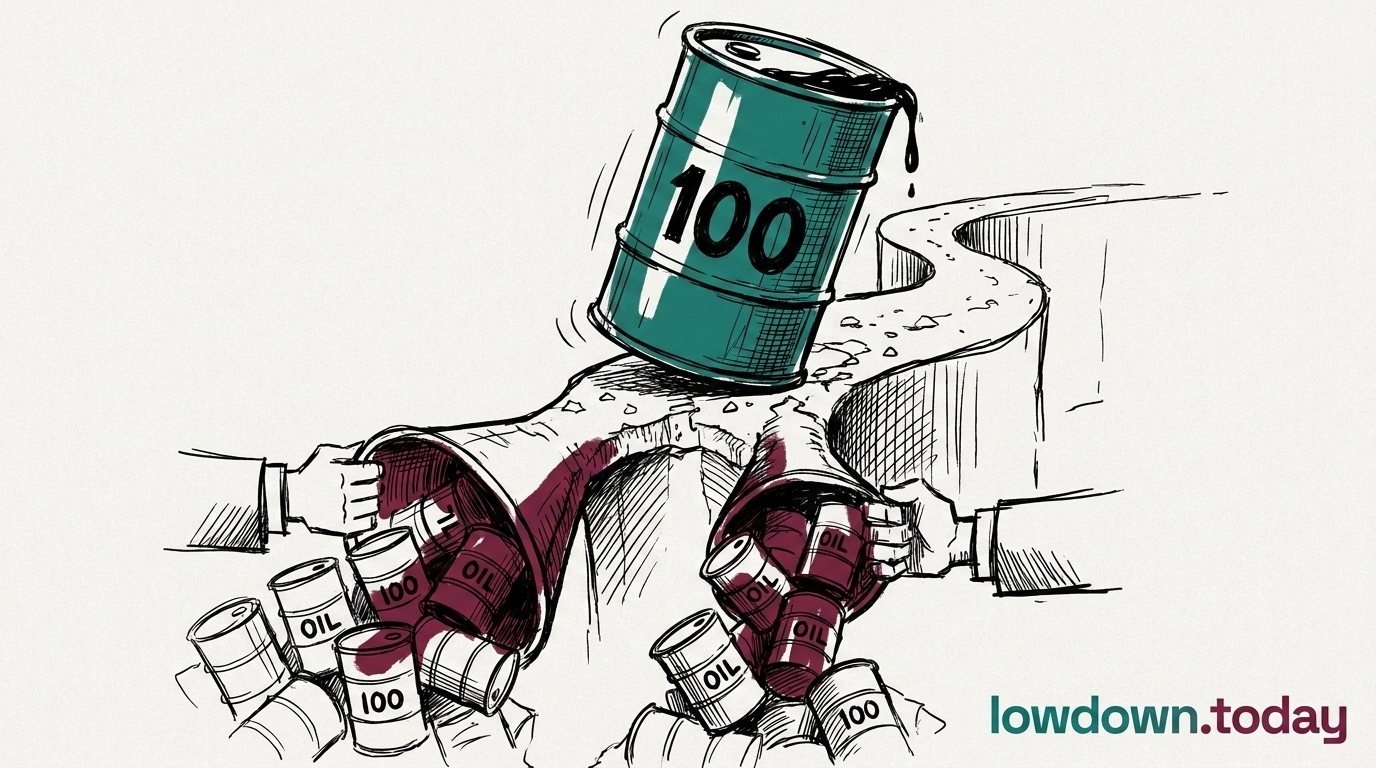
The sequence creates two parallel clocks. The diplomatic clock, set by the Pakistan-channel written exchange , runs as long as paper continues to move. The kinetic clock, set by the IRGC, expires on 2 June. Brent Crude is currently pricing the diplomatic clock as the binding one, with the price down to $101.70 from the $123 30 April high . The market has not yet repriced the kinetic clock; one small-boat contact would change that.

Deep Analysis

In plain English

On 3 May, Iran's Revolutionary Guard issued a 30-day ultimatum: end the US naval blockade of Iranian ports or face consequences by around 2 June. On the same day, Iran's parliament declared that Project Freedom, the US escort mission, was itself a violation of the existing ceasefire. These two moves together mean Iran has set a clock and given itself a legal justification to act when it expires. Whether the IRGC would actually carry out an attack on US vessels is uncertain, but the declarations put a specific date on a confrontation that previously had no calendar attached to it.

Deep Analysis
Root Causes

The IRGC ultimatum traces to a specific structural tension inside Iran's decision-making. The IRGC needs to demonstrate to its domestic constituency that it has not accepted permanent blockade as a negotiated condition. The Majlis NSC resolution, declaring Project Freedom a ceasefire violation, provides the parliamentary rationale for a response without requiring the Supreme Leader to formally terminate the ceasefire, which would remove Iran's primary diplomatic protection.

The 30-day window also reflects the IRGC's assessment of its own operational readiness. The 2 May declaration that 60% of small-boat fleet is intact was not an intelligence disclosure; it was a public signal that the IRGC has sufficient assets for a sustained harassment campaign against Project Freedom escorts if the deadline passes without blockade relief.

Escalation

The convergence of the 30-day IRGC deadline with the Murkowski AUMF 11 May filing date and the 1 June WPR operative cliff creates a three-week window in which the diplomatic and military calendars overlap.

If no AUMF passes by 1 June and the IRGC deadline expires without blockade relief, Iran has both a parliamentary rationale (Majlis NSC resolution) and an IRGC readiness declaration (2 May) that together constitute a pre-authorisation for escalation. The US has no signed legal instrument authorising a military response to that escalation.

What could happen next?
  • Risk

    The 2 June IRGC deadline converges with the 1 June War Powers Resolution operative cliff. If neither the US AUMF nor a ceasefire materialises by that date, both governments will have exhausted their domestic legal frameworks simultaneously.

    Short term · 0.76
  • Precedent

    The Majlis NSC resolution declaring Project Freedom a ceasefire violation establishes a parliamentary pre-authorisation for IRGC action that the Supreme Leader does not need to personally approve, reducing the civilian government's ability to prevent an escalatory response.

    Short term · 0.71
  • Consequence

    The 30-day ultimatum gives Pakistan a concrete deadline to intensify its back-channel diplomacy, as failure by 2 June removes the diplomatic cover that has kept the Pakistan channel operationally useful.

    Short term · 0.65
First Reported In

Update #88 · 15,000 troops unsigned; Pakistan carries first reply

Gulf News· 4 May 2026
Read original
Causes and effects
This Event
IRGC sets 30-day blockade clock for US
Tehran now has a calendar trigger of approximately 2 June and a formal parliamentary rationale for a second-stage response if no further written engagement arrives, layered onto the same Sunday Project Freedom launched.
Different Perspectives
India
India
India buys more Saudi crude than any other country and has 2.5 million nationals working in the kingdom, so a $100 Brent and a live strike on Saudi tankers reach New Delhi through both fuel bills and remittance risk. Neither channel has an alternative route the way Saudi Arabia's own pipeline does.
Qatar
Qatar
Qatar co-authored the four-mediator ten-day ceasefire proposal alongside Egypt, Pakistan and Oman, centred on resuming Hormuz navigation, while separately pursuing its dated compensation claim against Iran at the UN Security Council filed on 21 July. Doha is mediating and litigating in the same week.
Israel
Israel
Israeli intelligence, reported by the Wall Street Journal, assesses Iran moved thousands of centrifuges and part of its roughly 440kg enriched-uranium stock into Pickaxe Mountain after the June 2025 strikes on its three main nuclear sites. Some of the US refuelling aircraft now deploying to the region are bound for Israeli bases and Ramon Airport.
Houthis
Houthis
Yahya Saree announced the missile and drone strikes on the Encelia and Layla on 22 July as enforcement of the embargo his forces had declared by radio warning alone two days earlier. Six vessels already turned back on the broadcast; the strike shows Houthi forces will use weapons once warnings stop working.
Saudi Arabia
Saudi Arabia
Saudi Arabia's state news agency confirmed only a fire on the Encelia's bow, with the crew safe; the Layla strike remains unconfirmed by Riyadh. The kingdom built its Petroline pipeline specifically to bypass Hormuz through the Red Sea, so the tanker fire lands on the route Riyadh had already spent billions escaping.
United States
United States
Washington is weighing both ten-day proposals but wants a longer truce than either offers, and moved F-16 and F-35 jets plus refuelling aircraft into the region while it decides. That deployment, not Trump's Pickaxe Mountain remarks, is the measurable US action, buying options for the day talks fail rather than betting on them.