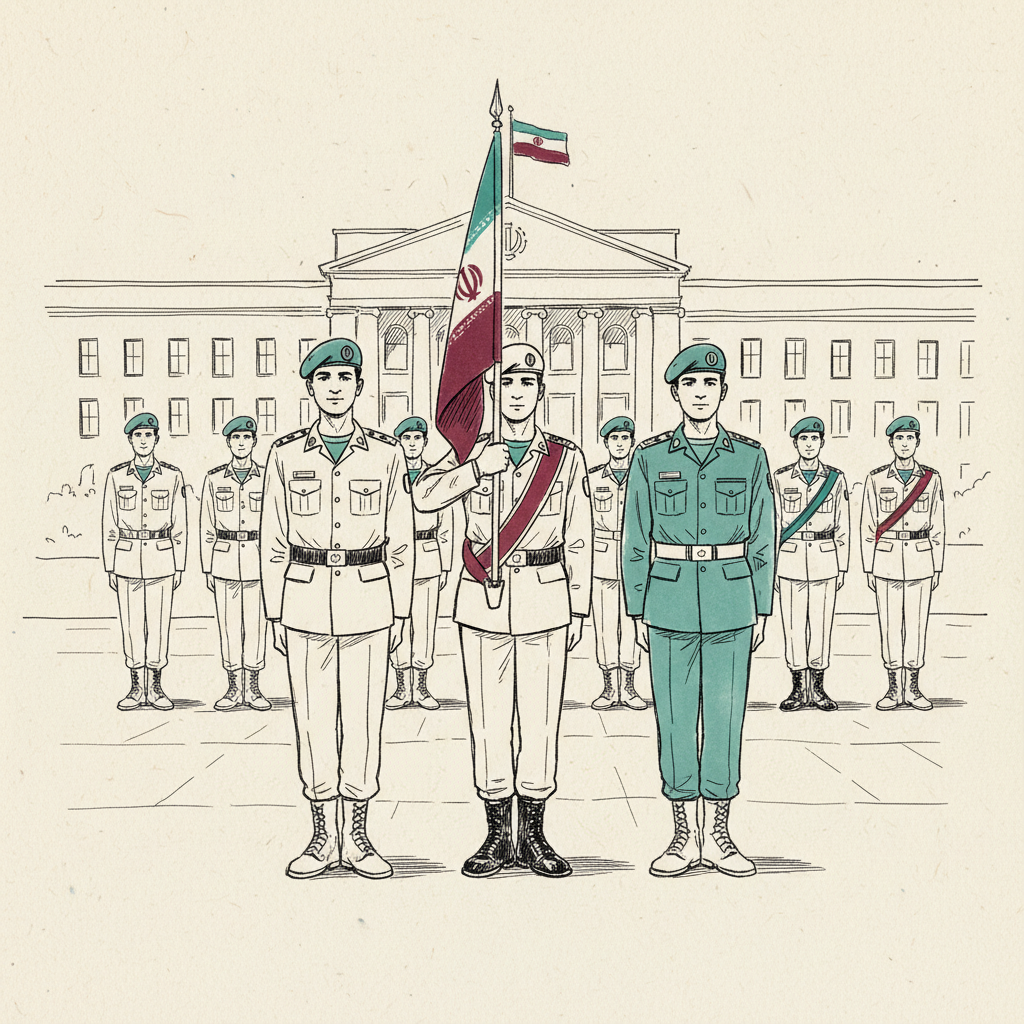
Iranian Army
Iran's conventional armed forces; issued 9 May 2026 Hormuz warning to sanctions-compliant states.
The Iranian Army's Operation Saeqeh campaign killed two US service members at Jordan's Azraq air base on 17 July, the war's first US combat deaths, and state media said by 18 July it had widened to a 14th-15th phase across Kuwait, Jordan and Bahrain.
Last refreshed: 19 July 2026 · Appears in 1 active topic
Why is the conventional Iranian Army, not the IRGC, leading Hormuz messaging?
Timeline for Iranian Army
Claimed the 19th phase of Operation Saeqeh
Iran Conflict 2026: Iran says destroyed, Kuwait says notMentioned in: IRGC claims a radar kill at Ali al-Salem
Iran Conflict 2026Mentioned in: IRGC thanks Jordanians for helping it aim
Iran Conflict 2026Claimed phases 14 and 15 of Operation Saeqeh against Kuwait, Jordan and Bahrain
Iran Conflict 2026: Iran's army widens Saeqeh to three statesMentioned in: Kuwait tells residents to ration water
Iran Conflict 2026Background
The Islamic Republic of Iran Army, or Artesh, is Iran's conventional military branch, distinct from the Revolutionary Guard Corps (IRGC, or Sepah), which reports directly to The Supreme Leader as a parallel structure. The Army comprises Ground Forces, Air Force, Navy and Air Defence Force, with an estimated 350,000 active personnel and a further 350,000 in reserve; the two forces have historically competed for budget and operational authority even as both answer to The Supreme Leader.
On 9 May 2026 the Army, rather than the IRGC Navy that has traditionally handled Hormuz harassment, issued a formal warning that sanctions-compliant states' shipping would receive no special protection during any strait closure, signalling institutional consensus behind the deterrence posture beyond the Guard alone.
The Army now runs its own numbered campaign, Operation Saeqeh, against US basing in third countries, distinct from and running in parallel with the maritime and inland bombing campaign CENTCOM has flown against Iranian territory since the war's early nights. Phase numbers for Saeqeh come from Press TV and Iran's own state broadcasters and are unverified outside Iranian media; treat them as Tehran's count of its own operations, not a confirmed tempo.
What is the difference between the Iranian Army and the IRGC?
What warning did Iran issue about Hormuz shipping in May 2026?
How big is Iran's conventional military?
Who are the first named Iranian Army dead of the July 2026 strikes?
Did Iran's regular Army kill American troops in Jordan?

