Skip to content
You can now search across every topic, entity and event.What's new
Iran Conflict 2026
23JUL

Brent tops $100 as the reroute closes

2 min read
19:27UTC

Brent crude crossed $100 a barrel on 23 July for the first time since May, and traders tied the jump straight to the tanker strikes in the Bab al-Mandab.

ConflictDeveloping
Key takeaway

Brent cleared $100 because the southern reroute closed, not because the strikes on Iran grew heavier.

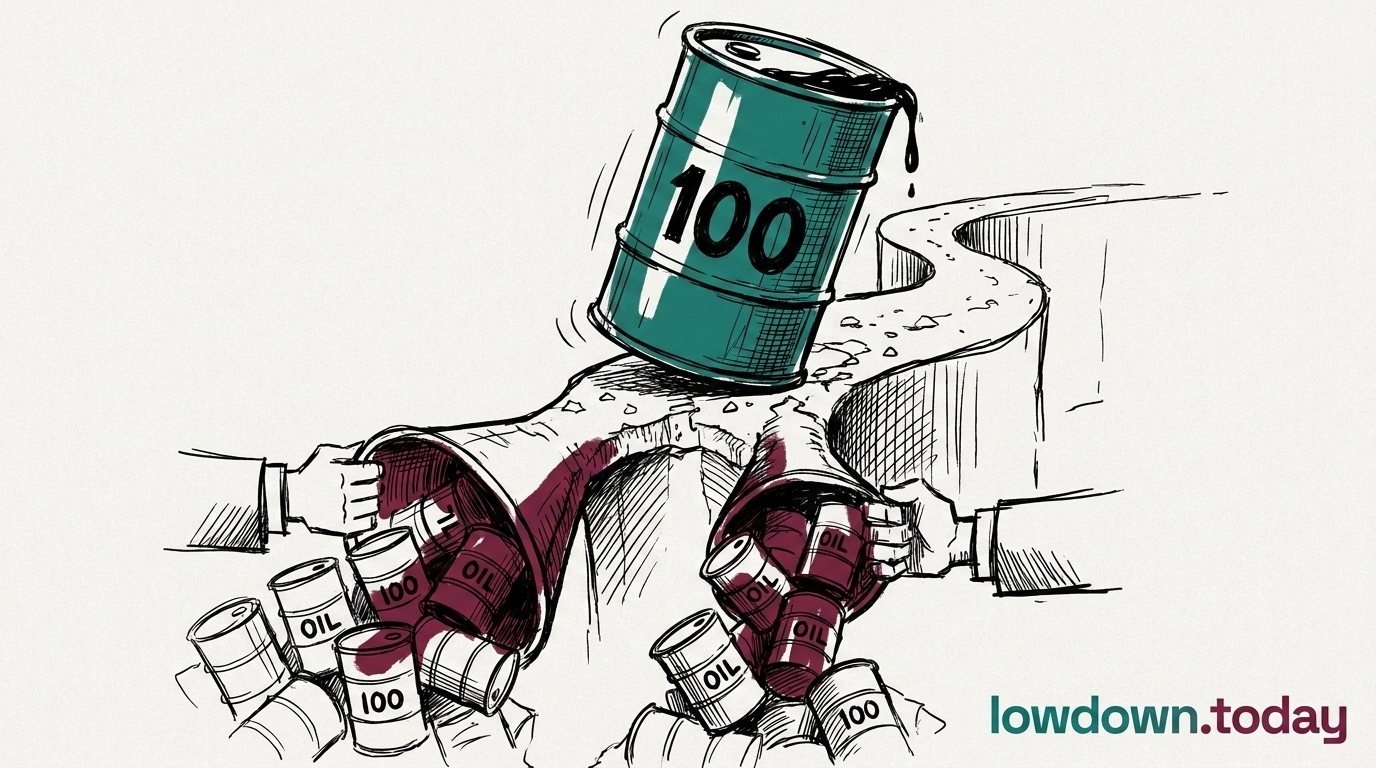
Brent Crude crossed $100 a barrel on 23 July for the first time since 26 May, rising about 6.7% to roughly $100.37 by 1401 GMT, with traders tying the move directly to the previous day's tanker strikes 1. The benchmark had closed at $92.09 only a day earlier , the top of a slow four-session climb.

Brent is the international price for seaborne crude, the benchmark behind roughly two-thirds of the world's traded oil, and it carries structural exposure to shipping chokepoints that inland grades do not. For a fortnight it had shrugged off vertical escalation, more nights and a rising toll, because the barrels kept moving through the dark fleet and the Omani-shore reroute south of Hormuz, which kept cargoes reaching buyers even as the northern strait was contested.

A strike in the Bab al-Mandab removes that release valve, so the market is now pricing two contested chokepoints at once rather than one. One caution belongs on the print. Oil has spiked and faded before in this war, clearing $87 on the July blockade before sliding as cargoes found a way round. The second tanker, the Layla, remains an unconfirmed Houthi claim, and a single denied strike could take the premium out as quickly as it went in.

Deep Analysis

In plain English

Brent crude is the main international price used to set oil costs around the world. On 23 July it went above $100 a barrel for the first time since May, jumping sharply in a single day. Traders say the jump is a direct reaction to the tanker strikes: when ships carrying oil through dangerous waters become targets themselves, the oil gets more expensive because it costs more to ship and insure. This matters at the petrol pump and in home energy bills. Oil prices this high, if they hold, tend to filter through to what people pay to fill a car or heat a home within weeks.

Deep Analysis
Root Causes

Brent's structural exposure to chokepoint risk is built into the benchmark itself: it prices seaborne North Sea and Gulf cargoes, unlike West Texas Intermediate, which moves overwhelmingly by pipeline and reacts far less to Gulf shipping risk.

The move above $100 also compounds a climb that was already under way before the Encelia strike, so the jump builds on an existing tightening rather than starting from a calm baseline.

What could happen next?
  • Consequence

    Sustained Brent prices above $100 typically reach UK and European pump prices within two to four weeks, given normal refining and distribution lags.

  • Risk

    If insurers keep pricing Bab al-Mandab and Hormuz as active war zones, the premium embedded in Brent may not unwind quickly even if strikes pause, unlike the rapid snapback seen after Abqaiq in 2019.

First Reported In

Update #160 · Houthis hit Saudi tankers; Brent tops $100

Reuters· 23 Jul 2026
Read original
Different Perspectives
India
India
India buys more Saudi crude than any other country and has 2.5 million nationals working in the kingdom, so a $100 Brent and a live strike on Saudi tankers reach New Delhi through both fuel bills and remittance risk. Neither channel has an alternative route the way Saudi Arabia's own pipeline does.
Qatar
Qatar
Qatar co-authored the four-mediator ten-day ceasefire proposal alongside Egypt, Pakistan and Oman, centred on resuming Hormuz navigation, while separately pursuing its dated compensation claim against Iran at the UN Security Council filed on 21 July. Doha is mediating and litigating in the same week.
Israel
Israel
Israeli intelligence, reported by the Wall Street Journal, assesses Iran moved thousands of centrifuges and part of its roughly 440kg enriched-uranium stock into Pickaxe Mountain after the June 2025 strikes on its three main nuclear sites. Some of the US refuelling aircraft now deploying to the region are bound for Israeli bases and Ramon Airport.
Houthis
Houthis
Yahya Saree announced the missile and drone strikes on the Encelia and Layla on 22 July as enforcement of the embargo his forces had declared by radio warning alone two days earlier. Six vessels already turned back on the broadcast; the strike shows Houthi forces will use weapons once warnings stop working.
Saudi Arabia
Saudi Arabia
Saudi Arabia's state news agency confirmed only a fire on the Encelia's bow, with the crew safe; the Layla strike remains unconfirmed by Riyadh. The kingdom built its Petroline pipeline specifically to bypass Hormuz through the Red Sea, so the tanker fire lands on the route Riyadh had already spent billions escaping.
United States
United States
Washington is weighing both ten-day proposals but wants a longer truce than either offers, and moved F-16 and F-35 jets plus refuelling aircraft into the region while it decides. That deployment, not Trump's Pickaxe Mountain remarks, is the measurable US action, buying options for the day talks fail rather than betting on them.