Skip to content
You can now search across every topic, entity and event.What's new
Iran Conflict 2026
23JUL

Brent settles $105.33, war's biggest week

3 min read
19:27UTC

Brent crude closed Saturday 25 April at $105.33 per barrel, up roughly 16% on the week despite an indefinite ceasefire announced five days earlier.

ConflictDeveloping
Key takeaway

Brent's biggest week of the war registers a market that has stopped pricing the ceasefire and begun pricing the carriers.

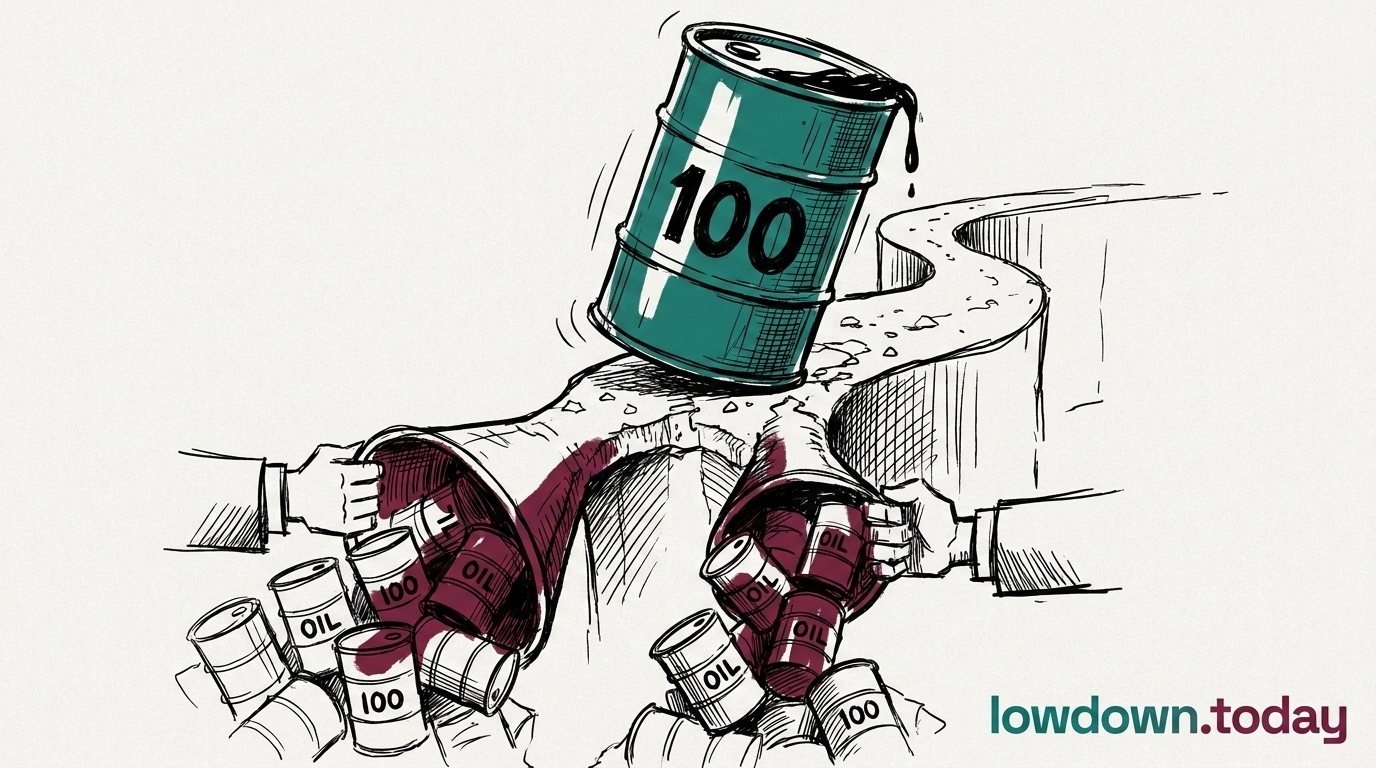
Brent Crude settled at $105.33 per barrel on Saturday 25 April, the largest weekly gain (roughly 16%) since the war began and approximately 57% above the pre-war baseline of about $67 1. The settlement came five days after the indefinite ceasefire announcement that briefly knocked the contract back. Brent is the global crude benchmark used to price two-thirds of the world's traded oil; a move of this scale on a ceasefire week is a market correction against the underlying assumption.

Brent has now ignored two pieces of de-escalation paper inside a fortnight: the indefinite-ceasefire announcement and the Lebanon ceasefire extension on 23 April . Traders are pricing the inverse of the diplomatic track; the carrier concentration in CENTCOM AOR, the IRGC's verbal escalation and the AIS-blank Hormuz transits are now the dominant inputs.

Insurance, not navies, sets the structural floor under the price. With the major Protection and Indemnity clubs out of Iranian waters and war-risk premiums into double-digit millions per trip, the cost of moving a barrel through the strait has stepped up regardless of whether kinetic events occur on a given day. For European and UK forecourt prices, $105 Brent through the bank-holiday window keeps pump prices elevated; for Indian, Korean and Japanese refiners pricing forward cargoes, the unpriceable insurance leg is now the binding cost driver.

Deep Analysis

In plain English

Oil prices track closely with what is happening in the Strait of Hormuz because roughly one-fifth of all the oil the world uses each day normally passes through that narrow waterway. When it is effectively closed, oil companies have to find other routes or buy from different suppliers, which costs more. On top of that, the shipping companies that carry oil have to pay enormous insurance premiums just to attempt a transit, adding further costs. The price at the petrol station reflects these extra costs within a few weeks. At $105 a barrel, you are paying roughly 20-25% more to fill your car than before the conflict started in late February.

What could happen next?
  • Meaning

    At $105/bbl sustained for three months, **UK** and **EU** inflation forecasts for mid-2026 will need upward revision of roughly 0.4-0.7 percentage points, complicating central bank rate-setting ahead of summer monetary policy meetings.

    Short term · Assessed
  • Meaning

    The 16% weekly gain sets a new psychological floor for oil-market participants: each subsequent failed diplomatic round is now priced as a new price plateau rather than a temporary spike.

    Short term · Assessed
  • Meaning

    Sovereign wealth funds in Gulf states whose budget breakeven sits at $87-95/bbl (Saudi Arabia and UAE) are now running significant surpluses that give them more patience than Western consumers to wait for a negotiated resolution.

    Short term · Assessed
First Reported In

Update #80 · Three carriers, zero instruments

Angle360· 26 Apr 2026
Read original
Different Perspectives
India
India
India buys more Saudi crude than any other country and has 2.5 million nationals working in the kingdom, so a $100 Brent and a live strike on Saudi tankers reach New Delhi through both fuel bills and remittance risk. Neither channel has an alternative route the way Saudi Arabia's own pipeline does.
Qatar
Qatar
Qatar co-authored the four-mediator ten-day ceasefire proposal alongside Egypt, Pakistan and Oman, centred on resuming Hormuz navigation, while separately pursuing its dated compensation claim against Iran at the UN Security Council filed on 21 July. Doha is mediating and litigating in the same week.
Israel
Israel
Israeli intelligence, reported by the Wall Street Journal, assesses Iran moved thousands of centrifuges and part of its roughly 440kg enriched-uranium stock into Pickaxe Mountain after the June 2025 strikes on its three main nuclear sites. Some of the US refuelling aircraft now deploying to the region are bound for Israeli bases and Ramon Airport.
Houthis
Houthis
Yahya Saree announced the missile and drone strikes on the Encelia and Layla on 22 July as enforcement of the embargo his forces had declared by radio warning alone two days earlier. Six vessels already turned back on the broadcast; the strike shows Houthi forces will use weapons once warnings stop working.
Saudi Arabia
Saudi Arabia
Saudi Arabia's state news agency confirmed only a fire on the Encelia's bow, with the crew safe; the Layla strike remains unconfirmed by Riyadh. The kingdom built its Petroline pipeline specifically to bypass Hormuz through the Red Sea, so the tanker fire lands on the route Riyadh had already spent billions escaping.
United States
United States
Washington is weighing both ten-day proposals but wants a longer truce than either offers, and moved F-16 and F-35 jets plus refuelling aircraft into the region while it decides. That deployment, not Trump's Pickaxe Mountain remarks, is the measurable US action, buying options for the day talks fail rather than betting on them.