Skip to content
You can now search across every topic, entity and event.What's new
Iran Conflict 2026
23JUL

Brent falls $21 across four sessions

4 min read
19:27UTC

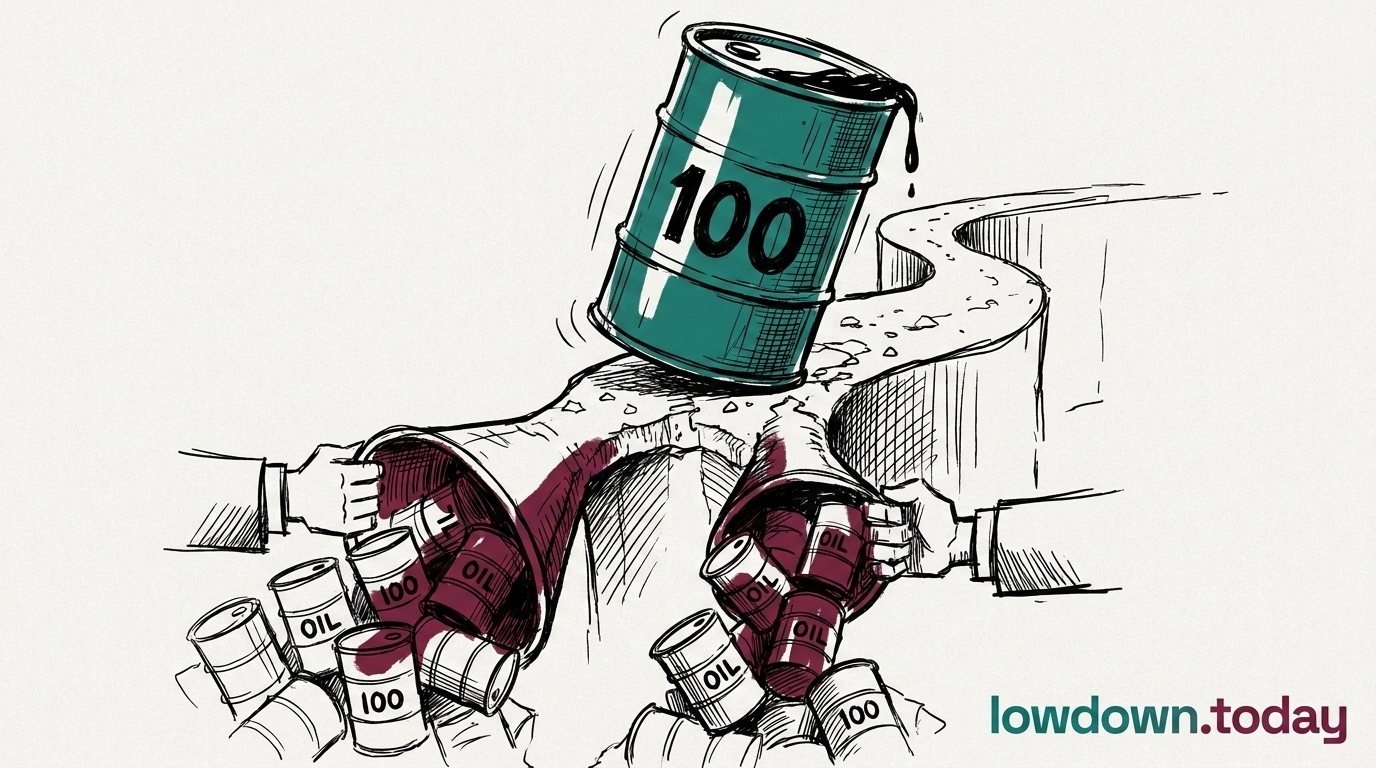
Brent crude consolidated a four-session decline from $123 on 30 April to $101.70 on 4 May, with each leg attached to a discrete diplomatic trigger rather than a single Trump post.

ConflictDeveloping
Key takeaway

Markets priced four diplomatic signals in sequence, not a single Trump post; one IRGC round reverses the entire $21 concession.

Brent Crude settled at $101.70 per barrel on 4 May 2026, completing a four-session decline from the $123 post-war high of 30 April . 1 The cumulative move of $21.30, about 17 per cent, is the war's largest sustained price drop and is distinct in pattern from any single-session fall recorded since fighting began on 28 February.

Each leg of the decline tracked a separate diplomatic trigger. The first was the UAE's exit from OPEC's quota framework on 30 April , which broke the cartel cohesion holding the post-war price floor. The second was Trump's rejection of Iran's 14-point ceasefire text on 1 May, which carried a $14.83 single-session fall . The third was the Project Freedom announcement on 3 May , which markets read as a humanitarian-framed escort rather than a kinetic escalation. The fourth was the Pakistan-channel US written reply on the same Sunday, which markets read as the first procedural step toward a settled paper diplomacy.

Markets are pricing four sequential signals, not reacting to a single Truth Social post. The IRGC issued a 30-day ultimatum on 3 May demanding the United States end its port blockade of Iran. The Majlis national security commission ruled that Project Freedom would be considered a violation of the ceasefire. Both sit on the other side of the trade. A single mine, a single small-boat interception, or a single written rejection through the same Pakistani diplomats would reverse the $21 concession in one session; market positioning suggests a $15 to $20 rebound on a confirmed IRGC fire on a Project Freedom escort.

UK pump prices remain roughly 8 to 10 pence per litre above the pre-war baseline at the standard wholesale-pass-through lag. A reversal would push another 5 to 7 pence onto the litre within two to three weeks. Wholesale gas remains decoupled because Hormuz LNG is largely Qatar-routed and unaffected for now.

Deep Analysis

In plain English

Oil prices fell sharply in the first week of May, dropping from $123 a barrel to around $101.70. Brent remains $34 above its pre-war level of $67.41, but the drop is the largest sustained move of the conflict. Each time a diplomatic signal arrived, whether the UAE leaving OPEC, Trump engaging with Iran's proposals, or Pakistan carrying a US written reply, the oil price fell a little more. Traders marked down the probability of the war getting worse, not a change in physical supply. UK petrol prices remain elevated, but a sustained Brent decline should start feeding through to forecourts within two to three weeks.

Deep Analysis
Root Causes

The structural driver of the four-session decline is the market's reassessment of tail risk: at $123, Brent was pricing a scenario where Project Freedom escalates into a direct US-Iran naval exchange that permanently closes the strait.

Each diplomatic trigger reduced the probability of that tail event. The UAE OPEC exit reduced the probability of a Gulf-wide supply alliance against Western interests; Trump's written rejection of Iran's terms confirmed the US was still engaging; the Pakistan reply confirmed Iran was still at the table.

The secondary structural cause is the arithmetic of the $21.30 move relative to pre-war prices. Brent at $101.70 remains $34 above its pre-war baseline of $67.41. The market has not priced a full ceasefire; it has priced partial de-escalation. The remaining premium reflects continued blockade risk, Majlis Hormuz sovereignty law uncertainty, and the P&I insurance freeze that prevents normal transit even if Iran formally agrees to reopen.

What could happen next?
  • Consequence

    The market's four-leg diplomatic pricing model means any single diplomatic reversal, such as a collapsed Pakistan round or an IRGC-Project Freedom contact, could reverse the $21.30 decline in one or two sessions.

    Immediate · 0.81
  • Risk

    Brent at $101.70 still embeds a $34 war premium above pre-war baseline. If Project Freedom's escort mission fails to move stranded vessels within 30 days, supply frustration will push prices back toward $115-120.

    Short term · 0.69
  • Opportunity

    Sustained oil prices below $100 for four-plus weeks would reduce Iran's war revenue sufficiently to strengthen the economic argument for ceasefire among Iran's civilian government, independent of any military outcome.

    Medium term · 0.57
First Reported In

Update #88 · 15,000 troops unsigned; Pakistan carries first reply

Trading Economics· 4 May 2026
Read original
Different Perspectives
India
India
India buys more Saudi crude than any other country and has 2.5 million nationals working in the kingdom, so a $100 Brent and a live strike on Saudi tankers reach New Delhi through both fuel bills and remittance risk. Neither channel has an alternative route the way Saudi Arabia's own pipeline does.
Qatar
Qatar
Qatar co-authored the four-mediator ten-day ceasefire proposal alongside Egypt, Pakistan and Oman, centred on resuming Hormuz navigation, while separately pursuing its dated compensation claim against Iran at the UN Security Council filed on 21 July. Doha is mediating and litigating in the same week.
Israel
Israel
Israeli intelligence, reported by the Wall Street Journal, assesses Iran moved thousands of centrifuges and part of its roughly 440kg enriched-uranium stock into Pickaxe Mountain after the June 2025 strikes on its three main nuclear sites. Some of the US refuelling aircraft now deploying to the region are bound for Israeli bases and Ramon Airport.
Houthis
Houthis
Yahya Saree announced the missile and drone strikes on the Encelia and Layla on 22 July as enforcement of the embargo his forces had declared by radio warning alone two days earlier. Six vessels already turned back on the broadcast; the strike shows Houthi forces will use weapons once warnings stop working.
Saudi Arabia
Saudi Arabia
Saudi Arabia's state news agency confirmed only a fire on the Encelia's bow, with the crew safe; the Layla strike remains unconfirmed by Riyadh. The kingdom built its Petroline pipeline specifically to bypass Hormuz through the Red Sea, so the tanker fire lands on the route Riyadh had already spent billions escaping.
United States
United States
Washington is weighing both ten-day proposals but wants a longer truce than either offers, and moved F-16 and F-35 jets plus refuelling aircraft into the region while it decides. That deployment, not Trump's Pickaxe Mountain remarks, is the measurable US action, buying options for the day talks fail rather than betting on them.