Skip to content
You can now search across every topic, entity and event.What's new
Iran Conflict 2026
23JUL

CENTCOM redirections rise to 52, pace slows

4 min read
19:27UTC

CENTCOM's Hormuz vessel-redirection count rose from 44 on 1 May to 52 by 7 May; the daily pace has slowed materially while Brent's rebound priced the missiles, not the steadier blockade.

ConflictDeveloping
Key takeaway

Eight more redirections in a week, but Brent moved on one night of missiles, not on the trend line.

CENTCOM's vessel-redirection count rose from 44 on 1 May to 52 by 7 May, an increase of eight redirections across the week . The pace has slowed materially. Earlier in the campaign, between roughly Days 60 and 62, CENTCOM was logging five redirections every two days. The 1-7 May window worked out to roughly two redirections every three days. CENTCOM is still tagging vessels in the strait, but the surge phase that ran into Day 62 has passed.

CENTCOM uses the redirection count as the cleanest single quantitative metric of operational tempo. Every redirection is a vessel ordered to change course, hold position outside the strait, or accept a CENTCOM escort. The figure compresses cumulative friction into a number that tracks weekly. The slowing pace, in isolation, would suggest a normalising chokepoint: traffic adapts, owners accept the delay, the system reaches a steady state.

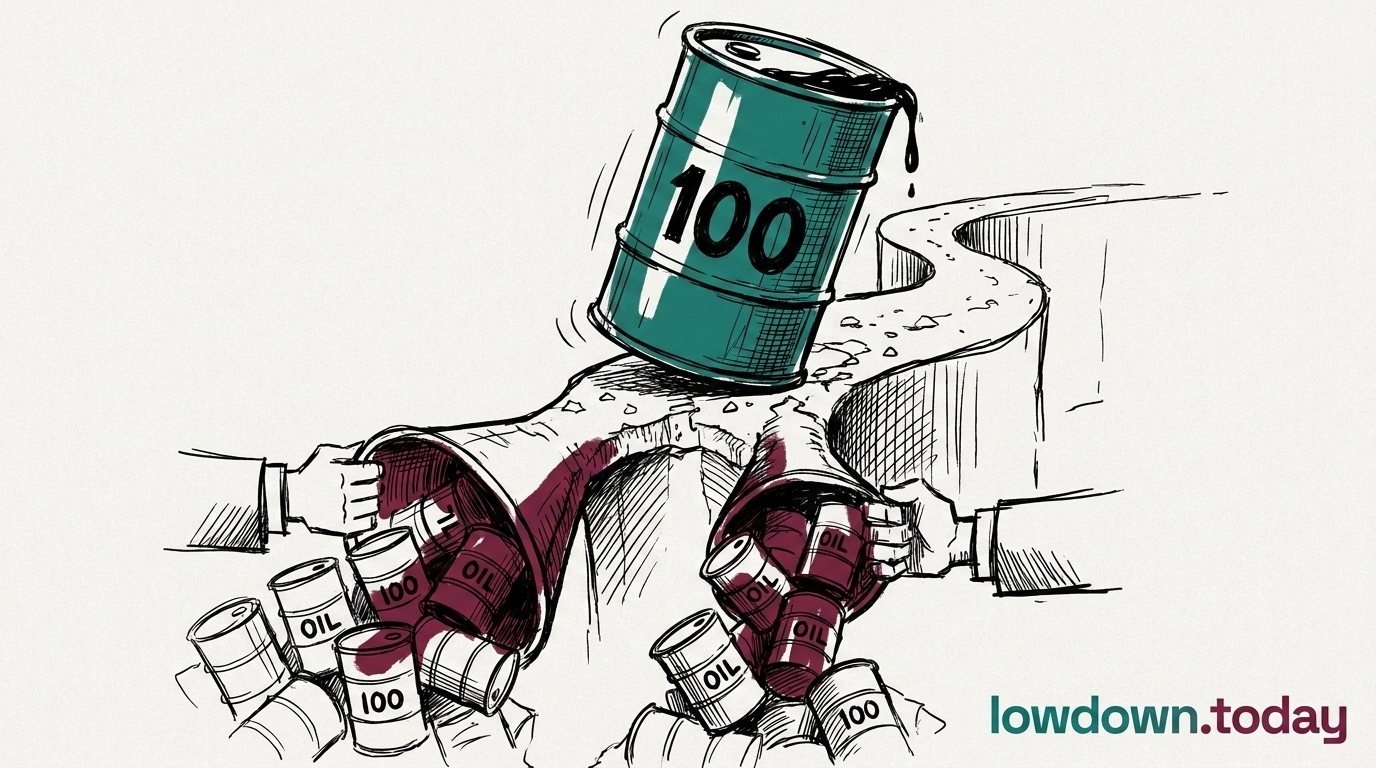
Brent Crude did not read it that way. Brent's 8 May rebound followed the night of kinetic exchange in Hormuz, not the redirection count. Three days of price losses going into 7 May had reflected the MOU's progress through Pakistan; one night of kinetic action reversed all of it. The market is pricing the spikes, not the floor.

CENTCOM's redirection trend pointed one way; the Brent reversal pointed the other. Continuous infrastructure does not move oil prices once it is priced in. Kinetic events do, especially when they involve named US Navy assets in the strait that gives the benchmark its name. The blockade has settled into the background; the IRGC strike on the destroyers has not.

For producers and refiners in the United Kingdom, the practical reading is that pump prices will track the next missile, not the next redirection. Brent has now sat above the $100 mark long enough to feed through to forecourt repricing on its normal lag, and a sustained triple-digit Brent environment translates to roughly 10-12p per litre over the pre-war baseline. The next downward break in Brent will require either a signed instrument, rather than a paper one before Tehran's 9 May expiry, or a clean week without further exchanges of fire in the strait.

Deep Analysis

In plain English

The US military has been tracking how many ships it has turned away from the Strait of Hormuz since it started blocking vessels bound for Iran. That count reached 52 by 7 May, up from 44 a week earlier. But the rate at which ships are being turned away has slowed down noticeably compared to the opening weeks. The reason: most ships that were going to change course already have; the ones still trying to pass through either have Iranian permission or are willing to pay the toll. Meanwhile, oil prices react more sharply to the headline news of missiles being fired than to the slower-moving redirection count.

What could happen next?
  • Consequence

    The deceleration from five per 48 hours to two per 72 hours signals CENTCOM has shifted to a maintenance-rate interdiction posture that is sustainable for months without additional fleet deployment, removing the time-pressure that might have accelerated Iranian compliance.

  • Risk

    If oil markets continue pricing kinetic spikes rather than the redirection baseline, the next exchange of fire in the strait will produce another $1-3 Brent spike regardless of the underlying redirection trend, amplifying energy-price volatility for UK consumers and businesses.

First Reported In

Update #91 · MOU in Tehran, missiles in the strait

CENTCOM· 8 May 2026
Read original
Different Perspectives
India
India
India buys more Saudi crude than any other country and has 2.5 million nationals working in the kingdom, so a $100 Brent and a live strike on Saudi tankers reach New Delhi through both fuel bills and remittance risk. Neither channel has an alternative route the way Saudi Arabia's own pipeline does.
Qatar
Qatar
Qatar co-authored the four-mediator ten-day ceasefire proposal alongside Egypt, Pakistan and Oman, centred on resuming Hormuz navigation, while separately pursuing its dated compensation claim against Iran at the UN Security Council filed on 21 July. Doha is mediating and litigating in the same week.
Israel
Israel
Israeli intelligence, reported by the Wall Street Journal, assesses Iran moved thousands of centrifuges and part of its roughly 440kg enriched-uranium stock into Pickaxe Mountain after the June 2025 strikes on its three main nuclear sites. Some of the US refuelling aircraft now deploying to the region are bound for Israeli bases and Ramon Airport.
Houthis
Houthis
Yahya Saree announced the missile and drone strikes on the Encelia and Layla on 22 July as enforcement of the embargo his forces had declared by radio warning alone two days earlier. Six vessels already turned back on the broadcast; the strike shows Houthi forces will use weapons once warnings stop working.
Saudi Arabia
Saudi Arabia
Saudi Arabia's state news agency confirmed only a fire on the Encelia's bow, with the crew safe; the Layla strike remains unconfirmed by Riyadh. The kingdom built its Petroline pipeline specifically to bypass Hormuz through the Red Sea, so the tanker fire lands on the route Riyadh had already spent billions escaping.
United States
United States
Washington is weighing both ten-day proposals but wants a longer truce than either offers, and moved F-16 and F-35 jets plus refuelling aircraft into the region while it decides. That deployment, not Trump's Pickaxe Mountain remarks, is the measurable US action, buying options for the day talks fail rather than betting on them.